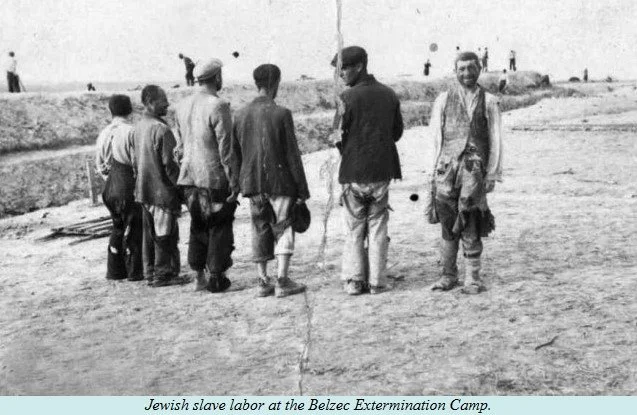
Belzec Sub-Camps
A pre-curser to the notorious Belzec Extermination Camp was a series of camps around the Belzec region, southern Poland, where Jews were forced into slave labor. In 1940, a total of some 35 camps were created with over 10,000 workers employed on building fortifications, roads and regulating rivers. The 10,000 Jews were gathered from Lublin, Radom and Warsaw districts between the end of May, 1940 until August 1940. In accordance with the German plans at the very beginning of the Nazi occupation, the Lublin district was intended to become 'the pillar of the General Gouvernement's agricultural policy’.
Their main duty was building fortifications at the Soviet Union border: a rampart of 140 km between the Bug River and the San River. In fact, until October 1940, the "Eastern Rampart" (between Belzec and Dzików Stary village) was only 40 km long, 2.5 m deep and 7.5 m wide.
A series of ghettos and labor camps were established which the Germans used in conjunction with Belzec. These included:
- Belzec-Dwor Labor Camp
- Belzec-Mlyn Labor Camp
- Belzec-Parowozownia Labor Camp
- Cieszanow Labor Camp
- Izbica Transit Ghetto
- Lipsko Labor Camp
- Plazow Labor Camp (different from Krakow-Plaszow Death Camp)
- Surhow Labor Camp
- Turkowice Labor Camp
- Tomaszow Lubelski Ghetto
- Zwierzyniec Labor Camp
Below is some information that is known about the Belzec sub-camps:
AUGUSTOWKA: In 1942, 300 Jews from former Czechoslovakia were interned in the Augustówka labor camp, located in Surhów and Małochwiej Duży (directly west of Krasniczyn). There, they worked on water management and irrigation near the Wojslawka River. Jews from Izbica, Zolkiewka, Krasniczyn, Krasnystaw, Gorzkow and other nearby towns may have also been sent to Augustowka. Not much information is available about the forced labor at this location and few, if any, of the victims survived the duration of the war. No trace of the camp has remained.
BELZEC VILLAGE: The pre-war Jewish population was 100. In Belzec Labor Camp (prior to becoming the notorious Death Camp), Jewish prisoners lived at three sites: The manor, called “Belzec-Dwor” (1,000 people), Kessler's Mill, called “Belzec-Mlyn” (500 people) and in the locomotive shed, called “Belzec-Parowozownia” (1,500 people). These housed workers were forced to build the so-called “Otto Line,” a series of fortifications along the border with the Soviet Union. The locomotive shed was later used for sorting and initial cleaning of victims’ stolen property. The victims’ clothing was stored in the shed before being shipped to DAW Lublin.
A labor camp was constructed near the Belzec railway station in the mill and locomotive shed, 400 meters from the death campsite. Over 2,500 people, mainly Jews and Gypsies, were used to build this rampart and were imprisoned in the work camp. Jews were seized from Lublin and other towns and transported directly to the Belzec labor camps. Within a few months, the whole area had become one string of labor camps serving these massive fortifications. The resident S.S. commander of the entire Belzec complex, S.S. Sturmbannführer Hermann Dolp, was a cruel, sadistic, and uncompromising overseer. The main operation was for the laborers to construct anti-tank ditches.
Eventually, this slave labor operation transferred to an efficient killing operation. See: Belzec Death Camp.
BONCZA: Bończa is directly east of the town of Krasniczyn. After May, 1942, several hundred Jews from Krasnystaw, Krasniczyn and Izbica who remained alive were sent to work on the estate in Bończa — a slave labor location and sub-camp of Belzec. Not much information is available about the forced labor at this location and none of victims survived the duration of the war. No trace of the camp has remained.
BZITE: There was a forced labor camp at Bzite near Krasnystaw. There, Jewish prisoners worked on water management and peat works. It is unclear how many prisoners were held at this locale and not much information is available about the forced labor at this location. None of the victims survived the duration of the war and no trace of the camp has remained.
DZIKOW (STARY DZIKOW): The pre-war Jewish population of Dzikow was 360. Around 1,000 prisoners were sent to Dzikow beginning in June, 1940; most of them were transferred from nearby Cieszanów. Notoriouos S.S. man Oskar Dirlewanger was the commandant at Dzikow. Slave laborers were involved in construction projects. The camp was liquidated in November of 1940, with most of the Jews sent to an unknown destination; a small number were deported to the ghetto in Lubaczów. Not much information is available about the forced labor at this location and few, if any, of the victims survived the duration of the war. No trace of the camp has remained.
CIESZANOW: The pre-war Jewish population of Cieszanow was 1,200. In the first half of 1940, a group of 50 Jews was brought to Cieszanow to help the Nazis establish a forced labour camp at this location. It was opened in the Spring of 1940. On August 18, 1940, 3,000 Jews were transported to the camp. In the autumn of 1940, there were as many as 3,800 Jewish prisoners, who created fortifications and roads as well as river fortification. In October 1940, a group of 1,000 Jews was transferred to the nearby forced labour camp at Stary Dzików. Yad Vashem provides a detailed analysis of this labor camp.
IZBICA: The pre-war Jewish population of Izbica was 4,500. From the start of the Nazi occupation, Jews were forced to perform heavy labour in the town. The slave labor tasks included street cleaning, brick works/building, and agricultural works. Transports of Jews from Lublin, Lodz, Czestochowa, Glowno, Konin and Kolo were sent to Izbica. Some engaged in slave labor while others were simply being transported on to the gas chambers nearby. After that, Jews from Czechloslovakia, Moravia, Germany, and Austria arrived. From March to May 1942, approximately 12,000 to 14,000 Jews were transported to Izbica. Among them were highly qualified specialists: engineers, doctors, economists including the vice president of Prague, Austrian army generals and professors. From March until June, 1942, around 17,000 Jews from abroad were deported to Izbica. A listing of known transports is provided here. The Nazis liquidated the orphanage in Izbica by shooting all of the children there.
According to testimonies and literature, the first two deportations from Izbica (on 24 March 1942 and 8 April 1942) were sent to Belzec Death Camp. Most of these victims were Polish Jews. They were deported due to the S.S. requiring space for deportees from western countries. The transport of 14-15 May 1942, which consisted of German/Czech Jews, went to Sobibor Death Camp and Majdanek Death Camp. Another 4,000 Jews from areas near Izbica and from the Zamosc Ghetto were sent to Izbica transit camp in 1942. According to testimony, the S.S. killed around 2,000 Jewish victims in the course of Izbica's last execution. It took place at the local Jewish cemetery (which had already been destroyed) in November of 1942. On 2 November 1942, a Ukrainian unit of S.S. men from Trawniki and the Police in navy blue from Izbica surrounded the village. In the next few days the Jews were sent to Belzec and Sobibor. Several thousand Jews had been rounded up in the fire station, from where they were chased in groups to the Jewish cemetery and executed there. It is estimated that around 4,000 victims were murdered at buried at the Izbica cemetery.
According to witness Jan Karski, “The camp barracks could accommodate about half of the prisoners. The remainder had no other choice than to stay outdoors. The smell of human excrement, sweat, filth and decay permeated the air." Later on, the slave labor tasks for those who remained included collecting and organizing the property left behind by the Jews who had been sent to the death camps.
LIPSKO: The Lipsko labor camp near Zamosc had 2,086 Jewish prisoners in slave labor. At Lipsko, prisoners were involved in road and construction projects as well as disposing of Jewish prisoners’ property, belongings and covering up the Nazi crimes. Not much information is available about the forced labor at this location and none of the victims survived the duration of the war. No trace of the camp has remained.
PLAZOW: The Plazow labor camp (different than Krakow - Plaszow concentration camp) near Belzec had 1,350 slave laborers at the camp. At Plazow, prisoners were involved in road and construction projects as well as disposing of Jewish prisoners’ property, belongings and covering up the Nazi crimes. Not much information is available about the forced labor at this location none of the victims survived the duration of the war. No trace of the camp has remained.
SURHOW: At Surhow near Krasniczyn, slave laborers from Poland, Austria, Germany, Slovakia, and Czech Republic worked in slave labor related to the Wojsławka River. The camp had over 300 prisoners. It was dissolved in August of 1942 and all prisoners were deported to the Bełżec death camp. Not much information is available about the forced labor at this location and none of the victims survived the duration of the war. No trace of the camp has remained.
TURKOWICE: At least 250 Jewish prisoners were tasked with deepening and widening a channel to the Khuchva River at Turkowice — near Tyszowce. According to Israel Geist, in the Bilgoraj Yizkor Book, "At Turkowice, we worked barefoot, up to our waists in water full of leeches which attached themselves to our legs and sucked our blood. The heat was unbearable, yet we were not given a drop of water to drink, and we had to drink from the contaminated river. The engineers and supervisors treated us sadistically and beat us murderously." No trace of the camp has remained.
TOMASZOW LUBELSKI: Rachanie’s pre-war Jewish population was 80 Jews and the pre-war Jewish population of the larger city nearby, Tomaszow Lubelski, was 4,500. From April 1942 to August 1943, a German Nazi forced labor camp operated in Rachanie, a small suburb of Tomaszow, next to the school. Approximately 100 prisoners were held in forced labor at this location. The laborers were forced to perform land reclamation work. Not much information is available about the forced labor at this location and few, if any, of the victims survived the duration of the war. No trace of the camp has remained.
ZWIERZYNIEC: The pre-war Jewish population of Zwierzyniec was 1,500 and a nearby village called Rudka had 75 Jews. Groups of Jews in Zwierzyeniec had been forcibly deported from Kalisz, Katowice, Lodz and Poznan. Zwierzyniec was located south and west of the city of Zamosc. At least 550 Jews from the Zwierzyniec ghetto were conscripted for slave labor at a sawmill and lumber yard on the former Zamoyski estate. Others were forced to expand and repair roads leading from Zwierzyniec to Bilgoraj and Szczebrzeszyn. Fifty-two Jews were sent to Belzec Death Camp in September 1942 via Bilgoraj. A mass extermination of the Jews of Zwierzyniec commenced on October 21, 1942. All Jews from Zwierzyniec and nearby Rudka were murdered in the Holocaust. No trace of the camp has remained.