Remember Jewish Pavlivka (Poryck)
Pronunciation: Poritz
HISTORY OF JEWISH PORYCK
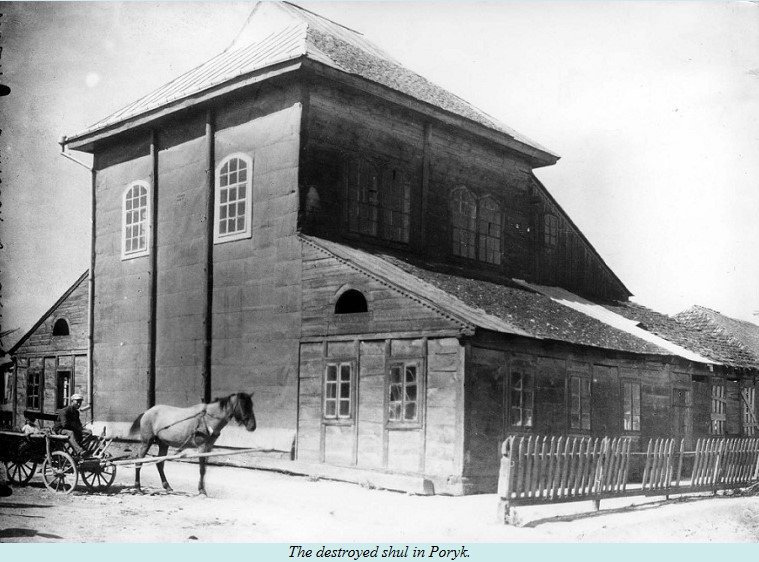
Poryck, now called Pavlivka, is located in the Volhynia region of Ukraine, former Poland. After the partition of Poland, the town became a part of the Russian empire. Jews are first mentioned as living in Poryck in the mid-1500s. The Jewish population increased from 101 in 1784 to 296 in 1790. In 1786, an independent printing house was created and operated by the Jewish community and began to publish books in Hebrew. 1,100 Jews were counted in 1847. By 1897, the Jewish population numbered 1,316 and comprised 58% of the total population. In 1915, Jewish property was looted by Russian soldiers as fighting increased in the area. After World War I, Poryck again became part of Poland. During this period, the town had a synagogue, and one of its rabbis, Kalman Horovitz (? – 1885), was the grandson of the “Seer of Lublin” (Rabbi Yaakov Yitzchak HaLevi Horowitz).
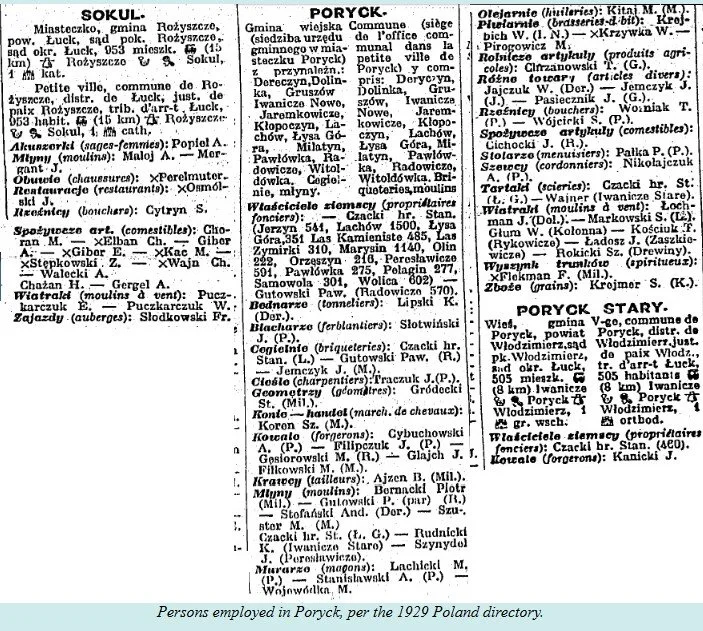
In 1913, the Jewish community members had 27 food locations in town, a wood warehouse and 13 manufacturing stores. In the inter-war period, Zionist parties and youth movements (especially Hashomer Ha’tzair), as well as Zionist pioneering training communes (such as He’chalutz), were active in Poryck. Tarbut, the Zionist Hebrew-language network of educational institutions, operated a school and a library in the town, and there was also a Yiddish school and a Hebrew private school.
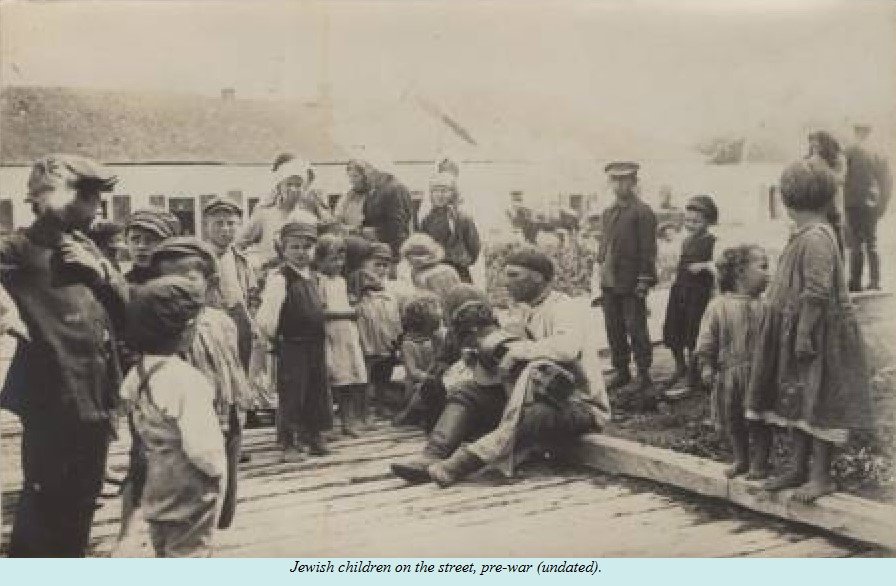
In 1939, Poryck was inhabited by almost 2,000 people, about half of whom were Jewish. The countryside was populated mainly by Ukrainian peasants.
PORYCK DURING THE HOLOCAUST
After September 17, 1939, with the entry of the Red Army into the town following the Ribbentrop-Molotov Pact, Poryck became part of Soviet Ukraine. It is estimated that in 1941, after the beginning of the Soviet-German war, the Jewish population reached 3,000 as refugees from Nazi-occupied Poland streamed into the town. Specifically, around 1,100 Jews from Bessarabia and Bukovina were displaced to the community of Poryk.
The Germans captured Poryck on June 23, 1941. By August, a ghetto was established and a Judenrat was selected. the German authorities imposed a series of “contributions” on the Jewish population, compelling them to hand over all valuables and fur clothing. In late August or early September, 1941 the Germans shot to death about 100 Jewish men, women, and children in the forest outside the town. A series of anti-Jewish measures in Poryck were established that included a night curfew, a requirement to wear armbands bearing the Star of David (later replaced with a yellow circle on their chests), prohibition from leaving the ghetto area, systematic beatings by the Ukrainian police and being subjected to participate in heavy forced labor. Jews from the surrounding villages were resettled into the Poryck Ghetto. This resulted in considerable overcrowding and the spread of disease, including typhus. A hospital existed inside the Jewish quarter of Poryck.
On September 1, 1942 members of the German Gendarmerie (rural order police), assisted by Ukrainian auxiliary police, burst into the ghetto and shot to death Jewish patients in the hospital and some elderly Jews who were unable to walk. The rest, mainly women and children, were taken to the village of Przesławicze, where they were kept in the camp there. After three days, during which time approximately 300 people died, the remaining Jews were taken from the camp to the Kuczków farmstead, where they were shot to death.
This murder operation was concluded on September 5, 1942. It is estimated that about 2,000 Jews from Poryck and its surroundings were murdered at this time. According to one testimony, about 100 Jews who had fled from Poryck at the start of the murder operation were soon recaptured and taken back to town. There the Ukrainian police cut off their hands or other parts of their bodies and then burned them alive in the remaining Jewish houses. The ghetto was liquidated on March 18, 1944.
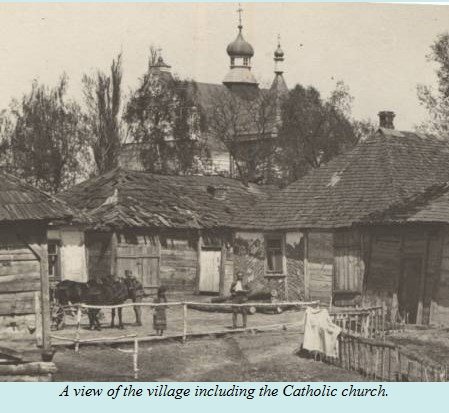
Ukrainians also attempted to force Poles out of the region. On July 11, 1943, units of the Ukrainian Insurgent Army murdered Polish inhabitants of the town. Most people were killed during a ceremony in a local Roman Catholic church. The Ukrainians entered the church and threw grenades at the faithful. Then they shot at them with machine guns and finally set fire on the church filled with people.
Of the approximately 1,000 Jews who lived in pre-war Poryck, only around 20 survived the Holocaust. Most of the survivors went to Israel.
Poryck was liberated by the Red Army on July 18, 1944. The town was re-named Pavlovka (Pavlivka) in 1945.
Please review the site content below. Zachor - We Remember.
Return to Ukraine Index
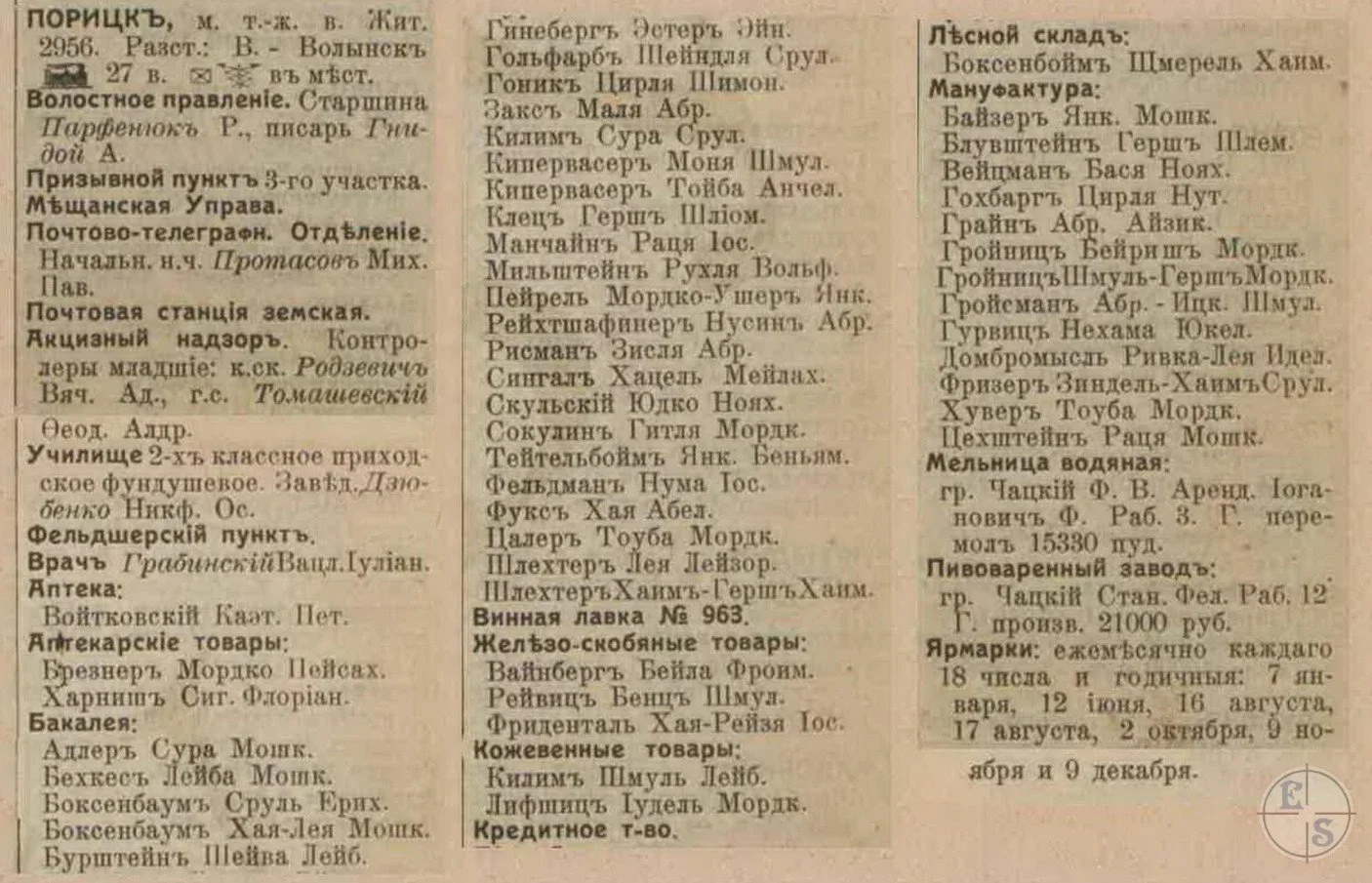
1913 city directory, Poryck (Pavlivka).
LINKS
Join the Poryck group on Facebook!
Town of Poryck:
- Coming Soon
Remember Your Family:
- Central Judaica Database - Museum of History of Polish Jews
- Grandchildren of Holocaust Survivors on Facebook
- Guide to the YIVO Archives
- Holocaust News/Events from Generations of the Shoah Int'l
- Holocaust Survivors and Victims Database
- JewishGen Family Finder
- JewishGen Holocaust Database
- JRI-Poland: Search for Your Family
- Museum of History of Polish Jews Introduction
- Yad Vashem: Search for Your Family
- Yad Vashem: Submit Names of Your Family Members
- Yad Vashem Requests Photos of Shoah Survivors and Families
CONTACTS
U.S.: genealogykid20@aol.com