Remember Jewish Belz (Ukraine)
HISTORY OF THE JEWISH COMMUNITY
Belz is a city in western Ukraine, in the Sokal Raion of the Lviv Oblast. It is located 28 km southwest of Sokal, 72 km north of Lviv, and 524 km west of Kyiv. It lies on the Solokiya River. Belz was formerly a part of Poland.
The first mention of Jews in Bełz dates back to 1413, but Jews lived there even before then. The city was mentioned in the list of Jewish communities, subject to royal tax in 1507. Already at that time, there was a synagogue in Belz. In 1538, 27 Jewish families lived in the community.
At the turn of the 16th and 17th centuries, the rabbi in Belz was Joel, son of Samuel Sirkes, a famous Talmudist and expert in halacha, the author of the work "Beit Hadash". Rabbi Yehoshua, son of Alexander ha-Kohen Falk, author of the books "Beit Israel" and "Sefer Meirat Enaim", also lived in Belz. During the Chmelnytsky Uprising in the years 1648-1649, about 200 Jews of Belz died as a result of epidemics and starvation. Another blow to the Jewish community was the Swedish Deluge, during which dozens of Jewish children were killed.
The first privilege for the Jewish community in Bełz was issued by King Sigismund I the Old, and the rights acquired by the Jews of Bełz were later confirmed by Sigismund II August and Stefan Batory. At the beginning of the 1800s. Belz became one of the most powerful Hasidic centers. The founder of the local tzaddik dynasty was Shalom Rokeach, called Sar Shalom. He was a student of Jakub Yitzhak Horowitz, (Hebrew: יעקב יצחק הורוביץ), the famous "Seer of Lublin", thanks to whose recommendation he became the rabbi of Bełz in 1817. After the death of his teacher, Shalom Rokeach was recognized as a tzaddik. The first "Belzer Rebbe" was considered a miracle worker, able to expel dybbuks [wandering spirits] from the bodies of people haunted by them and free human souls trapped in animals. He emphasized doing good deeds and observing religious commandments, and he discussed numerous issues with his wife Małka. After the death of Shalom Rokeach in 1855, he was succeeded by his youngest son, Yehoshua Rokeach (1855-1894), who became involved in political activity and formed the Orthodox Machzichai ha-Dat group. In 1894, Issachar Dow, son of Yehoshua Rokeach, became rabbi, and held this position until 1927. His son Aharon Rokeach was the next rabbi in the community.
In 1834, the Great Synagogue was erected in Bełz — a monumental building in the Moorish style. In 1880, there were 2,135 Jews living in Bełz, who constituted 51.7% of the total population. By the end of the century, the number of followers of Judaism had risen to 2,872 people.
In the nineteenth century, the city became the scientific and spiritual center of Galician Hasidism. The Belz yeshiva gained special fame. Bełz is commonly credited with the popular song "Majn shtetele Bełz.” In 1910, there were 3,625 Jews living in Bełz, who constituted 60.2% of the population of Bełz. The period of the First World War contributed to the decline in the number of Jews in Belz. During the 1921 census, only about 2,100 Jews were recorded in Belz, at the same time the percentage of the Jewish population was around 51%.
Jewish Trade: In 1473, Jews were engaged in farming royal taxes, and by the end of the 15th century, Szania of Bełz, served as a royal banker. The Jewish community received its first privileges—which also carried economic significance—from King Sigismund I the Old; these were subsequently confirmed by Sigismund II Augustus and Stephen Báthory. The rights granted to them permitted Jews to engage in both trade and crafts in town. They participated in both local and long-distance commerce, dealing in goods such as cloth, spices imported from the East, and oxen from Wallachia. They took part in major trade fairs—such as those held in Lublin—and were also permitted to sell their wares at the fairs held in Bełz itself. Furthermore, during the first half of the 17th century, Bełz was home to a large number of Jewish artisans—including those practicing rare or specialized trades—such as tailors, butchers, brewers and distillers, glaziers, gunpowder makers, and musicians. The 18th century was a period of revitalization, including in the economic sphere. In 1817, Belz became a destination for many visitors, emerging as one of the most powerful and significant Hasidic centers in all of Galicia. This ‘pilgrimage-based’ movement fostered the growth of the service sector, while the state of manufacturing and artisanal crafts remained very poor. Trade was limited to the local exchange of agricultural produce; selling these goods further afield was impossible due to the aforementioned, prolonged lack of access to the railway (the distance to the nearest stations was 10 miles).
In 1881, the Rawa Ruska–Sokal railway line was finally constructed. One of the stations was located in Bełz, bringing about a revitalization of the local economy. The timber industry, based on the forest resources surrounding the city, became a vital source of livelihood for the city's inhabitants. Interestingly, the area that later became the municipal forest was sold to the city council specifically by Jews, who agreed to the transaction on the condition that they be granted a concession for the production of alcoholic beverages (known as propinacja). Among the service establishments where the Jewish inhabitants of Bełz were particularly active in the 20th century were bakeries (21 in 1939), spice shops (34 in 1939), and small-scale industrial workshops (18 in 1939). The majority of shops, both large and small, were concentrated around the market square. Jews worked as barbers, merchants, dairymen, tailors, timber industry workers, construction laborers, butchers and meat traders, carpenters, and shoemakers. Teachers in cheders (known as melameds) constituted a significant group. There were also several taverns owned by Jews. In the 1930s—much as throughout the rest of Poland—a campaign against Jewish commerce, known as the “economic boycott,” was launched. These actions, fueled by antisemitic sentiments, relied heavily on a propaganda campaign aimed at discouraging people from shopping at Jewish-owned stores.
Education: In the interwar period, there were two seven-grade state folk schools in Bełza – one for boys, the other for girls. Children of three nationalities studied in both schools: Polish, Ukrainian and Jewish. However, there was only one language of instruction – Polish. From the third grade, Ukrainian was also taught as a second language, and from the fifth grade, children had additional German lessons (twice a week). In addition, religion classes were held twice a week. Initially, only Catholic and Orthodox religions were taught at the school, while Jewish students were not allowed to have classes in Judaism until 1933. Until then, during religion classes, they left the classroom and played in the corridor or, when religion was the last lesson, returned home. Anti-Semitic sentiments were strong at the school, which caused Jewish families to increasingly refrain from sending their children to state schools[1.1]. In the period in question, there were no public secondary schools in Belza. Children from wealthy families were sent to a gymnasium in Krakow or Ternopil.
Jewish Culture: In the interwar period, there were two seven-grade state folk schools in Bełza – one for boys, the other for girls. Children of three nationalities studied in both schools: Polish, Ukrainian and Jewish. However, there was only one language of instruction – Polish. From the third grade, Ukrainian was also taught as a second language, and from the fifth grade, children had additional German lessons (twice a week). In addition, religion classes were held twice a week. Initially, only Catholic and Orthodox religions were taught at the school, while Jewish students were not allowed to have classes in Judaism until 1933. Until then, during religion classes, they left the classroom and played in the corridor or, when religion was the last lesson, returned home. Anti-Semitic sentiments were strong at the school, which caused Jewish families to increasingly refrain from sending their children to state schools[1.1]. In the period in question, there were no public secondary schools in Belza. Children from wealthy families were sent to a gymnasium in Krakow or Ternopil[1.2]. As in every Polish city and town, in the interwar Belz many cultural events were conducted by political organizations that made it a point of honor to have their own cultural institution. In particular, currents associated with Zionism and the socialist Bund were strong in the city. Each of them organized events aimed at promoting ideas close to these movements – emigration to the future Eretz Israel and the promotion of the Hebrew language, or strengthening the role of the Yiddish language and the idea of Jews remaining in their place of residence. Each of the parties organized its own library. In the Zionist countries, books were available in two languages, Yiddish and Hebrew, while the Bundists had a collection of books only in Yiddish. The General Zionists, the Zionist-Orthodox Organization "Mizrachi" and the Zionist-Revisionist Organization in Poland (New Zionist Organization) maintained their libraries in Belza, but the library created by the Zionist Labor Party "Hitachdut" could boast the largest number of books. In turn, the oldest library in Bełza belonged to the Bundists. It was established during the Austrian partition. The collection survived the difficult time of the First World War only because at the outbreak of the First World War it was distributed among party members and kept until the end of the conflict. The Bund library had about 1500 volumes. Apart from fiction, one could find many works on the history of socialism or the workers' movement.
Other Jewish cultural organizations that were active in the city included: (1) Gordonia is a pioneering youth organization based on the ideas of Aron David Gordon's "work religion", associated with the secular Zionist party Hitachdut. In the former Galicia, to which Bełz also belonged, established in 1923. Not far from Hashomer Hatzair in terms of program, however, it criticized its individualistic approach, manifesting ambitions to become a general movement of the Jewish youth masses. In Belza, the association included m.in. Aaron Reuwen Meir and his wife Chanehla. (2) Bne Akiva ("Sons of Akiva") – actually the Religious-Scout Youth Organization "Bnei Akiva" – a religious, Zionist youth organization, associated with the religious Zionist Mizrachi party, intended for children aged 12-18, whose educators were adult members of the party. It has been active in Poland since 1929, as the first to be initiated in nearby Lviv. In Belza, the number of its members reached about 20 people. At the same time, they were members of the Tora wa-Awoda ("Torah and Work") movement, who initiated the creation of the Bel branch. The leading activists in the 1930s were, m.in. Moshe Hadari and Mirel Ziefert. (3) Keren Kajemet le-Israel (Jewish National Fund) – a fund created to acquire land in Palestine and develop it. It was established at the end of 1901 at the Fifth World Zionist Congress, and was active in Poland especially in the period before the outbreak of the Second World War. Its representative, who came to Bełz in the interwar period, was Dr. Bernstein. (4) Bne Akiva ("Sons of Akiva") – actually the Religious-Scout Youth Organization "Bnei Akiva" – a religious, Zionist youth organization, associated with the religious Zionist Mizrachi party, intended for children aged 12-18, whose educators were adult members of the party. It has been active in Poland since 1929, as the first to be initiated in nearby Lviv. In Belza, the number of its members reached about 20 people. At the same time, they were members of the Tora wa-Awoda ("Torah and Work") movement, who initiated the creation of the Bel branch. The leading activists in the 1930s were, m.in. Moshe Hadari and Mirel Ziefert. (5) Tora wa-Awoka ("Torah and Work") is a movement associated with religious Zionism and its political arm, the Mizrachi party. Initially, "Tora i Praca" existed in Sokal, about 20 km away from Belz. Its founders in Belz were, m.in. Isaac Mautner, Szmul Shpindel, Isaac Teller and Miriam Eliasz, who named the local branch He-Chalutz ha-Tzair of the East (Young Pioneer of the East), in reference to the Zionist youth organization. The oldest member, Lieberman, became the chairman of the Belz branch, and Špindel, Teller and Roth became secretaries. The first meeting of the organization in Belz took place in the summer of 1930, and Yaakov Rosner, the leader of the "Torah and Labor" movement in eastern Galicia, was invited to the next one. Initially, the only woman in the unit was Miriam Eliasz, but later others joined, m.in. Etti Rosen, Temma Rosen and Rywka Roff. The organization was engaged in cultural activities. Its members taught the Hebrew Bible (Tanakh) and Hebrew, and also founded a branch of Bne Akiva in Belz. They also collaborated with the Zionists. First, they rented a room near the cemetery, and then they had their own club in the city center, located near the courthouse. The number of members was around 60 people, which was a significant number at the time. Members of the Belz branch took part in conferences of the entire "Torah and Labor" movement, which took place in Lviv.
Libraries: As in every Polish city and town, in the interwar Belz many cultural events were conducted by political organizations that made it a point of honor to have their own cultural institution. In particular, currents associated with Zionism and the socialist Bund were strong in the city. Each of them organized events aimed at promoting ideas close to these movements – emigration to the future Eretz Israel and the promotion of the Hebrew language, or strengthening the role of the Yiddish language and the idea of Jews remaining in their place of residence. Each of the parties organized its own library. In the Zionist countries, books were available in two languages, Yiddish and Hebrew, while the Bundists had a collection of books only in Yiddish. The General Zionists, the Zionist-Orthodox Organization "Mizrachi" and the Zionist-Revisionist Organization in Poland (New Zionist Organization) maintained their libraries in Belza, but the library created by the Zionist Labor Party "Hitachdut" could boast the largest number of books. In turn, the oldest library in Bełza belonged to the Bundists. It was established during the Austrian partition. The collection survived the difficult time of the First World War only because at the outbreak of the First World War it was distributed among party members and kept until the end of the conflict. The Bund library had about 1500 volumes. Apart from fiction, one could find many works on the history of socialism or the workers' movement.
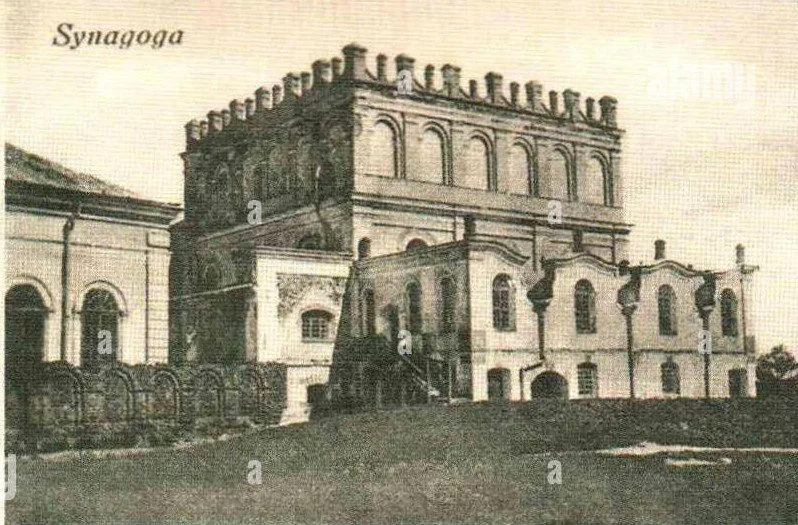
Right: The destroyed
synagogue in Belz.
NEARBY JEWISH COMMUNITIES
Information is available about some Jewish communities near Belz, including:
- DLUZNIOW: A census of Poland in 1921 indicated that 19 Jews lived in the rural village of Dłużniow, which is directly north of Belz on the route to Hrubieszow. During the Holocaust, a group of young Jews from Warsaw area — including Avraham Bekerman, Jerzy Bielawski, Olek Halbsztadt, Salek Hazenszprung and Fela Szabszyk Finkelstztajn — stayed on an estate in this rural village in hopes of fleeing the perpetrators of the Holocaust. More information is available about them at Betar Partisans in Hrubieszow During the Holocaust.
BELZ DURING THE HOLOCAUST
When World War II broke out, Bełz came under Soviet occupation. However, on October 10, 1939, it was taken over by Germans by virtue of the agreement between the Third Reich and the USSR. Prior to the entrance of Nazi troops, the majority of local Jews had fled to the east.
The Germans established a forced labour camp in Bełz. Its prisoner population comprised Jews displaced from nearby localities. The Germans established a Judenrat, with Dr. Leon Taube as the Chairman.
A group of Jews from Mielec were deported to the Belz ghetto in late March of 1942. By May 1942, there were 1,540 Jews residing in the Bełz Ghetto. On June 2, 1942, ca. 1,000 Jews were deported from Bełz to Hrubieszów, from which they were later sent to the Sobibór extermination camp. In September 1942, the remaining 504 Jews of Belz met the same fate.
Tzaddik Aharon Rokeach and his brother Mordechai were sent from ghetto to ghetto. In May 1943, they eventually managed to escape to Budapest and then reached Palestine in early 1944. Following his arrival in Eretz Israel, Tzaddik Aharon established his own Hasidic court and a yeshiva. The Belz dynasty is currently headed by his nephew – Yissachar Dov Rokeach, son of Mordechai of Bilgoraj.
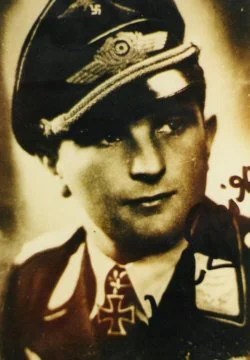
Among the S.S. members stationed in Belz were: Karl Beier, Otto Busse, Arthur Jerz, Karl Kohler and Fritz Pietsch. A photo of Beier is below.
ADDITIONAL SOURCES
The Landlordship of Bełz in Israel (ji. Belzer Landslajt Farajn in Israel) and the Association of Belz Jews in America (Belzer Jidn in Amerika) published in 1974 a book of remembrance dedicated to the Jewish community in Belz, entitled Belz: Sefer zikaron = Belz memorial book, published by Belz Societies in Israel and America, Tel Aviv 1974. Information about the Bund in Belz is available in this book: Polski słownik judaistyczny. Dzieje, kultura, religia, ludzie (The Polish Judaistic Dictionary. History, Culture, Religion, People), Zofia Borzymińska, Rafał Żebrowski (eds). Warsaw, 2003.
WHAT REMAINS
To this day, Bełz remains a pilgrimage site for many Hasidim, who visit the graves of tzaddikim at the local cemetery.
To cater to their needs, a hotel and a synagogue have recently been built next to the cemetery.
The first Jewish cemetery in Belz was located in today's center of the village, at Mickiewicza Street (Ukr. Міцкевича вул., Mickevycha Vul.). It served as a burial site until the mid-nineteenth century. As a result of the devastation, no tombstones have survived in its area to this day. On the modern fence there is a plaque with the inscription: “Holy place. The former Jewish cemetery, which functioned for centuries until 1846. The fence was built in 2007 by the Bel Hasidim Center from the holy city of Jerusalem.”
The Jewish cemetery in Bełz was founded around 1790 in the western part of the city. It is located at Mickevycha 106 (Ukr. Міцкевича вул., Mickevycha vul.). As a result of the devastation, about 150 matzevot have survived to this day, including the tombstones of the leaders of the local Hasidic dynasty: Shalom Rokeach of Belz, called Sar Shalom (d. 1855), his son Yehoshua Rokeach (d. 1894) and grandson Issachar Dov Rokeach (d. 1926). Recently, the necropolis has been tidied up and fenced. A building was erected on the neighboring plot, housing a synagogue and a hotel for people making pilgrimages to the graves of tzaddiks.
The Jewish quarter was located near the market square in Belz, west of the Dominican monastery. Typical buildings of a pre-war Jewish town can be found in a dozen or so tenement houses and villas dating from the end of the nineteenth and the beginning of the twentieth century, and preserved to this day. Some of them are richly decorated and topped with turrets. There is also a modest, one-storey mikveh building in Belz, which is the only section of the Great Synagogue complex to survive. Its facades are decorated with wide pilaster strips and horizontal entablations. However, the building of the beit midrash and the palace of the rabbi were completely destroyed.
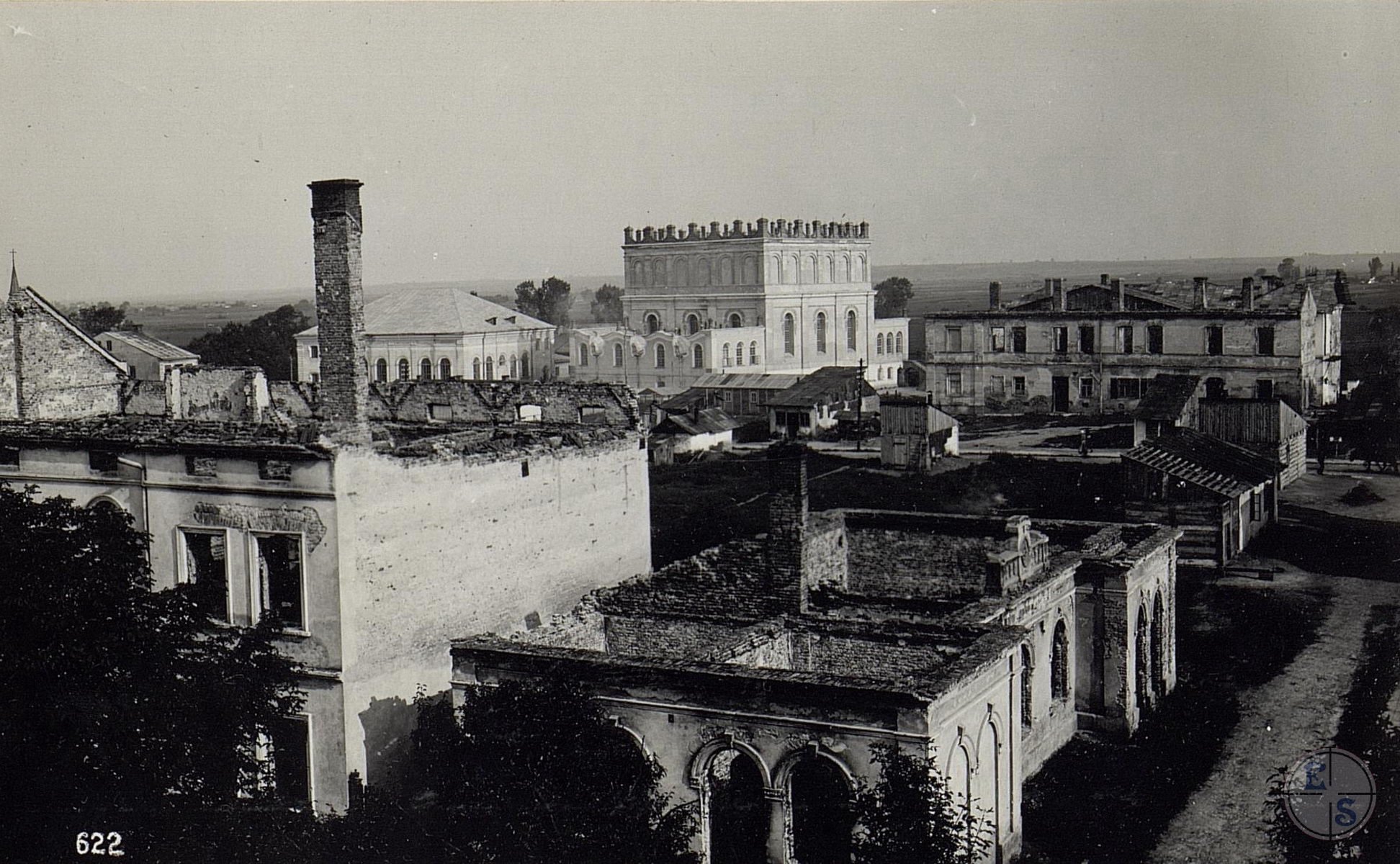
Belz: Destruction of the city after World War I. In the foreground is the Palace of Rebbe; behind it is the Great Synagogue; to the right of it is the Beit Midrash.
Right: S.S. man in Belz, Karl Beier.
Rabbis of Belz (incomplete listing)
Joel son of Samuel Sirkes
Yehoshua son of Alexander Ha-Kohen Falk
Shalom Rokeach
Yehoshua Rokeach (1855–1894)