Remember Jewish Cyców
Pronunciation: Sitz-ov
HISTORY OF JEWISH CYCOW
Cycow is a village in Leczna County, Lublin Voivodeship, in eastern Poland. It is 19 km. east of Leczna and 41 km. east of the regional capital Lublin.
In 1564, the village had 26 families. In the 18th and 19th centuries, the village was known for its production of knit fabric. In 1827, the village of Cycow had 52 houses and 257 inhabitants. At the end of the 19th century, Cycow had a mill operated by a member of the Jewish community. At that time, linen and flax cultivation were the main occupations of the residents. In 1880, three Jewish merchants explored Cycow. They were: Moses Landau, Chaim Oppenheim and Abraham Koppel from Kalisz, Poland.
In 1921, the religious division in the village was as follows: the largest group was evangelicals (321 people), followers of the Mosaic religion (181 people), Orthodox Christian (175 people) and Catholic (174). A private beit ha-midrash operated by Mordko Heryng in Cycow after 1916.
Jewish community members in Cycow before the war included: B. Kister, midwife; P. Cyngiel, R. Brand, D. Pilicer and Sz. Pilicer were store owners. The cattle trade was made by A. Celnik, D. Szpiro and Z. Sznajderman. M. Hering had a candy shop. Poultry was dealt with by Migdal. [Word not translated correctly] was run by Ch. Sztrajcher. Graneries were possessed by M. Niski and D. Pilicer. The horse trade was done by Sz. Bajtelman, I. Wertman, and Grynszpan and Rochman. Tailors in town were J. Goldwaser and J. Szymel. A mill was owned by by L. Zonenberg. The dairy shop was owned by Ch. Handelsman. N. Nizki on D. Pilicer dealt with oil production. Bakeries were owned by K. Keller. Stores with different goods were owned by Ch. Bronswajg, D. Pilicer, I. Pilicer, R. Szuchman. The butchers included: L. Boleslawski, J. Chlasciak, W. Hanschol, I. Heryng and W. Stopura. And Sz. Rojtholc had an [unclear position]. There were numerous grocery stores owned by R. Brand, M. Gildmer, A. Grudnia, Sz. Hering, J. Iwaniuk, P. Kliniuka, P. Stopy, B. Szpiro, B. Wertman and W. Zawadzki. The Cycow windmill was owned by A. Loksztajn. The iron shop was owned by Z. Blusztajn.
It is unclear how many Jews lived in Cycow in 1939.
NEARBY JEWISH COMMUNITIES
Towns near Cycow also had Jewish community members, almost all of which were eliminated in the Holocaust. These communities included: Andrzejow (unknown Jewish population), Grabniak (see below), Swierszczow (25 Jews), Urzulin (50 Jews), Wereszczyn (105 Jews), Wierzbica (150-200 Jews), Wytyczno (50 Jews), Zamolodycze (50 Jews) and Zastawie (15 Jews). The Cycow community belonged to the kehilla in Siedliszcze. The Jewish population played a significant role in the economic development of these communities.
- Urszulin: Urszulin had a pre-war Jewish population of around 50 Jews. None of them survived the duration of the war.
- Wierzbica: The Jewish cemetery in Wierzbica was established around 1831. The population was between 150 and 200 Jews in 1939. On July 17, 1942, the Nazi authorities ordered an enclosed ghetto be created. They forced 300 Jews into constructed barracks. Around 500 total Jews were in the ghetto, including some from other locations. It is unclear where or how the 500 Jews from Wierzbica ghetto were murdered.
- Wereszczyn: Wereszczyn had a pre-war population of between 100 and 300 Jews. On the morning of 14 May 1942, Germans entered the village and murdered all Jewish residents. Mariam Raz-Zunszajn, a 9-year-old Jewish girl, witnessed the murders and has provided testimony about them. A photo of Alter Zunszajn, textile merchant from Wereszczyn, who was also appointed head of the Judenrat, also exists.
CYCOW DURING THE HOLOCAUST
When the German occupation started, a number of escapees from other centers arrived in Cycow, so that the number of the village's Jewish inhabitants grew to 465 by 1940 and 538 by 1942. The ghetto lasted for a very short period of time between April 1 and June 1, 1942.
In Wolka Cycowska, near to Cycow, the Nazis shot 110 individuals (including Jews and Roma) on May 27, 1942. Between May 25-30, 1942, all of the remaining Jews in Cycow were deported to the gas chambers at Sobibor.
A little north of Cycow, 6 km. west of Urszulin and 37 km. south-west of Wlodawa sits a village called Grabniak. Before the war, the families Adamczuk and Szulim Silbersztajn were two Jewish families that lived in the village. In June of 1942, the Nazis came to Grabniak for the few Jews living in the community. They went house to house looking for Jews. They threatened that they would kill Poles who hid Jews. According to Polish historian Adam Panasiuk, there was a group of Jews who hid in this area with the help of Polish farmers. It was a good hiding spot because the buildings were spread out (7 km. between them), there were three lakes (Sumin, Rotcze and Usciwerz) surrounding the village and the Germans were intimidated by some of the local farmers.
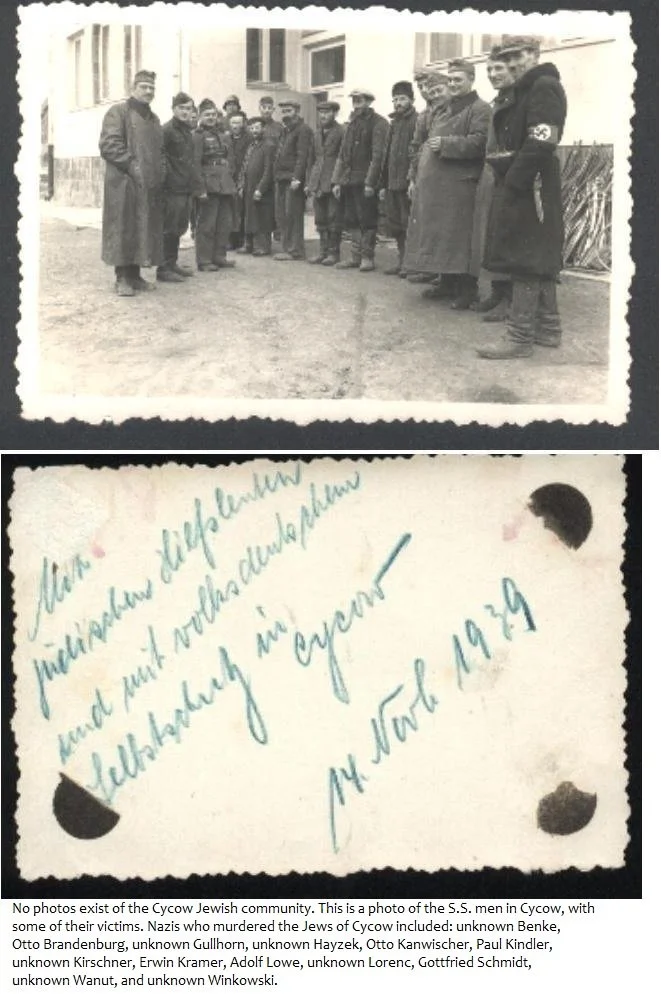
Some of the Nazi S.S. responsible for the murders in Cycow included: unknown Benke, Otto Brandenburg, unknown Gulhorn, unknown Hajzyk, Otto Kanwischer, Paul Kindler, unknown Kirchner or Kirschner, Erwin Kramer, Adolf Loeve (Löwe), unknown Lorenc, Distriktgouverneur Friedrich Schmidt, Gottfried Schmidt, unknown Wanut and unknown Winkowski.
WHAT REMAINS
The Jewish community ceased to exist.
In 1984, a monument to the murder victims in Cycow was erected in nearby Wolka Cycowska, at the National Defense League shooting range area. This was due to the initiative of Edward Nakielski.
Northeast of Cycow was the Jewish cemetery, which was established in the 1800s. It is not currently marked and no matzevot remain. Cycow did not have a Jewish synagogue and relied on private houses of prayer or synagogues from nearby shtetlach such as Chelm, Siedlescze or Leczna for prayer services. There was no rabbi in town and they relied on the cantor or schochet to perform rabbinical ceremonies.
Zachor - We Remember. Please review the site content.
------------------------------------------------------------------------
[Cycow - Virtual Sztetl]
[Zastawie and Wola Wereszczynska Holocaust Victims]
------------------------------------------------------------------------
LINKS
Click to join the Facebook group for Cycow!
Rabbis of Cycow
- Moshe Yoel
- Naftali Tzvi Shpiegel
Righteous Gentiles
- The Matuszak family hid a Jewish family from Nadrybie
- Irena and Izydor Urbach in Zalasocz and later Zalasocz hid Miriam Raz Zunszajn (from Wereszczyn)
- The Czarnecki family in Lake Sumin & the Czuprynski family in Debowiec hid a Jewish family from Warsaw
Remember Your Family
- JewishGen Family Finder
- JRI-Poland: Search for Your Family
- Yad Vashem: Search for Your Family
- Yad Vashem: Submit Names of Your Family Members
CONTACTS
U.S.: LublinJewish@gmail.com
Return to Lublin Index