Remember Jewish Kamionka
HISTORY OF JEWISH KAMIONKA (NEAR PULAWY / LUBLIN, POLAND)
Kamionka, located near Puławy in the Lublin region of Poland, had a notable Jewish community that was largely destroyed during the Holocaust. Jews lived in Kamionka since at least 1598.
A dye house, brickyard, windmill, and two oil mills existed in the village. The local Jewish population was engaged in trade, crafts, agriculture and weaving. Jews lived mainly near the market square. A Jewish cemetery was established in the 1860s and a synagogue had probably been established prior to that.
By the 1920s, Kamionka had a synagogue, a beit ha-midrash, a ritual slaughterhouse, a mikveh, and a funeral fraternity (Chevra Kadisha). By 1927, the Jewish community also had a library in town. A Hebrew school also existed in town.
In his book about Kamionka, “Rather Die Fighting,” Holocaust Frank Blaichman says: “There was little opportunity for advancement in our little shtetl. Though we were on the main bus route that ran from Lublin, 12 miles to the south, with Warsaw 80 miles to the northwest, I was completely ignorant of what was going on in the outside world. We had no radio and we didn’t talk about politics or foreign affairs at home.”
NEARBY JEWISH COMMUNITIES
Jews also lived in nearby villages such as Firlej (167-250 Jews), Garbow (125 Jews), Kurow (2,000 Jews), Michow (2,000 Jews), Markuszow (2,000 Jews), Staroscin (10 Jews) and Zagrody (14 Jews).
In January of 1943, the Germans perpetrated a massacre of 27 Jews and 1 Pole in the village of Samoklęski, which is 5.1 km southwest of the village of Kamionka.
KAMIONKA DURING THE HOLOCAUST
556 Jews lived in Kamionka before the Holocaust.
The ghetto in Kamionka included nearly 700 Jews from nearby Jewish communities. The Judenrat Chairman was Mendel Rajs. There was also a Jewish police. All Jewish businesses were confiscated, Jews were forced into a poor part of town and all Jews had to wear the star of David arm-band. According to Frank Blaichman, one of two surviving witnesses who survived the Holocaust from the town, “1941 was a year of increasing hardships. The Nazi propaganda machine encouraged our neighbors to despise us.” He also notes, “People who lived around Majdanek noted that the ‘air spelled as if they are burning cats’, making a joke about the murders of Jews in the camp.” In May of 1942, a group of Jews from the Markuszow ghetto escaped to Kamionka after learning that they may be deported to a death camp.
On October 9, 1942, Jews in the communities of Firlej, Kamionka, Łęczna, Łuszawa, Niemce, Samoklęski, Tarło, Tyśmienica and Uścimów were forced to relocate to the Lubartow Ghetto, or else be killed. Subsequently, Jews in the Lubartow Ghetto were dispatched to either the Belzec or Sobibor killing centres in October of 1942.
Two local Poles, Stanisław Misiuk and Ludwik Borówka, traveled to Lubartów the following day, and both saw the bodies of Jews from Ostrów Lubelski strewn along the road. Jews who did not complete the walk to Lubartow may have been shot at the Jewish cemetery in Kamionka.
The Jewish community of Kamionka ceased to exist.
WHAT REMAINS
556 Jews lived in Kamionka in 1939. Of those, 2 survived the duration of the war.
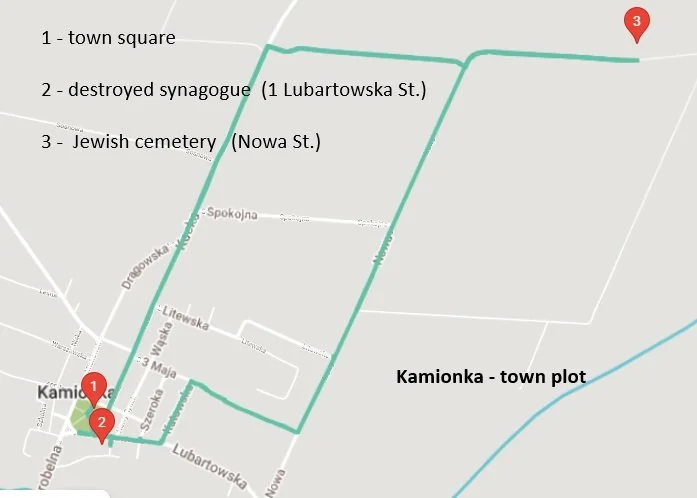
The Jewish cemetery at Nowa St. was established in the 1860s and is found on the road leading to Skrobow-Kolonia. It was destroyed during the Holocaust. A few tombstones do still exist.
The synagogue was located at 1 Lubartowska St. It was wooden and built around 1800. Around 1855, a new brick synagogue was constructed in its place. It was destroyed during the Holocaust.
Zachor - We Remember.
-----------------------------------------------------------------------------------
[Frank Blaichman Holocaust Testimony - Kamionka] (right side)
[Transfer of Kamionka Jews to Lubartow - Yad Vashem]
-----------------------------------------------------------------------------------
CONTACTS
U.S.: LublinJewish@gmail.com
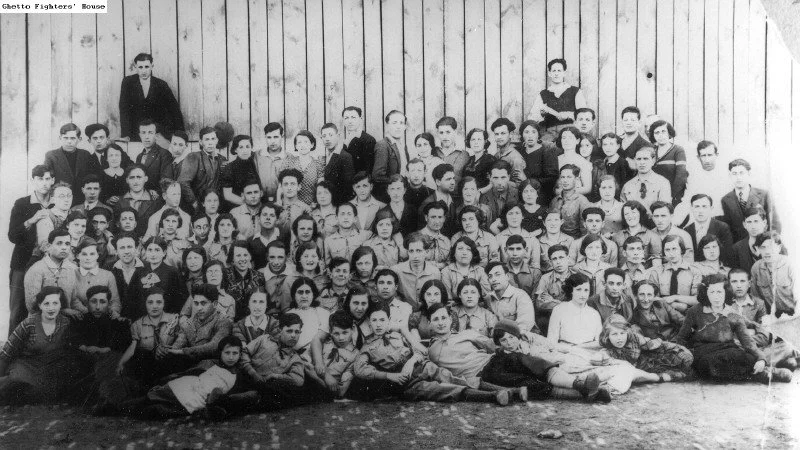
Freiheit youth group, Kamionka, pre-war.
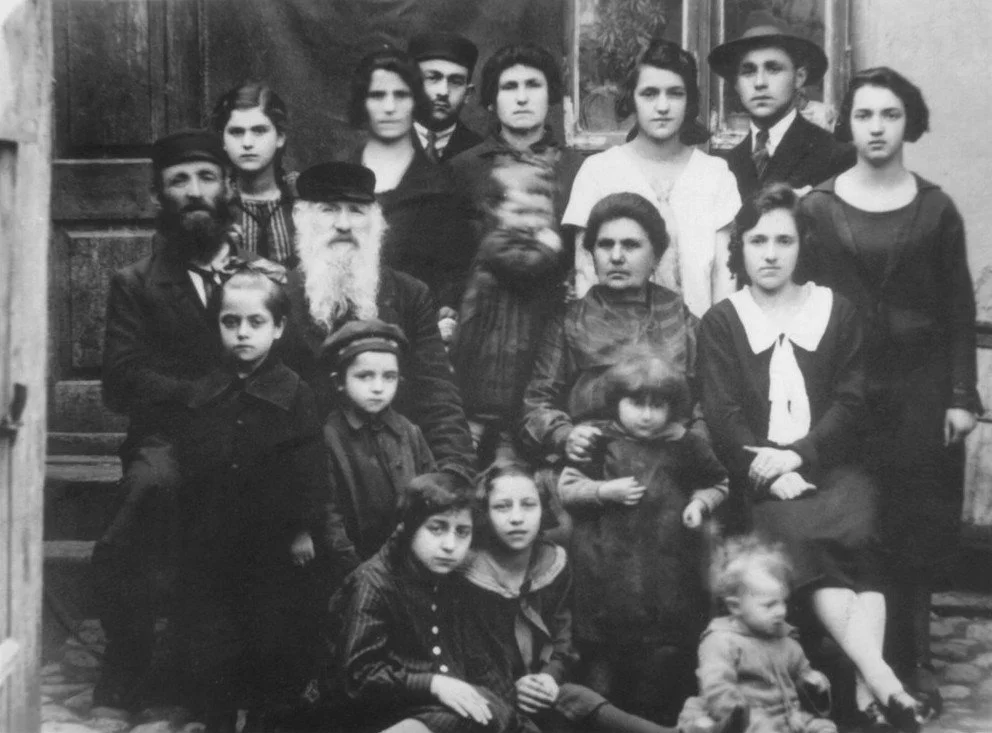
The Blechman/Blaichman
family from Kamionka.