Remember Jewish Kurow
Pronunciation: Kew-rov
HISTORY OF JEWISH KUROW
The first Jews appeared in Kurów in the mid-16th century. Stanisław Zbąski, the community owner, allowed the Kurów Jews to set up their own independent Jewish community beginning in 1568. The first synagogue probably existed from around 1550 but was destroyed with the invasion of Khmelnytsky's troops. The synagogue was rebuilt.
In 1661, Kurów numbered 384 people, among whom there were 50 Jews. In 1668, Bogusław Jan Zbąski allowed the Jewish community to construct buildings by the town square, build a synagogue, construct a brewery, a steam bath, and the permission to trade freely. By 1674, the town population was 361, including 61 Jews. The Jewish population lived in the southwestern part of Kurów, near the town pond, in the area encircled by Głęboka, Dworska (today I Armii Wojska Polskiego Street), Stawna and Tylna streets. In 1775, there were 89 Jewish families in the town. In 1786, Kurów numbered 1,500 people, among whom there were 803 Jews.
In the 1700s, the rabbis for the community included Izaak Pinkasowicz, Chaim Ickowicz and Szloma Lejbusiowicz. Literature confirms the following residents in the mid-1700s: Berek Abramowicz (bookbinder), Lejzer Chaimowicz, Aron Dostorowicz, unknown Gierszonowicz, Lewek Irkowicz (capmaker), Mosiek Irkowicz (capmaker), Sochar Izraelowicz, Kusiel Jozwowicz, Mortko Jeskowicz (baker), Berek Judowicz (capmaker), Szal Lejbowicz, Abram Leskowicz, Bereke Leskowicz, Mosiek Leszkowicz, Mortka Leskowicz (merchant), Abram Markowicz, Aron Markowicz (butcher), Zejler Moskowicz (tailor), Chaim Markowicz (capmaker), Szmal Moskowicz (tailor), Jakub Szalowicz, Jakub Salomonowicz, Szloma Szymonowic and Perec Zalmanowicz.
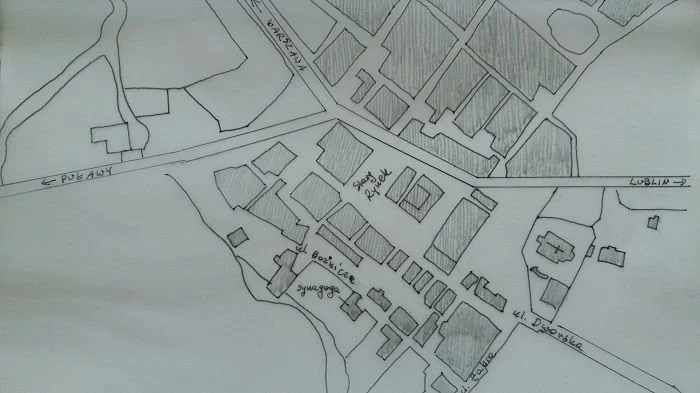
In 1856, Kurów numbered 2,664 people, among whom there were 1,564 Jews (58%). In 1892, there were 4,381 residents in Kurów, of whom 2,486 (56%) were Jews. At the turn of the 19th and 20th century, the synagogue was headed by Rabbi Chil Lejzor Goldberg and Rabbi Mordko Jankiel Rabinowicz. The Kurów kehilla included: a synagogue (Bożniczna Street – today: Nowa Street), the old cemetery (Bożniczna Street), a bathhouse (Żabia Street), a slaughterhouse (by the bathhouse) and the new cemetery (Blich Street).
In the 1920s and 1930s, Mordko Rabinowicz and Mojlech Guterman were the rabbis. At the end of the 1920s, Majer Zalcman and Icek Kirszenbaum were the ritual slaughterers/shochets.
At the beginning of the twentieth century, the Union of Small Merchants and Traders was founded. Hersz Wurman became its chairman. In 1913, there were two floor laying shops — one run by Lizyk Leberbaum employing 13 workers and another overseen by Pines Lenberg employing 8 people. At Bożniczna Street, there was a Jewish soap shop owned by Lejbuś Cukierman. In 1925, there was an oil mill owned by Mendel Medkorn and a motor mill with a power plant run by Oskar Urlich and Mordko Finkielsztajn. The mill was situated near the public bath, on the Kurówka, in Warszawska Street. The other mill was located in Puławska Street and was owned by Holcman. There was a post-office in Kurów run by Mr. Tarczyński; the letter carrier was a Jewish woman. Mendel and Chaya Mandelkern owned a cotton manufacturing company in Kurow. In 1936, the Jews owned 161 commercial venues in Kurów; only 23 were owned by the Poles.
Zionists had a significant influence among the Jewish community in Kurów. Under the auspices of this movement, the Jewish Cultural and Educational Association "Tarbut" was founded in the city. Its founders included: I. Tajtelbaum, M. Strasburg and M. Najmark. It was established in the mid-1920s. The Association ran orphanages and schools (elementary and vocational) and organized evening courses and folk universities. In addition, it conducted educational activities among adults in the form of clubs, reading rooms, libraries, concerts and lectures. Classes were held in Hebrew, Polish and Yiddish.
In 1927, the Poale Zion organization was established in Kurów. The board consisted of: Moszek Blumels – a trader, 24 years old (president), Icek Berek Rozen – a trader, 24 years old (secretary), Szmul Finkielsztejn – a saddler, 23 years old (librarian). In 1932, Moszek Blumels became the president, Mosiek Finkielsztejn became the secretary, and Szmul Tajtelbaum (a horse trader, 28 years old) became a member. During this period, the organization had 26 members in Kurow. Its goal was to rebuild the state of Israel and organize the emigration of Jews to Palestine. Other leaders in the group included Aron Zajchler, Aron Akierman and Pinder Mandrowski.
Additionally, in 1929, the Gemilus Chesed Charity Association was established in Kurów. Its purpose was to help poor Jews. The headquarters were located in a private apartment at 40 Kościuszki Street. At the turn of 1934 and 1935, the following persons sat on the board: Fiszman, Celzman, Cymerman, Kawa, Ruchelsman, Rotefor. The audit committee consisted of: Cederbaum, Rozen and Sznajdleder, and the finances were handled by Icek Fiszman. In 1932, the local branch of the Organization of Orthodox Jews "Shalom Emunel Israel" began its activity in Kurów. Its goal was to defend religious rights and promote Judaism among young Jews. The organization published the magazine “Jud” and had 36 members.
In 1928, a branch of the Society for the Union of Jewish Schools was established in Kurów. Josiek Lerman (bookkeeper, 28 years old) became the president, Szmul Finkielsztejn (a laborer, 24 years old) became the deputy, Dawid Kartman (a salesman, 23 years old) became the secretary, and Moszek Najmark (a gaitersman, 42 years old) was Treasurer.
A cheder operated in Kurów between 1907 and 1911. It was run by Dawid Strasburg, and the teacher was Abram Lejba Brycman. The facility was located near the synagogue. In the 1920s and 1930s, there was a Jewish religious school for girls (Bet Yaakov) operating in Kurów. It was led by supporters of the orthodox Agudas political party.
Jews lived on the following streets in town: Blich, Bożnicza (now called Nowa), Dworska (now called I Armii Wojska Polskiego), Dzika (now called Kilińskiego), Głęboka, Kościuszki, Lubelska, Stawna, Tylna and Żabia.
NEARBY JEWISH COMMUNITIES
Nearby Jewish communities existed in Michów, Niedrzwica and Wąwolnica.
KUROW DURING THE HOLOCAUST
In 1939, Kurów numbered 4,365 people, of whom 2,571 were Jewish (55%).
In 1940, the Germans set up a tannery in Kurów in which 50 people were employed, including five Jews.
During the Nazi occupation, a labor camp was established for the Jews. It functioned until the end of 1942. The Jews kept there were forced to work on hardening of the road from Kurów to Klementowice. The material for road construction was taken from the synagogue and Jewish houses destroyed in September 1939. The road was also built from Jewish tombstones, taken from the cemetery in Blich Street. The work was supervised by the German company Bauman and Losch.
In April 1941, 40 Jewish families from Lublin and Wąwolnica arrived to the ghetto.
On April 8, 1942, the Nazis transported Kurów Jews to the railway station Puławy, and from there to the extermination camp in Sobibór. On November 13, 1942, the second deportation was organized — during which the Germans killed 36 Jews. They were buried in the Jewish cemetery in Blich Street. Another 23 people were shot at the Jewish cemetery on December 19, 1942.
RESISTANCE DURING THE HOLOCAUST
During the expulsion of the Jews from Kurów, numerous residents resisted or attempted to escape. Those who were successful were hiding in Garbów forests, where a Jewish partisan unit was active, headed by Chaim Eliezer Wurman.
WHAT REMAINS
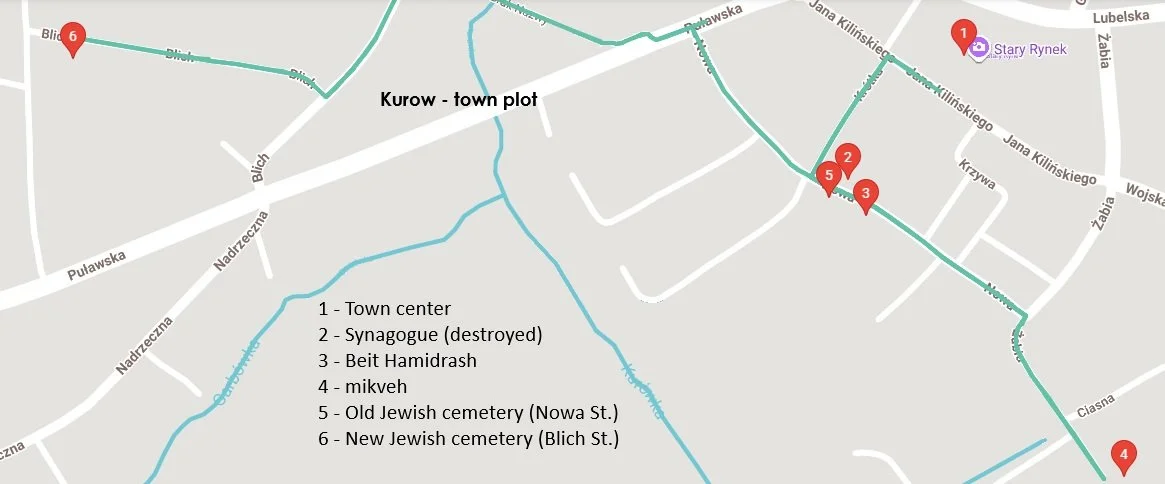
The Jewish Community in Kurów had a kahal complex that included a synagogue, cheder, cemetery, mikveh and ritual slaughterhouse. The last two buildings were located at Żabia Street, within one building. No information about the date of construction of the buildings and their original appearance and equipment was found in the sources. The ritual slaughterhouse and mikveh survived the war and are now in private hands.
The synagogue in Kurów was located on a hill, at Bożniczna Street (now Nowa Street), between Stawna and Tylna Streets. It was burned down by the Nazis on Sept. 8, 1939.
Opposite the synagogue stood a Jewish school. The synagogue was covered with a 2-story roof – the lower story was hipped, the top was semi-gable constructed from brick and stone. The pilaster strips were located in the corners on the axis of the eastern and southern walls. The buttresses were located in the corners, as well as at the southern wall. The main hall had six semicircular windows, located in splints between pilaster strips in the eastern, northern and southern walls. Adjacent to the main part of the building housing the prayer room was a wooden 2-story annex, which housed a hall with a staircase leading to the women's house on the first floor. At the southern wall, there was an entrance to the cellar. Around 1900, a wing perpendicular to the main building was added to the synagogue, housing the second hall and a room on the first floor.
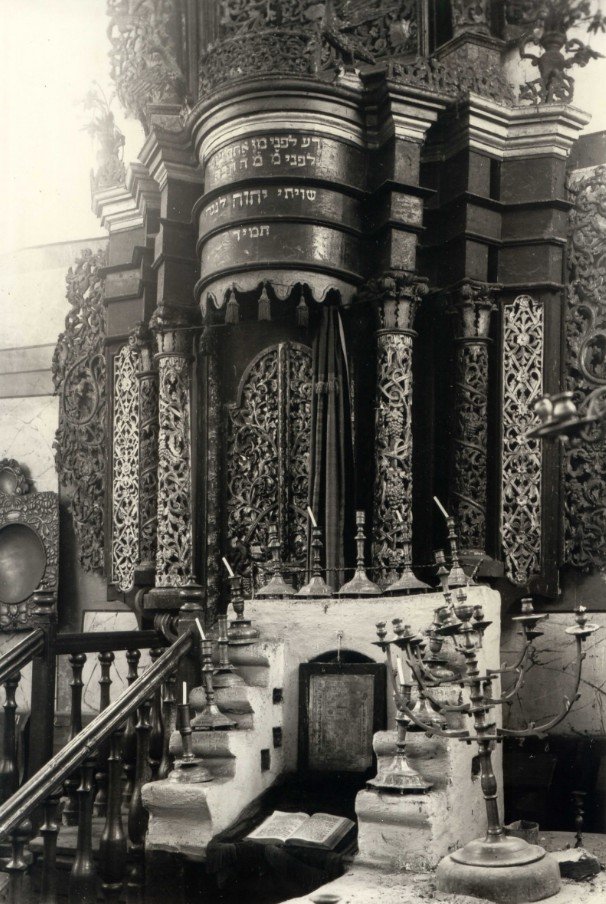
Inside of the synagogue, two chandeliers hanging from the ceiling were visible. The stairs to the choir were provided with a balustrade. Under the choir there were columns ending in a semicircular mesh. The prayer hall was covered with a wooden ceiling, and inside there was a 2-story Aron ha-kodesh, richly carved, depicting plant motifs. The octagonal wooden bimah in the Baroque style had the form of an octagonal gazebo with an openwork canopy, topped with a lantern with a crown.
The house of prayer in Kurów was founded in 1887. In 1922, the daily attendance was from 75 to 200 people. It was destroyed during the Shoah. The old Jewish cemetery in Kurów is located at Nowa Street and was built after 1650. It is located at former Bożniczna Street, now called Nowa. The last burial took place in the 1800s. No grave markers remain. The new Jewish cemetery in Kurów is located at Blich Street and was built in the 1800s. In 1914, a wall was created to surround it to replace an earlier constructed wooden fence. In the 1930s, there were several hundred matzevot, a small building and an ohel. It was destroyed by the Nazis during the occupation during World War II. A brick wall with fragments of the surviving matzevot was constructed in 2018.
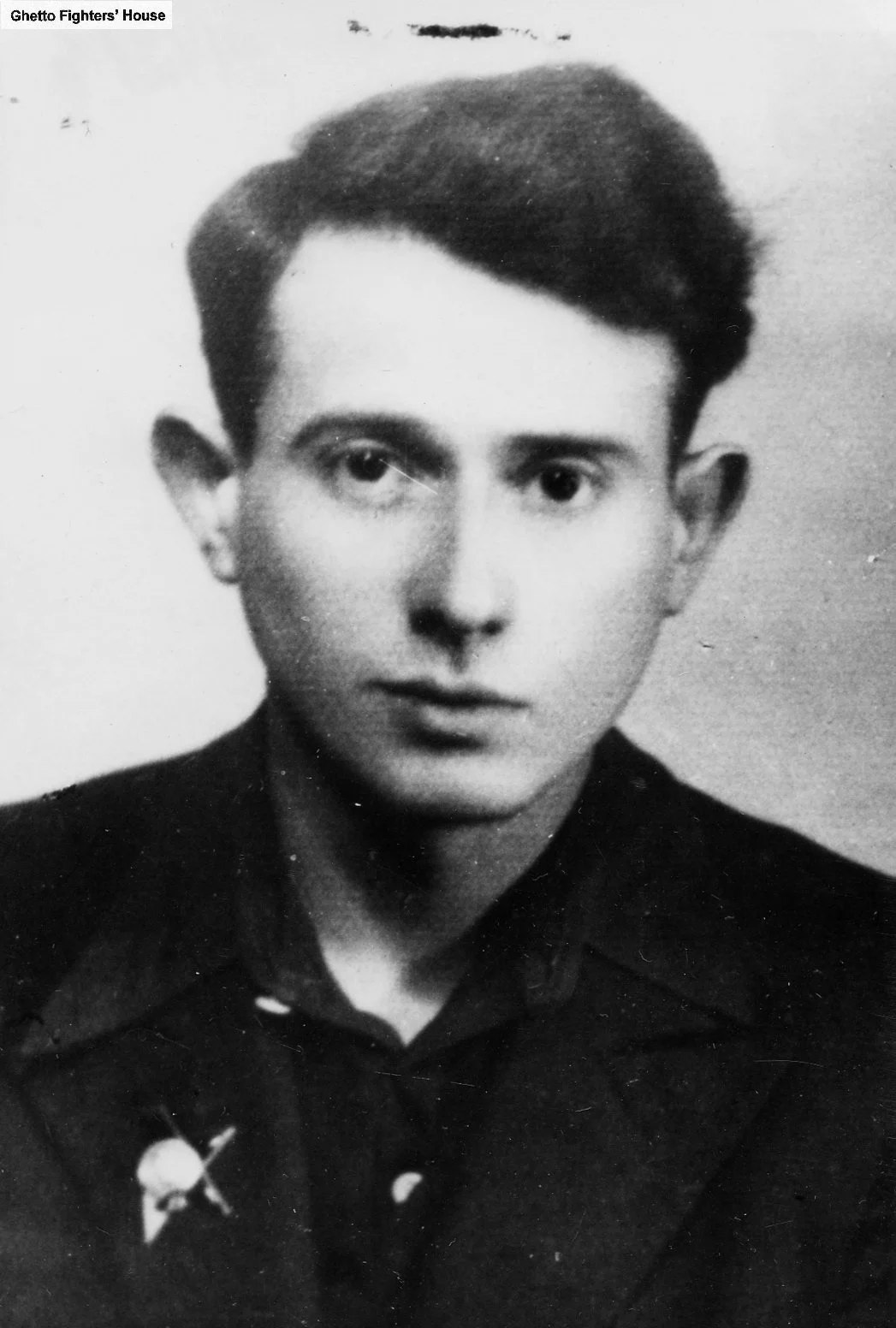
Netanel Rozenson, a Jewish partisan fighter who served under the Soviet partisan commander General Sydir Kovpak during World War II. Rozenson detailed this history in his extensive memoir, “Through Forests and Pathways” (Bi-shevilim uvi-ye'arot ba-hativat Kovpak), published in 1978. He was from Kurow.
Important Links:
• Kurow Yizkor Book [English translation]
Town plot, Kurow.
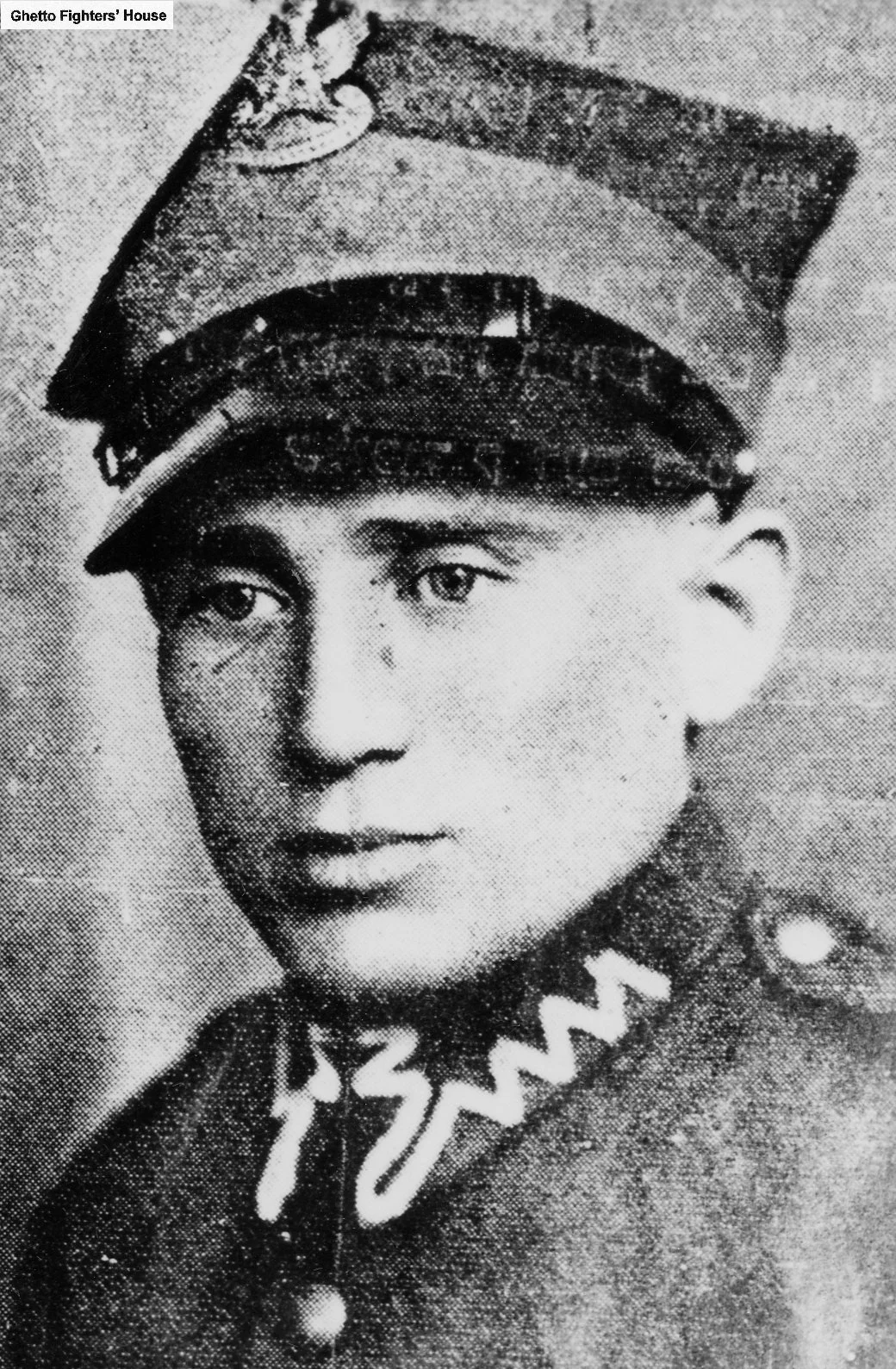
Chaim Rozenson, Jewish partisan fighter from Kurow, who was murdered in the war.
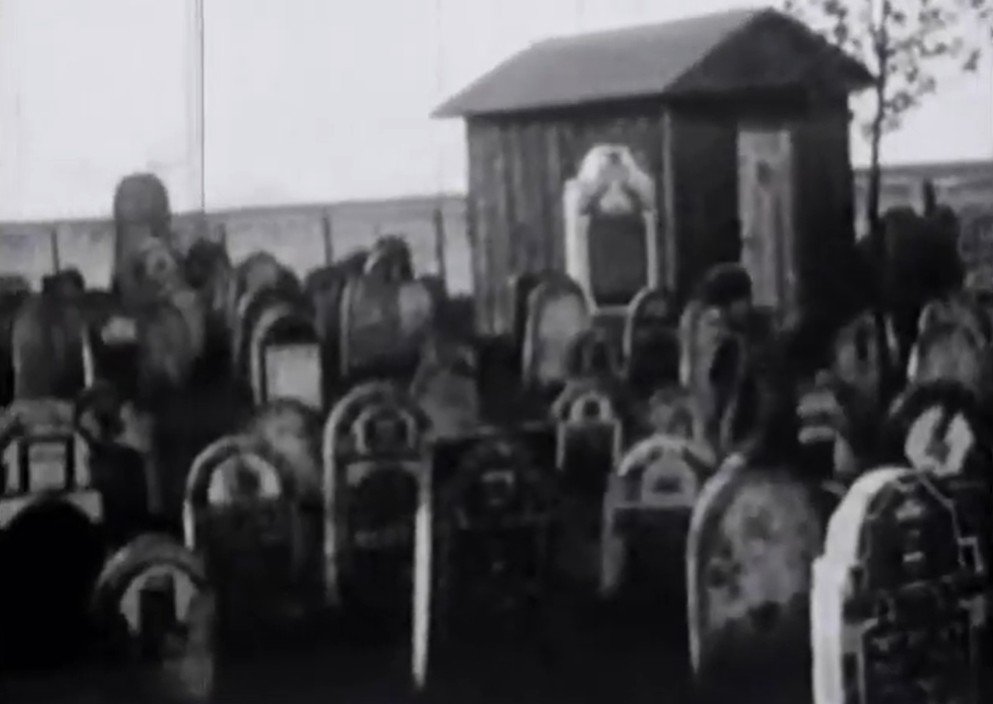
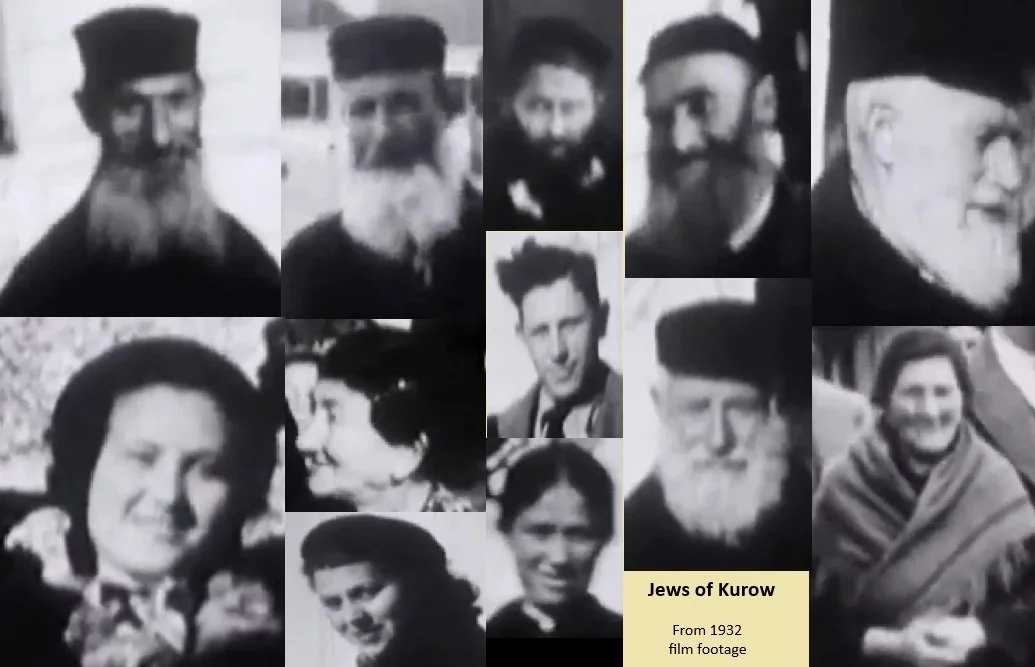
Film footage was recorded in 1932 that included the pre-war Jewish residents of Kurow. See: Kurow film footage.
Interior of the synagogue (left) before it was destroyed, including the Aron HaKodesh.