Remember Jewish Opole Lubelskie
Prononciation: O-pole Loo-bell-skee
HISTORY OF THE JEWISH COMMUNITY
The first records regarding the Jewish population in Opole Lubelskie date back to the 16th century. In 1674, the Jewish population was 88 individuals. The Jewish population settled primarily in the market square and the Old Town—specifically along Błotna Street—where a distinct Jewish quarter began to take shape. This area served as the hub of Jewish commercial activity. At that time, members of the Jewish community in Opole Lubelskie engaged primarily in trade (often small-scale and itinerant) and various crafts (tanning, weaving, butchery, and baking). During the early modern period, they accounted for over 90% of all merchants in Opole. The town’s rapid economic growth led to the formation of guild associations, which quickly resulted in a division between Jewish craftsmen (cobblers, shoemakers, tailors, butchers, and bakers) and Christian craftsmen (blacksmiths, masons, carpenters, and coopers)
In 1860, nearly 70% of the community was Jewish, including 1,585 persons. By 1900, 50% of the population in town was Jewish, including 3,328 members.
JEWISH CULTURE IN OPOLE LUBELSKIE
Thinking about the needy, the poor and the sick, in 1929 the Charity Association "Gemiłus Chesed" (actually Gemilut Chesed; Hebrew for doing grace, charity) was founded in Opole Lubelskie. It was an organization affiliated with the American Jewish Joint Distribution Committee, commonly known as the Joint. Gemilut Chesed was aimed at supporting the care activities carried out by the municipality. The association was mainly engaged in supporting the poorest members of the Jewish community in Opole Lubelskie, including by granting low-interest loans. It also cooperated with the existing shelter for the poor, sick and elderly of Jewish origin in the city. In 1932, a branch of the Zionist Labor Party "Hitachdut" was organized in Opole Lubelskie. Lejba Goldbaum, an employee of a Jewish bank, contributed to its founding. At the peak of its popularity, however, the group had only 23 members. Over time, the unit ceased its activity. The reason given was the lack of a leader and modest financial capabilities. The “Liga” social organization branch in Opole Lubelskie was organized at the end of the 1920s. The organization functioned mainly in the workers’ environment. It often carried out its activities under the auspices of the Bund. In the mid-1930s, the association devoted itself to political activities, which led to conflict with local authorities. "Liga" also ran a library. The organization “Tarbut” conducted evening courses and folk universities. In addition, it managed educational activities among adults in the form of clubs, reading rooms, libraries, concerts and lectures. Classes were held in Hebrew, Polish and Yiddish
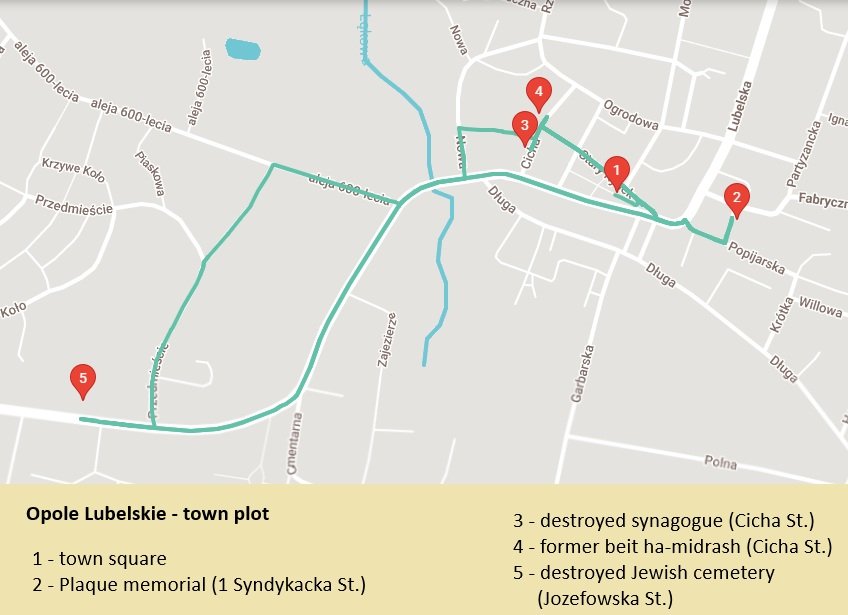
The original brick synagogue in Opole Lubelskie was constructed before the early 17th century. The new synagogue in Opole Lubelskie was erected in 1872. It was a building made of white stone. The synagogue in Opole Lubelskie was situated within the Old Town, in the vicinity of Mudna Street (now Cicha Street), which was the location of the Jewish quarter. The synagogue was destroyed during the Holocaust period. No material traces of it exist. The building of the bet midrash was also created with a white stone in 1870s. During the occupation, it was used as a residential building serving displaced people. The building was destroyed by the Nazis. No material trace has survived. In the interwar period, there was a ritual bath (mikveh) in Opole Lubelskie, located north of the Market Square, on the line of today’s Rzemieślnicza Street. No material trace of it has survived.
Staff of the Jewish community in 1930 include Rabbi R. Shapiro, J. Rubin (ritual slaughterer), M. Alpern (ritual slaughterer), J. Zamberg (ritual slaughterer), Sz. Goldberg (ritual slaughterer), W. Wizenberg (cantor), I. Fryder (supervisor of Talmud Torah), F. Azjensztat (secretary), and Ch. Korman (inspector).
In 1922 there were at least 11 houses of prayer in Opole Lubelskie: A house of prayer operating since 1920 only on Friday evenings, Saturdays and holidays belonging to Josko Nisenbaum and Abram Wizenberg; a house of prayer operating since 1921 only on Friday evenings, Saturdays and holidays; the House of Prayer operating from May 1922 only on Friday evenings, Saturdays and holidays and led by Szyja Ordnajkier (sp?); a house of prayer operating since March 1922 belonging to Kuna Aboziewicz; a house of prayer operating since 1921 operated by Lejzor Persztyk; a house of prayer operating since 1920 operated by unknown Tuchnajder; a house of prayer operating since 1921 operated by Fajvel Wajntraub; a house of prayer operating since May 1922; A house of prayer operating since August 1922.
During the interwar period, a cheder (an elementary Jewish religious school for boys) operated in Opole Lubelskie. An educational institution of the Talmud Torah was also active in the town. In 1930, its director was I. Fryderniej (sp?). The Gordonia Zionist youth organization incorporated numerous educational elements into its program. A portion of these activities was dedicated to the history and traditions of Palestine, and lively discussions were also held regarding the political and cultural situation. In August 1928, the Jewish Cultural and Educational Association “Tarbut” founded a school in Opole Lubelskie for children aged 7 and higher, with a foundational curriculum in Hebrew instruction. They attended this instruction after attending public schools.
Trade and craftsmanship remained the primary sources of income for the Jewish population throughout the interwar period as well. In the 1920s, there were 420 craft workshops operating in Opole Lubelskie—predominantly cobbler, tailoring, hat-making, carpentry, and tanning establishments. Retail shops were concentrated mainly within the market square and the Jewish quarter. During the interwar period, members of the Jewish community owned 269 enterprises. These businesses employed 507 workers, the majority of whom were Jewish. Entrepreneurs hailing from the Jewish community in Opole Lubelskie also owned 5 tanneries, 2 oil mills, and 3 groat mills.
Prior to 1939, 4,325 Jews lived in Opole Lubelskie, constituting a significant portion of the town’s population.
NEARBY JEWISH COMMUNITIES
Jewish communities near Opole Lubelskie also existed, as follow:
- Chodel: In 1787, Chodel had 31 Jews. By 1857, it included 123 Jews that represented 21% of the community. By 1921, the community of Jews was 646, representing around 50% of the whole. At least from about 1860, a private house of prayer and a mikveh functioned, and in the second half of the 60s of the nineteenth century, one of the existing buildings was transformed into a synagogue. No later than around 1872, a cemetery was demarcated. In 1910, the Jewish population included 1 saddler, 1 tinsmith, 3 men's tailors, 6 women's tailors, 8 shoemakers, 4 carpenters, 4 glassmakers and several bakers. In the interwar period, there were two tanneries owned by Jews (Hersz Hochsztejn, Samuel Knoploch), 5 kosher slaughterhouses and a transport company “F. Cyrkler.” In 1939, under the administration of the commune, there was a brick synagogue, a house of prayer, a cemetery, a mikveh and a ritual slaughterhouse. Between 1915 and the Holocaust, a house of prayer existed and had a daily attendance of 600 people. The mikveh building in Chodel was erected in 1860s but was eventually destroyed by a fire in 1892. The new mikveh, founded by the Cukierman family, was located at the outlet of Bożnicza Street, by the Chodelka River. The bathhouse consisted of a brick part, housing a mikveh and a small, wooden hall, in which there was a bathroom room and a changing room. The building was destroyed. The Jewish cemetery in Chodel is located about 500 m. northeast of the Market Square, on the road to Adelin. No grave markers remain and there is no marker or memorial for the Jewish community. Yitzchak Kronenblat was the rabbi after 1918. The synagogue in Chodel was formerly at Bożniczna Street (now 9 Koscielna St.) was built in the 1870s. It burned down in 1892 and was rebuilt by Abraham Cukierman. There was a women's house located on the first floor of the synagogue. The building included stone bonded with lime mortar. The gable roof was covered with shingles. It was destroyed in the Holocaust.
Chodel, 39 kilometers southwest of Lublin, had 776 Jewish residents on the eve of the outbreak of WWII in September 1939. The village became a collection point for deportees from Łódź, Puławy, and Warsaw. In March 1941, 203 Jews from Kraków Jews were also deported to Chodel. Due to the influx of refugees by June 6 1941, Chodel’s Jewish population had grown to 1,655, including 947 refugees. Early in the war, Jews from Chodel were deported to the Belzec and Sawin labor camps as well as to the Jozefow nad Wisla Ghetto. Jews from Germany, Krakow, Lublin and Pulawy were also dispatched to the Chodel Ghetto. In January of 1940, a ghetto was created with a Judenrat; Chil Grinberg was appointed as chair. By April of 1941, Grinberg was replaced by Icek Erlich. A labor camp was located nearby where Jews engaged in slave labor. On September 21, 1942, the population of the Chodel Ghetto were relocated to Poniatowa Concentration Camp or Opole Lubelskie ghetto (depending on which source -- it is not clear which) and then were dispatched to Sobibor or Belzec killing centers. The final deportation of the Chodel community took place in September 1942 after which there were no more Jews remaining in Chodel.
- Karczmiska: It is unclear what the pre-war Jewish population of the village of Karczmiska was.
- Nałęczów: The pre-war Jewish population of Naleczow constituted around 400 Jews, three of whom survived the Holocaust. In December of 1939, 146 Jews from Pulawy, Kurow and Markuszow were sent to the ghetto at Naleczow. In April, 1942, 2,200 Jews from Slovakia were also added to the ghetto; some were also sent to the ghettos in Konskowola, Pulawy or Opole Lubelskie. During the Nazi occupation, there was a small labor camp located in a barracks near the train station that became a forced gathering point for Jews from Kurow, Markuszow, Austria and Slovakia. Around 200 Jews were at this camp to sort cargo and stolen goods. The otherJews in the Naleczow Ghetto were deported to the Sobibor Death Camp on May 12, 1942.
- Niedźwiada Duża: In the Polish village of Niedźwiada Duża, local Polish families provided life-saving food to Jewish people hiding in bunkers. The village is recognized in studies of the Holocaust for Polish residents who, despite the danger, aided Jews during the Holocaust. A photo from December 1944 shows a Jewish soldier, Semyon Tilipman, with fellow soldiers in the village, documenting the area during the war’s later stages.
OPOLE LUBELSKIE DURING THE HOLOCAUST
In March 1941, Nazis set up a ghetto in the western part of Opole Lubelskie. It was enclosed by Nowa, Ogrodowa and Nowy Rynek Streets. The area of the Jewish district was originally fenced in with barbed wire, which were later replaced with a high wooden fence that included poles and boards.
Jews from Opole Lubelskie were forced into slave labor at sites such as Karczmiska, Laziska, Rozalin, Wilkow, and Wymyslow. Information on forced labor at these locations is available at Poniatowa Sub-Camps.
Immediate executions and assaults were committed by Nazi military police on a daily basis. Under the administration of the local Judenrat, there was a 30-person unit of the security service – the Jewish police (Ordnungsdienst). Due to poor living conditions, the death rate in the ghetto was high: on average, 50 people died or were killed in Opole Lubelskie every day. Jewish men aged fourteen to sixty years old, were forced to slave labor for occupying Germans. Workers had to work in sugar factories, or were hired for cleaning works, road construction and various forest and agricultural jobs. These included labor camps at Niezdów, Janiszkowice, Górna Owczarnia and Łaziska.
Land Commissioner Horst Goede, a psychopathic sadist, infamous for many executions, such as murder on a few dozen patients at a Jewish hospital, was the terror of the ghetto. Upon his command, the Judenrat had to single out women to participate in orgies organized by Germans at the palace in Niezdów. Additionally, doctors from Vienna who were in the ghetto established a small hospital, but all the patients (about 30 people in total) were shot by Horst Goede in July 1941. In the spring of 1941, as a result of the terrible living conditions, a typhus epidemic broke out in the ghetto, as a result of which about 500 people died.
Jews were deported from Puławy, Kazimierz Dolny, Wąwolnica, Józefów and Austria, France and Slovakia. Opole Lubelskie became a large transit ghetto which housed more than 11,000 Jews from all over Europe. The two water wells within the ghetto hardly met the needs of several thousand inhabitants and extreme crowding, hunger, and a typhus epidemic caused massive fatalities in the ghetto.
The first mass deportations of people confined in the ghetto in Opole Lubelskie started in the Spring of 1942. On March 31, 1942, a group of 1,950 people were shipped to Naleczow, from which they were sent to the Bełżec Extermination Camp. In May, 2,000 more Jews were packed on to trains that led them to the gas chambers at Sobibór Extermination Camp. The final liquidation of the place where the entire Jewish population was gathered was carried out on October 24, 1942 when the remaining 8,000 Jews who still were confined to the Opole ghetto were sent to Poniatowa Concentration Camp and Sobibór Death Camp. Additionally, about 500 Jews were executed on the spot and buried in mass graves.
S.S. Operatives
S.S. operatives in Opole Lubelskie included: Horst Goede, Otto John, unknown Kirchner, Albert Klingebiel and Fritz Rudolph. Other local collaborators who worked with the S.S. included: unknown Krzyzalewski, unknown Porebski, unknown Rucinski, Antoni Siembida, Jan Siembida, Jozef Siembida, Wladyslaw Siembida, Wladyslaw Szkutnik and Tadeusz Zabkiewicz.
WHAT REMAINS
Of the pre-war Jewish population of 4,500 Jews, around 10 Jews from Opole Lubelskie survived the duration of the Holocaust.
The Jewish synagogue in Opole Lubelskie was used as the seat of the Judenrat and as a temporary shelter for numerous displaced persons. It was destroyed in the Holocaust. No material traces of it remain.
The Jewish cemetery in Opole Lubelskie is located on Józefowska Street. It was founded in the mid-1600s. In the 1960s, the area of the cemetery was fenced in. Only a few fragments of tombstones in the cemetery have survived till the present day. During the Holocaust, the Jewish cemetery was used a mass burial grounds for many of the victims of the Holocaust.
Zachor - We Remember. Please review the site content below.
------------------------------------------------------------------------
[Poniatowa Sub-Camps] [Poniatowa Concentration Camp]
[Additional information about Poniatowa]
------------------------------------------------------------------------
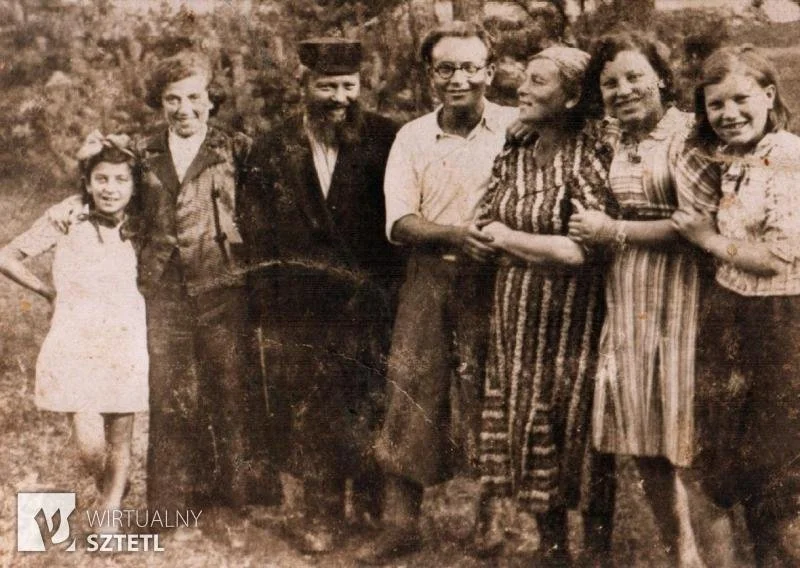
Tadeusz Tanchum Ajzensztadt's parents and siblings. Jakub and Ruchla, are in the photo, along with his siblings. They ran a bicycle repair shop in Opole Lubelskie. Tanchum had five siblings: Sara, Sznajdl, Ita, Zalman, and Mosze.
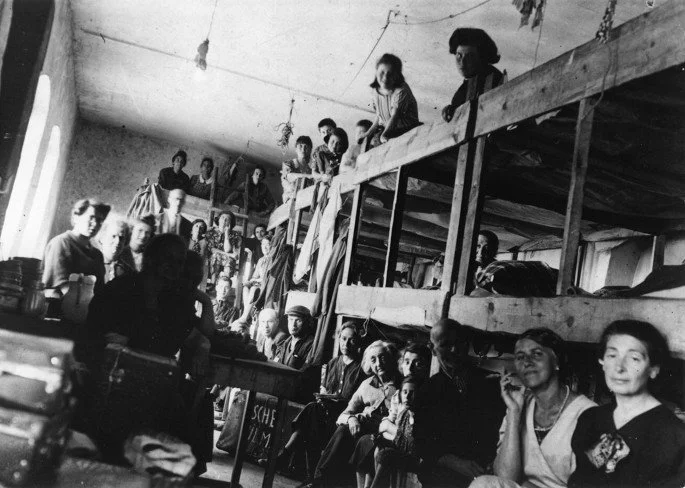
Living quarters for Austrian Jews in the ghetto in Opole Lubelski, in 1941. Source: Centropa.
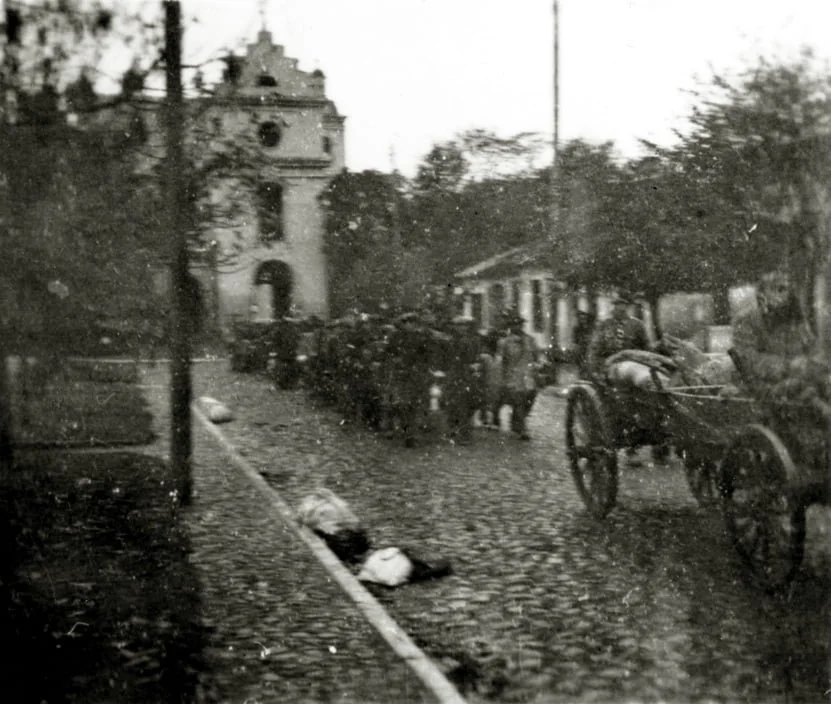
Autumn 1941, Opole Lubelskie: A very rare photograph, taken in secret... Jews from the ghetto are marching to the camp in Poniatowa (8 km).