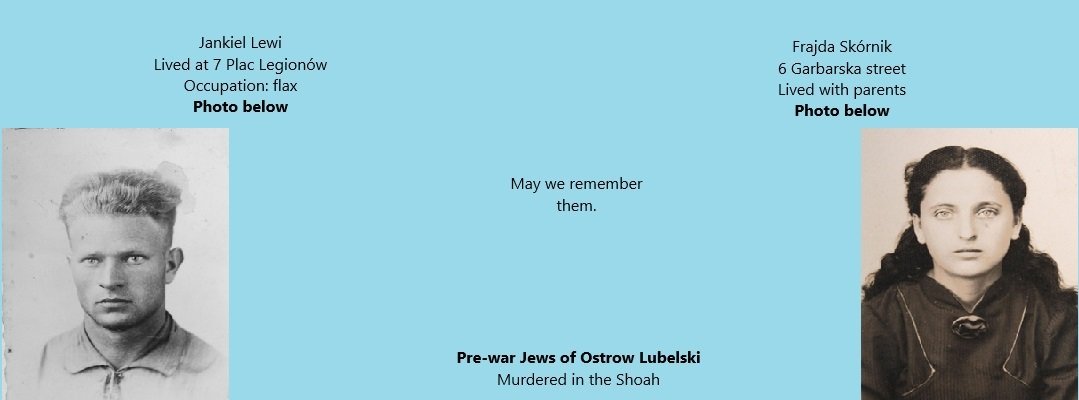
Remember Jewish Ostrow Lubelski
Pronunciation: Ost-rov Loob-ell-skee
HISTORY OF THE JEWISH COMMUNITY
Ostrów Lubelski lies 41 kilometers (25.5 miles) northeast of Lublin. The Jewish community in Ostrow Lubelski existed since the early 1600s. In fact, the oldest surviving mention of three Jewish householders residing in Ostrów dates back to 1565. Beginning in the 16th century, a synagogue was operational in Ostrow Lubelski. In 1876, a new synagogue was built after the previous one was destroyed. This synagogue operated until the Holocaust, when it was destroyed. In the early 1600s, a Jewish cemetery was established along the road leading to the village of Bójki (currently Batalionów Chłopskich Street at the intersection with Unicka Street).
According to data from 1676, 60 adherents of the Jewish faith resided in Ostrów. By 1764, there were 34 Jewish households. According to data from 1856, there were 851 Jews constituting 33% of the town's population. And by the end of the century, in 1897, this number had risen to 3,221 (which was 53% of the total). The Jewish population resided primarily in the town center, specifically in the Market Square, as well as along the following streets: 3 Maja, Ministra Pierackiego, Floriańska, Żabia, Garbarska, Szlachtuzowa, Przejazd, and Lubartowska, and also at Plac Wolności.
The Jewish Community in Ostrów Lubelski’s list of employees in 1930 included Rabbi D. Nelkenbaum, S.M. Kohn (ritual slaughterer), B. Zunszajn (ritual slaughterer), Sz. Zunszajn (ritual slaughterer), and H. Oliwka (grave-digger). In the interwar period, there was a ritual bath (mikveh) in Ostrów Lubelski. In 1922, private houses of prayer also operated within the town, owned by Moszek Lederman, Motel Grinberg, and Srul Kron. Jews were active in commerce, particularly in the trade of horses, cattle, and hides as well as in crafts. Numerous Jewish tailoring and shoemaking workshops, along with many Jewish bakeries, operated in the town.
NEARBY JEWISH COMMUNITIES
The Ostrów Jewish community encompassed over a dozen surrounding localities, including the villages of Bobryk (11 Jews in 1921), Drozdówka (11 Jews in 1921), Głębokie (16 Jews in 1921), Krasne (50 Jews in 1921), Masluchy (4 Jews in 1921), Nowy Orzechow (14 Jews in 1921), Nowy Uścimów (9 Jews in 1921) and Orzechow-Kolonia (13 Jews in 1921). Jews may have also lived in Bolechowice, Wola Wereszczynska and Zamoście but the number is not known.
In 1920, the kahal (community council) in Ostrów comprised a total of approximately 4,500 adherents of the Jewish faith. Several other Jewish communities near Ostrow Lubelski were prominent, including the following:
- Bobryk: In Bobryk, there were six Jewish families, with 35 members in total. In early May, 1942, the entire Jewish community of Bobryk was murdered by four German policemen, who were assisted by a local tailor.
- Kaznow: The pre-war Jewish population of the village of Kaznow was 10 Jews.
- Krasne: On May 19, 1942, 35 Jews still remained in Krasne. In May 1942, there were 145 Jews in the entire Uscimow district. There are three known Holocaust survivors of this group: Cypora Fridman Koren, Mala Frydman Zanger and Eliezer Grinblat. None of the Jews of Krasne survived the war.
- Marianka: The pre-war Jewish population of Marianka was 50 Jews.
- Nowy Orzechow: In Nowy Orzechow, 25 Jews lived in the village before the war, including: Mordechai and Gitla Frydman (mill owner), Chil Kodeńczuk, Hersz Kodeńczuk, Herszel Pachciarowicz, Menasze Szczupak, (fisherman), Ideł Tenenbaum and Shlomo the tailor (last name unknown). Shortly after the outbreak of war, the German authorities deported a group of Roma and Sinti — including men, women, and children — from the Suwałki area to the tiny village of Stary Orzechów. The deportees had nowhere to stay, and no means of supporting themselves. Sometime later, the German gendarmes brutally murdered all of them. Between April and June 1942, some Jews from the gmina moved to the town of Ostrów Lubelski, about 7 km. northwest. The Jewish Council in Ostrów recorded the new arrivals: Symcha and Lejb Ajzenberg from Bobryk; Chaim and Gitla Noizenbaum and four members of the Kachner family, all from Drozdówka; Estera and Chaja Kodeńczuk from Nowy Orzechów; and Szlomo Josef and Gela Eta Mas from Orzechów. On May 19, 1942, 34 Jews still remained in Nowy Orzechów. Sometime in summer of fall of 1942, Jews in the villages of the Uścimów gmina were deported to Ostrów Lubelski, about 13 km. east, and murdered there. The day after the liquidation of the Ostrów Ghetto, the Germans gathered the Jews from the surrounding villages in Ostrów, led them to the cemetery, and shot them all there. In May 1942, there were 145 Jews in the entire Uscimow district. There are three known Holocaust survivors of this group: Cypora Fridman Koren, Mala Frydman Zanger and Eliezer Grinblat.
- Sosnowica: The Jewish community operated a house of prayer, a cemetery, and a mikveh. Sosnowica had a pre-war Jewish population of around 300. (Note: This location is different than Sosnowiec.) During the Holocaust, a large German unit of about 120 men was stationed in Sosnowica, while another unit of eight stayed at the manor house in the village of Jedlanka. Sosnowica was not considered a part of the Uścimów district.
- Stary Orzechów: During the war, the family of Leon Eliezer Grinblat Grimblovski – his parents and siblings – were the only Jews living in Orzechów.
- Tarlo: Located south of Niedzwiada, there were 40 Jews in the village of Tarlo before the war.
- Tyśmienica: In 1921, 81 Jews lived in Tysmienica district, including 6 Jews in Babianka-Kolonia, 5 Jews in Kolechowice-Kolonia, 37 Jews in Kolechowice-Folwark and 33 Jews in the village of Tyśmienica. In August 1942, in preparation for the mass deportations of Jews by the Nazis from rural communities, an additional and more detailed list of the Jewish populations in all the villages in Tysmienica district was compiled for regional governor Emil Ziegenmeyer. It indicated that the overall number of Jews in the gmina had declined to a mere 16: six in Tyśmienica and ten in Kolechowice. No other villages from this gmina appeared on the list. On October 9, 1942, an order from the Nazi authorities required Jews from Tyśmienica district to relocate to the Lubartow Ghetto under the punishment of death if ignored. Michael Szija Szumak (cattle merchant), his wife Chava Szumak (née Nisinbaum), their baby Esther and Michael's brother and sister-in-law refused to move. They were all murdered shortly before the war ended. This action was coordinated with the mass deportation from Lubartów to Treblinka, which took place on October 11, only two days after the Jews in the villages had received their deportation order. Some of the Jews who had gathered in Lubartów were then transported to the death camp, while others were sent on to Piaski Ghetto on October 20, 1942 and from there to Sobibór gas chambers. Aleksandr Shumak, son of Michael Szija and Chava, is the only known Holocaust survivor from the Tyśmienica gmina.
- Uścimów: In 1921, 9 Jews lived in Uścimów. As of April 15, 1942, there were 185 Jews in Uścimów. Clearly, some Jews had been deported there from nearby localities. A month and 1/2 later, in May of 1942, there were 145 Jews in the entire Uscimow district, meaning that many of the Jews in the village of Uscimow likely had been killed or deported during that short period. There are three known Holocaust survivors from the entire district: Cypora Fridman Koren, Mala Frydman Zanger and Eliezer Grinblat.
OSTROW LUBELSKI DURING THE HOLOCAUST
The Jewish population of Ostrow Lubelski in 1939 was 1,994.
The Judenrat was established in October of 1939 and about 850 Jews from Lubartow was dispatched to Ostrow Lubelski in November of 1939. There was a Kriminalkommissariat post of the Security Police and the SD in the town of Lubartów, 20 kilometers west. Meanwhile, a large German unit of about 120 men was stationed in Sosnowica, while another unit of eight stayed at the manor house in the village of Jedlanka. Other transports to the Ostrow Lubelski ghetto included 851 Jews from the Poznan region in mid-December 1940, 200 Jews from Lublin in March of 1941 and 500 Jews from Slovakia in April of 1942. According to data from August of 1941, a total of 3,249 Jews were living in Ostrów. Some of them found shelter in the synagogue and houses of prayer, while around 400 of them were soon after deported to labor camps in the vicinity.
Isidor “Józef” Flanter (or Flatner) was Judenrat chair. By 1941, a 13-member Jewish police force also had been established, led by Mendel Zyman. The Ostrów branch of the Jewish Social Self-Help (JSS) was led by Poznan deportee Emil Hecht.
On April 13-15, 1942, as part of Operation Reinhard, 307 Slovak Jews, mainly women and small children, were deported (via Lubartow) to Ostrów Lubelski ghetto. There was an additional transport of 300 Jews from Slovakia between May 27-29, 1942, also via Lubartow. In May of 1942, the population in the ghetto was 3,062 Jews. In the summer of 1942, the Germans carried out an execution in which 50 people were murdered. By September, German officials noted 3,250 Jews resided in Ostrów.
On October 7 or 10, 1942, a group of S.S., S.S. Ukrainian auxiliaries, and German Gendarmes ordered the Jews assembled at the market square. A ghetto-clearing force went house to house, searching for those hiding. The postwar Institute of National Remembrance (IPN) Court Inquiries about Executions, Mass Graves, Camps, and Ghettos (ASG) documentation indicates that 50 Jews were killed for refusing to heed the assembly order. About 30 deemed too frail to march to Lubartów were brought to the synagogue to await transfer by peasant cart. Some Jews were also shot dead at the synagogue.
On October 7, 1942, the liquidation of the ghetto took place. The sick and infirm, as well as Jews attempting to hide in their homes, were murdered on the spot by the Nazis. All others — approximately 3,200 Jews — were driven on foot to the railway station in Lubartów. From there, they were deported, together with Jews from Lubartów, Kamionka, and Tarłów (and likely also from nearby Firlej), to the extermination camps at both Treblinka and Sobibór.
Among the Nazis involved in the murders of the Jewish community were unknown Arn, Hans Lemke (aka Hans Cygan), Heinrich Kassner (also known as Jan Kaszubowski), unknown Manthel and Fritz Schmiege.
JEWISH PARTISANS
In November, 1942, there were around 18 separate hunts for Jews in the forests surrounding Parczew. In Białka village, 96 men were killed in December 1942 after the local Polish population was caught helping Jewish partisans.
WHAT REMAINS
The location of the destroyed synagogue is not known. Josef Cynowiec, Holocaust survivor, mentions in his testimony the antisemitism of prominent Ostrów Poles, including the local Roman Catholic priest, diminished chances for Jewish survival.
The Jewish cemetery is located at Batalionow Chlopskich Street, near Unicka Street. It was established in the early 1600s and destroyed in the Holocaust. No material traces remain.
Zachor - We Remember. Please review the site content below.
-----------------------------------------------------------------------------------
[Ostrow Lubelski Yizkor Book - Translation]
[Facebook — Ostrow Lubelski Jewish Genealogy]
-----------------------------------------------------------------------------------