Remember Jewish Ryki
HISTORY OF THE JEWISH COMMUNITY
Ryki is 64 km. (40 miles) northwest of Lublin, on the main railway line to Warsaw. Its pre-war 1939 population of 4,500 included 3,000 Jews.
Jews appeared in Ryki as early as the first quarter of the fifteenth century, and in 1553 Jews owned 20 houses there. Jewish houses were built on one side of the road, while Polish houses stood on the other. The town slowly grew and as Jews from other cities increased, it became more and more cramped. The nobility took advantage of this situation and began to build houses on the other side of the road as well, renting apartments to Jews at high prices. The Catholic clergy often incited the inhabitants against the Jews.
Seventeen Jewish families lived in Ryki in 1764. By 1787, there were 204 Jewish residents. Jews leased forests, orchards and ponds, traded fish, fruit and forest products. Both crafts (bakers, tailors, shoemakers) and trade were important elements of Jewish life in Ryki.
In 1834, Ryki had 1,268 inhabitants, including 476 Jews (37%). During this period, the settlement became a center of Hasidism. The first rabbi of the Jewish community in Ryki was Baruch Eidels. Other rabbis in the community included Rabbi Levi Ashkenazy, Eliyahu Chaim Zuckerkop, Rabbi Issachar (d. 1900), Natan Neta Romer, Josef Romer, Moshe Inkas (d. 1910) and Asher Elimelech Holstein (d. 1935). The last rabbi of Ryk was Judah Fajfer, who died during the Holocaust.
A mikveh was created in town. Social organizations such as Hachnasat Orchim (Lodging House) or Maten-Besejser (Gift of Mystery) were created, as was Linas ha-Tzedek (which provided free medical care, overnight nursing, and sustenance to the poor, ill, and travelers).
Social institutions were established in the settlement, including a fund of interest-free loans, the organization of help for the sick, a shelter for poor wanderers, and an interest-free cash register by the local wealthy. The local wealthy included the butcher Lejbusz Borensztejn as well as Szlojme Zechiel Firanka and Shlomo Lederhendler. In 1897, the city had 1,615 inhabitants, including 1,575 Jews (97%).
At that time, 4 wealthy Jewish merchants, 16 shopkeepers, 54 shoemakers and many stallholders lived in Ryki. On Thursdays, a local fair took place, which benefited the Jews who sold via trading and crafting. A leather and embroidery factory was created, and Jews were also involved in the fish trade. On what is today Piłsudskiego Street, the following Jewish stores existed: Gutwajder's shoe shop, Srula Firanka's cloth shop, Zylberberg's iron shop, Wajsfisz's household shop, and Rzeźnika's bicycle shop. Weinberg had a liquor store on Wjazdowa Street.
In 1908, Ryki had 2,214 inhabitants, including 2,077 Jews (93%). In the 1916 elections to the city council, representatives of the Jewish community won 6 out of 12 seats. The synagogue burned down in 1925 along with many of the Jewish homes. Ryki had become a significant center of Zionism. In 1904, the first Zionist organization was founded in the city. During the interwar period, branches of the Zionist-Orthodox Mizrachi and Poale Zion Left parties was established in Ryki, as well as a branch of the Bund.
The Beis Yaakov movement established a school for girls in Ryki, attended by approximately 80 students. The school was located in the home of Sora Tajchman. At the school, the girls studied Jewish traditions as well as moral and ethical principles. Classes were held daily during the morning hours. On Friday evenings, all the students would gather together with their teacher to welcome the Sabbath.
In 1921, Ryki had 3,530 inhabitants, including 2,419 Jews (68%). There were about 10 home weaving mills, as well as Jewish transport companies. From 1926, the Jewish Cooperative Bank also operated in Ryki. Under the administration of the community there was a synagogue, a bet midrash, a mikveh and a ritual slaughterhouse, as well as a cemetery. The Talmud-Torah and several charitable organizations operated at the community: Gemilus Chesed (which resumed its activities in 1922), Linas ha-Tzedek, the Bikur Holim Society for the Care of the Sick (transformed into the Free Shelter Society in 1936), as well as Hach’noses Kale – an organization collecting dowries for poor girls, whose members formed a theater circle.
There was also a strong Agudas Israel in Ryki, under whose auspices a religious school for girls Bet Yaakov and Chesod Torah for boys was run. Moszek Tancer and Wolf Weinberg were among the local melameds (teachers). Other occupations of town dwellers included:
Medical Services:
doctor: Pajebrune Jan Ludwik, Kesfenbaun Rafał, Kesselbaum and Ajabel
dentist: Königsberg Felicia
midwife for Jewish women: Ekhajzer, Chanele
surgeon: Sztajnberg M., Gutwajdor M.
veterinarian: Königsberg, Isaac
pharmacist: Haiarych W.
Food & Drink:
baker: Fiksman A., Lewin S., Sztanbuch R. Winograd M. Mikowski A., Powroźnik L.
beer: Binem W., Keselbrener Ch.
eatery: Lejbman Ch., Kuzyn J, Naj Ch.
flour: Judenszneider A.
groceries: Gdala, Kupermann, Powroźnik L., Rosfor Ch., Fotkelz, Judensznajder
grain: Fajfermacher L., Mochobodzki, Paterman M.
miscellaneous: Apfelbaum L.
sugar: Borensztajn Ch.
sparkling waters: Derfner Ch.
tea: Borensztajn Ch., Herszenberg A., Palknfeld J.
water mill: Borensztein L., Keselbrener J.
Trade:
barracks: Bukler J.
blacksmith: Motek
cobbler: Lichtensztein S.
cooper: Weinberg M., Rotsztajn A.
dyer: Sztetner J., Merfisz K., Goldman A.
gait maker: Lichtenstein S., Mleczkowicz J.
haberdashery: Asz Sz., Gutwajder D., Weinberg L., Roman G.
hat maker: Gruszkiewicz
iron: Ajger K.
locksmith: Goldsztajn
saddler: Lusman
shoemaker: Hercyk Parys, Gutwaks P., Albert M., Bukler L., Ogman M.
stones: Apfelkern Ch., Borensztein S.
steelworks: Kujawski J., Kujawski S.
tailor: Grynkorn M., Kupefisz J., Tejchman J.
textile shop: Ajger L., Firanka Srul, Rosenbaum M., Sztern W.
tinsmith: Rotsztajn A. Rubinsztajn Ch.
watchmaker: Openheim F., Gruszkiewicz
window glass: Gothelf Ch., Roquefort S.
Other Services:
cab driver: Bajnysz
hairdresser: Sztajnberg B.
oil mill: Borensztajn
trees: Apelkern J.
NEARBY JEWISH COMMUNITIES
Jewish communities that existed near Ryki included the following:
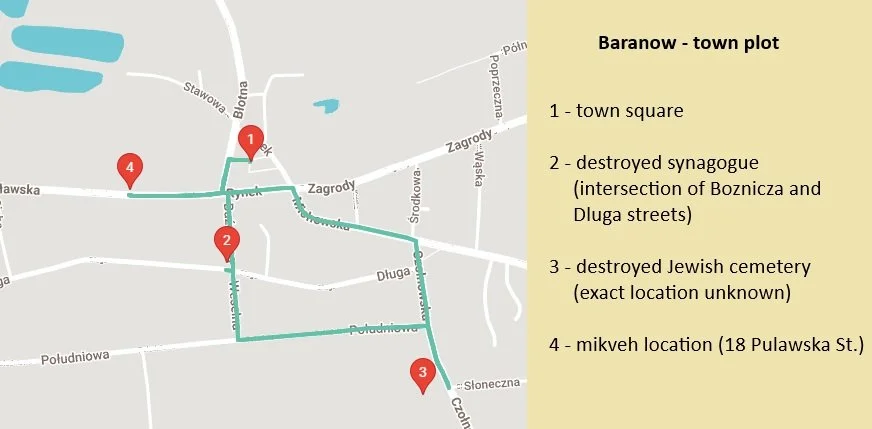
- Baranow: The first mentions of a Jewish presence in Baranów date back to 1621, although it is quite possible that Jews arrived much earlier. By 1626, the town was home to 30 Jewish artisans, including two tailors, four shoemakers, three butchers, four bakers, and four traders. In 1777, the town had 379 inhabitants, including 77 Jews. In 1790, 99 Jews were recorded in Baranów. They resided primarily near the market square and in the areas to its west and south (along Bóżniczna and Rybna Streets). In 1819, Jews accounted for 367 of Baranów’s 1,020 inhabitants (36%). By 1856, the Jewish population had reached 953 out of 1,799 (53%). According to a 1921 census, the town had a population of 1,907, including 1,028 Jews (54%). A wooden synagogue was built as early as the 17th century and is mentioned in records from 1861. Towards the end of the 19th century, the community erected a new synagogue. This building was also made of wood and stood south of the market square on Bóżnicza Street (location of the current health center). It is not known how the synagogue appeared. The Jewish cemetery was probably established in the first half of the 17th century, although the first documentary mention of it dates to 1724. The area of the Jewish cemetery is located about 300 meters southeast of the market square (access via Lubartowska and Czołnowska or Bożniczna, Długa and Czołnowska streets), on the border of buildings and farmland. The mikvah was situated east of the market square, roughly level with the former town hall. The Jewish community’s ritual slaughterhouse was situated near present-day Czołnowska Street (on its eastern side), between Długa and Południowa Streets. The Agudas Yisrael party—an international political organization uniting Orthodox Jews—was established at a conference in Katowice in 1912. The party’s branch in Baranów was founded in 1922, making it one of the first in the Puławy county. Aguda members regarded Hebrew as a holy language, whereas Yiddish was viewed as a secular, everyday language. In 1930, the Baranow Jewish community board consisted of M. Hochgelenter (chairman), members S. Rozenberg and J. Narensztejn, and secretary Szlama Brower. By 1939, there were 1,200 Jews in Baranow. In 1940, several hundred Jews from Puławy were resettled in Baranów. In the first half of May 1942, they were all deported to the Nazi extermination camp at Sobibór.
- Bobrowniki: In 1787, 297 Jews livedin the community representing around 35% of the population. By 1827, there were 310 Jews in town. In 1857, 519 Jews lived in the community. By the late 1700s, the Jewish community was residing in the southwestern part of the town. In 1789, there were 32 Jewish homes. The rabbis included Berek Grunfeld, Faivel Abramowicz and Josef Moskowicz. Izrael Taub, a proponent of Hasidism in Deblin, lived in the town in the mid-1800s. The population in 1897 was 282 Jews. By 1921, there were 164 Jews in the community. No documents or studies have survived that allow to reconstruct in detail the history of the Jewish community in Bobrowniki in the interwar period. It can be assumed that, as in other centers, they made a living from trade, crafts and services, as well as from the lease of orchards and gardens. It also seems that due to the small number of Jewish inhabitants of Bobrowniki, in the interwar period there was no separate community here, and the inhabitants of the settlement were subject to the kahal in nearby Dęblin-Irena. In the 1920s, 34 Jewish children attended the public school operating in the settlement. In 1939, more than 200 Jews lived in the community. Around May 5-6, 1942, elderly Jews of Bobrowniki were murdered in the Jewish cemetery and buried in mass graves. On May 6, 1942, 200 Jews from Bobrowniki — along with thousands of Jews from the Deblin ghetto — were transported to their deaths at the Sobibor Death Camp. The wooden synagogue in Bobrowniki was built in the second half of the 1700s. The synagogue was located between Masowska, Dęblińska and Zagłoby streets. The daily attendance ranged from 100 to 200 people. No trace of it remains after it was destroyed during the Holocaust. A .9 hectare cemetery was created by the Jewish community in the mid-1700s and located near Dęblińska Street. During the Shoah, the murdered bodies of 300 individuals who died during the march to the ghetto in Dęblin were laid in mass graves at the cemetery. Ignatz Bubis from Germany created a memorial at the cemetery in the mid-1980s in honor of his murdered mom, Chana Bubis. In 1999, Andrzej Trzciński from Lublin located 47 matzevot, however the vast majority were fractured or in pieces.
- Stężyca had a Jewish population of 125 in 1921. In the early 1500s, around a dozen Jews lived in Stezyca. Jews in the community were grain traders, shopkeepers, rag makers, peddlers, as well as tailors, shoemakers and other craftsmen. There was a local house of study and a ritual butcher. Jews in Stężyca were part of the kehilla in Garwolin. The organizations General Zionists and Agudat Israel were active in town. Before the outbreak of World War II, about 30 Jewish families lived in Stężyca. At the end of 1939, the Judenrat was established, and consisted of 3 members led by Epsztejn. Its main purpose was to provide Jewish workers for slave labor. There were several groups of workers formed: (1) Working in a German military hospital, which was established in the area; (2) working for the needs of the German army; (3) road repairment/fortification. Around 70 Jews from Stezyca engaged in this type of slave labor. From the beginning of 1940, Jews had to wear a white armband with the Star of David. Men fit for work were transferred to the labor camp in Dęblin in 1941. On May 7, 1942, SS men from Dęblin arrived in the city. The Jews were ordered to take a small luggage with them and gather at the assembly site. When this was made known, 15 Jews fled into the forest. Two of them were caught and shot by the Germans. The Jews remaining in Stężyca were resettled to Dęblin and from there, together with the local Jews, sent to the death camp in Sobibor.
A few weeks later, 40 Jews from the labor camp in Dęblin were brought to Stężyca. Some of them were former residents of Stężyca. Among them were there members of the Judenrat with their families, who were taken from the transport in Dęblin. The man responsible for them and who placed them in the new camp in Stężyca was a Pole from Poznań, Kowalski. The workers were employed in construction and in road repair. On October 27, 1942, Kowalski learned that the authorities were planning to liquidate a small labor camp in Stężyca. He warned the members of the Judenrat and thanks to him, about 20 Jews, together with a member of the Katowice and his family, managed to escape to the forests. Those who remained in Stężyca, about 40 Jews, were transferred to the labor camp in Dęblin. In April 1943, a new labor camp was established in Stężyca. The workers, about 200 in number, came from various camps in the Lublin province. They were accommodated in two houses in the city and worked on the construction of the road to Pawłowice. The camp existed for two months and was liquidated in June, 1943. The fate of these workers is unknown.
RYKI DURING THE HOLOCAUST
After the outbreak of World War II, September 10-12, 1939, Ryki was bombed by the German air force. The air raids caused panic among the Jewish and Polish inhabitants of the town. Several dozen Jews died in these raids.
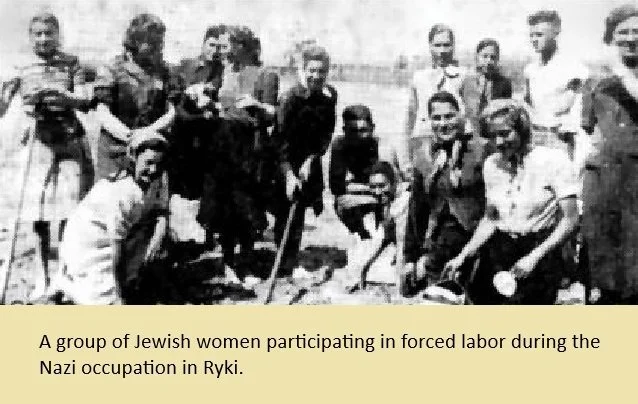
On September 17, 1939 Ryki was occupied by German troops. The period of German occupation caused the decline of Jewish trade and crafts in the settlement. For many, the only source of food became the communal canteen, which was used by about 150 people a day. The Jews were forced by the Germans to carry out cleaning work, including clearing rubble or clearing snow from the Warsaw-Lublin road. About 400 young Jews were sent to work in Dęblin in military warehouses.
In mid-October 1939, the Germans created the Judenrat. Its headquarters were located at Wjazdowa Street. Samuel Gudwajder became the chairman of the Jewish Council. The Germans also created a Jewish police force consisting of 10 officers. One of them was Jakub Mendelbaum. After the establishment of the Judenrat, the Germans conducted a census of the Jewish population. About 90 Jews were sent by the Germans to work on the regulation of the Vistula in Janiszów, and 45 Jews were forced to build fortifications in the vicinity of Bełżec.
After the outbreak of the German-Soviet war, 200 Jews were sent to work in ammunition depots in Stawy. Jews from Ryki were also dispatched to a forced labor camp at Zaryte, where they were engaged in quarry works. It is unclear how many worked at Zaryte or for what period.
A dozen or so young Jews worked for the Austrian company “Strasenbaum Schalinger und Company Wien”. This company was engaged in repairing the road from Ryki through Garwolin to Kołbiela. Its headquarters were located at today's Warszawska and Żytnia Streets.
In March of 1941, the Germans created a ghetto in Ryki. Its area included the market square and the streets leading to it (Kanalowa, Wjazdowa, Przechodnia, Wylot). The Germans gathered about 3,500 thousand Jews in the ghetto. Poor hygienic conditions quickly led to an outbreak of typhus. Many refugees from the areas incorporated into the Third Reich and the vicinity of Warsaw came to Ryki. They were accommodated in a synagogue. They were the first victims of the typhus epidemic. To prevent the spread of the epidemic, a temporary hospital was set up on the upper floor of the bet midrash, where beds were placed for the infected. Jews from Puławy, Żelechów and Slovakia were also in the ghetto.
At the beginning of 1941, the Independent Jewish Aid from Krakow sent money to the Ryki Judenrat. With these funds, the municipal kitchen and the sick room were opened. The sick room was located in the communal reading room, it was run by Dr. Kestenbaum. Despite the difficult situation, many actions were carried out to help those who fell into poverty. The Judenrat set up a commission to collect clothes for the needy, as well as food for large families, and above all to take care of the refugees who came to Ryki.
On the morning of May 7, 1942 the Nazis gathered all the Jews in the Market Square. As soon as they were gathered, the order was given to hand over all valuables: watches, rings, gold and silver. The Germans warned that if they found valuables on someone in half an hour, they would be shot. Then the elderly and the sick were shot on the spot. Around 11 a.m., the S.S. commander gave the order for the remaining Jews to line up in threes and prepare to leave the city. At the moment when the march began, the Germans began shooting at the marchers. The marchers were followed by carts carrying the elderly, women and children who could not keep up with the march, and empty carts for corpses.
There was a forced “death march” from Ryki to Deblin. During the march, about 150 people were killed. In Dęblin, about 200 Jews were selected to work at the local airport while another 3,000 women and children were sent to the Sobibor Death Camp. Additionally, a group of about 80 Jewish men were sent to the camp at Majdanek.
Some sources say that the final liquidation of the ghetto in Ryki took place in October 1942. Some of the Jews still in the ghetto at that time were sent to labor camps, while the rest were transported to the Treblinka death camp.
WHAT REMAINS
Several dozen Jews from Ryki survived the occupation, including some in the USSR. Some tried to return, but there were murdered, including natives Szaul Mliczkiewicz and Hersz Nachtajler, as well as two girls from Dęblin, who came to visit: Pola Ewensztajn and Rozenkiewicz.
Simcha Brozdowicz and a Jewish officer of the Polish People's Army – Wiślicki – were also murdered. The others, fearing the loss of their own lives, left Ryki.
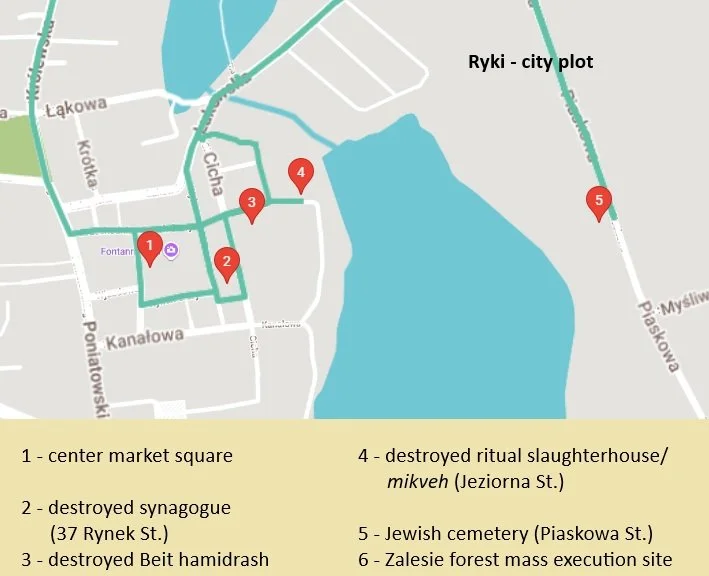
On the western side of Buksa Pond stood a mikvah and a ritual slaughterhouse. No material trace of these structures remain. After 1865, a bet midrash was established in Ryki. It was located next to the synagogue. Its owner was the Jewish Religious Community. The daily attendance in 1922 in this house of prayer was estimated at 350 people.
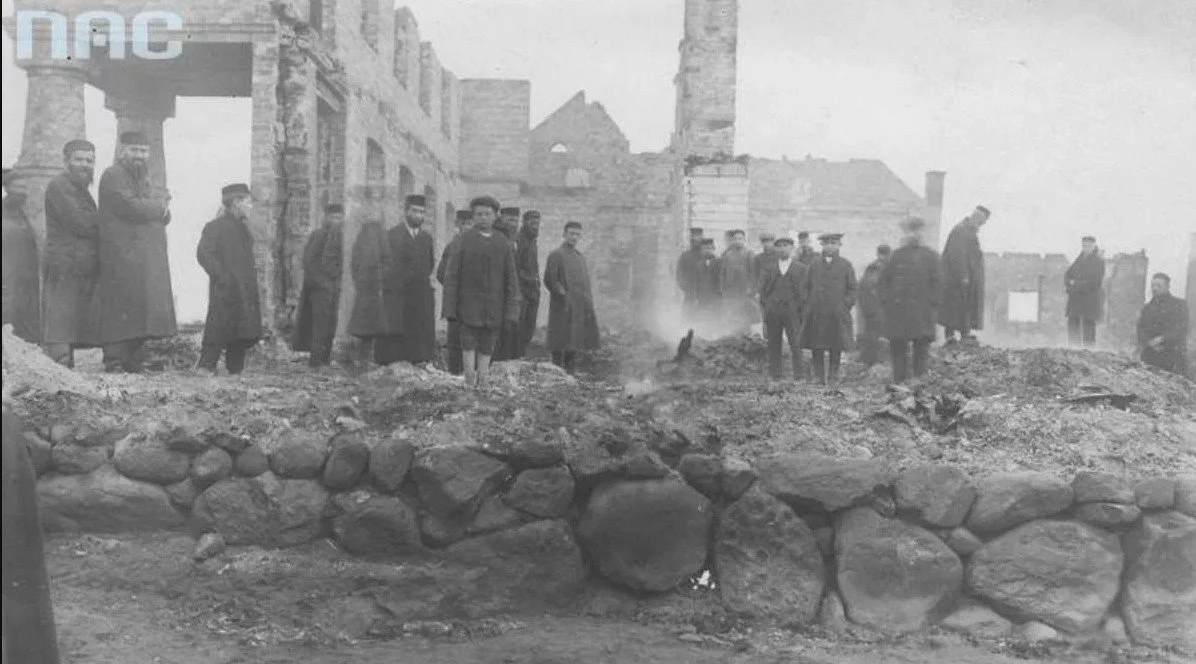
The first mention in documents of the wooden synagogue in Ryki dates back to 1819, when the building burned down. The synagogue was located in the south-eastern corner of the Market Square. In 1925, the synagogue burned down for the second time. Soon, however, the Jews erected a new synagogue. During World War II, the synagogue was devastated by the Germans. It was located at 37 Rynek Stary Street.
The Jewish cemetery in Ryki is located at today's Piaskowa Street, on a hill on the eastern side of the Buksa pond, at a distance of about 1 km from the Market Square. A few grave markers still remain but the area is unmarked.
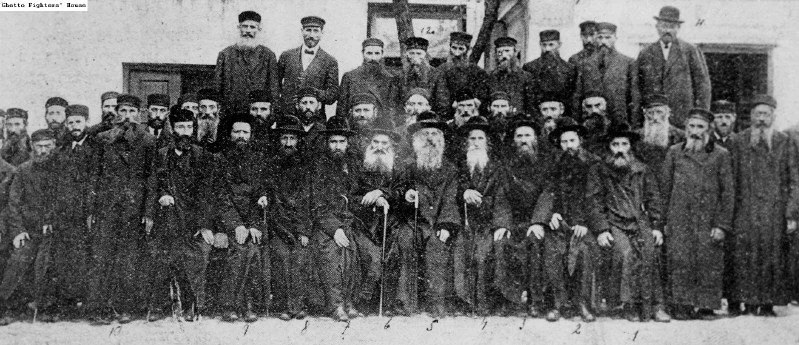
A group of rabbis in Garwolin for a conference, 1918. It includes a rabbi from Ryki.
A group gathers near the reconstruction site of the synagogue, 1925.
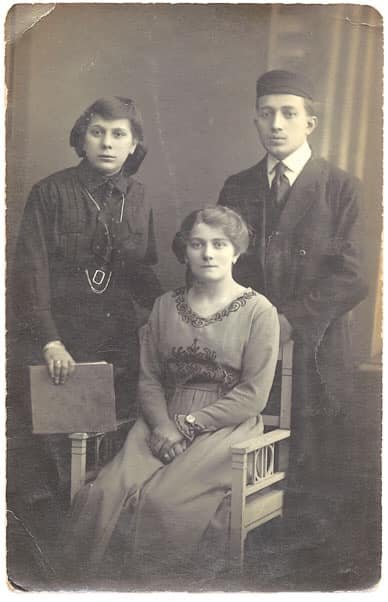
Above: Unidentified Jews from Baranow.