Remember Jewish Urzedow
Pronunciation: Ooh-djen-dov
HISTORY OF JEWISH URZEDOW
In 1566, King Zygmunt August II banned the settlement of Jews in Urzedow. It was upheld until at least 1860, however despite the ban some Jews settled in the town -- as noted by early complaints from Catholic residents. In 1781, 11 Jews lived in Urzedow.
In 1860, a Jewish family of 12, the Morganbessers, lived in the village. In 1889, 242 Jews lived in town. By 1900, 303 Jews lived in town out of 3,620 people. In 1921, only 284 Jews lived in town.
In the interwar period, the Jewish community managed a synagogue, beit midrash, mikveh, ritual slaughterhouse and cemetery. A Talmud-Torah school and private cheder were also active in Urzedow. Jews were involved in shoemaking, pottery, tailoring, weaving and ropemaking. In the second half of the 1930s, attacks on Jewish merchants and traveling traders took place in the settlement of Urzedow and nearby. Throughout the 1930s, Abram Wojnsztok was the rabbi.
In 1939, just before the outbreak of World War II, about 40 Jewish families lived in Urzedow -- e.g., 509 Jews.
NEARBY JEWISH COMMUNITIES
Jews also lived in nearby communities of Chodel (750-950 Jews), Dzierzkowice (146 Jews), and Łopiennik (population of Jewish residents unknown). Additionally, 143 Jews lived in the rural villages of Bęczyn, Boby, Ewunin, Moniaki, Ostrów (pre-war Janów Lubelski powiat), Popkowice and Zadworze in 1939.
Chodel developed as a local trade and agricultural center in the 1500s. It is unclear when Jews began to settle in the community. In 1787, there were 31 Jews in the community. The number increased to 123 Jews in 1857, which represented around 20% of the whole population. In the 1860s, Jewish entrepreneurs in Chodel operated a slaughterhouse, a manor inn, a convenience store and an elementary school in the community. The Jewish community had its own house of prayer since at least the 1850s and probably long before that. Later in the 1800s, Jews operated a pharmacy, tavern, brickyard, two tanneries, grocery store alcohol warehouse, haberdashery and colonial store. By 1921, 646 Jews lived in Chodel, representing almost half of the total population. During the interwar period, Jews in town operated several butchers and slaughterhouses as well as a carriage company.
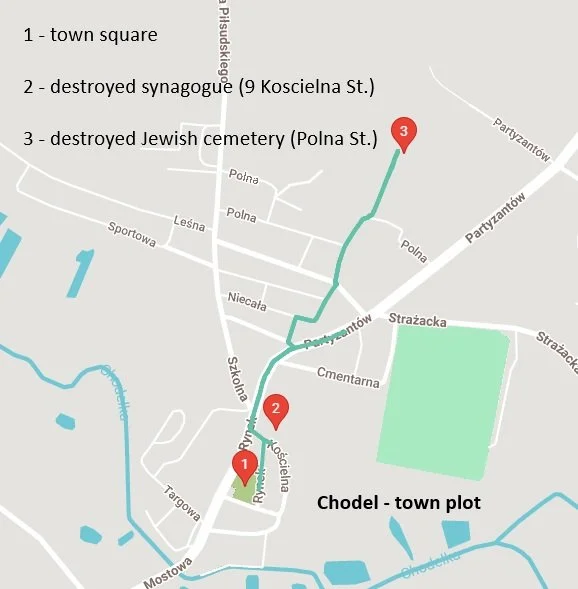
The Jewish cemetery in Chodel is located about 500 meters northeast of the Market Square, on the road to Adelina (on Polna Street). It was created before 1872. it had dimensions of 50 x 50 cubits, i.e. about 0.9 ha. In the interwar period, it had an area of 1 hectare and was surrounded by a limestone wall. No tombstones have survived. The cemetery area is currently used as a landfill.
Beginning in the late 1860s, the Jewish community operated a synagogue in Chodel, which was located at the current 9 Kościelna Street (formerly called Bożniczna Street). In September 1892, the synagogue burned down almost completely but was rebuilt at the initiative of Abraham Cukierman. The synagogue building, on a rectangular plan, housed a hall, a teacher's apartment and the main prayer hall with a bimah located in the middle. The external staircase located on the west side led to the women's house located on the first floor. The building was erected of stone bonded with lime mortar, but some structural elements, including the vault of the staircase, were made of brick. The plastered façades were divided by pilasters; the gable roof was covered with shingles. The synagogue was destroyed in 1914. It was rebuilt after World War I at the same location. A new house of prayer was established in 1915 after the earlier one had burned down in 1914. In 1922, the daily attendance at the house of prayer was 600 people. The synagogue and prayer houses were destroyed and no remnants of them remain.
The mikveh building in Chodel was probably erected in the 1860s. in 1892 it was destroyed as a result of a fire. The new mikveh, founded by the Cukierman family, was located at the outlet of Bożnicza Street, by the Chodelka River. The bathhouse consisted of a brick part, housing a mikveh and a small, wooden hall, in which there was a bathroom room and a changing room. The building was destroyed and no remnants of it remain.
German forces occupied Chodel on September 16, 1939. In January 1940, a Jewish Council (Judenrat) was formed, and the town soon housed displaced Jews from Pulawy, Krakow, and Lublin. German forces occupied Chodel on September 16, 1939. In January 1940, a Jewish Council (Judenrat) was formed, and the town soon housed displaced Jews from Pulawy, Krakow, and Lublin. During the year 1942, some Jews from Chodel were dispatched — probably on foot — to the nearby Opole Lubelskie ghetto. On either Yom Kippur or Hoshana Raba (September 21 or October 2, 1942), the Jews were expelled from Chodel. Like almost all the Jews in the southern part of Kreis Lublin-Land, the deportees probably first were consolidated in the Bełżyce Ghetto (different than Belzec). From there, they were transported to the railway station in Niedrzwica Duża and forced onto trains destined for either the Sobibór or Bełżec extermination centers. The Jewish population of Chodel ceased to exist.
URZEDOW DURING THE HOLOCAUST
On September 23, 1939, as a result of the German occupier's policy, Jewish children were removed from the public schools. From January 5, 1940, a ghetto was created in Urzedow and Jews were forced to wear a band with the star of David on their left arm. The Germans established a Judenrat in the city, with Moszek Rychtenberg at its head. Additionally, a Jewish police force that consisted of 10 individuals, ages 20-30, was headed by a Jew from Krasnik. His deputy was Manasze Szejnbrum, who was extremely cruel to the Jewish population.
In early 1940, expellees from Łódź and voluntary refugees from Warsaw also gathered in the Urzedow Ghetto. In May 1941, Jews from Wawolnica were deported to the Urzedow ghetto. At the end of that year, 70 Jews from Vienna were forcibly relocated to Urzedow. The ghetto population was as follows:
In March 1941 -- 401 Jews
October 1941 -- 549 Jews
June 1942 -- 541 Jews
The liquidation of the ghetto took place in October 1942. All those who were able to work were transported to the Budzyn camp, and the others were taken to the Krasnik ghetto, from where in November 1942 they were sent to the Belzec Death Camp. At this point, the Jewish community ceased to exist. Among the Nazis responsible for the murder of Jews in Urzedow were Hans Lenk and Maks Kaminer.
JEWISH RESISTANCE AND LEGACY
Some Jewish partisan activity took place in the Urzedow area: 15 young Jews were hiding in the forest between the suburbs of Beczyn and the village of Chruslanki. They managed to survive half a year in hiding, after which they were killed by the Germans. Other Jews were in hiding, among others in the Dzierzkowski forest, from where they came to Urzedow to buy food from the peasants. Non-Jews who helped Jews included Julian Dzikowski, Jan Smolinski and Mazurek.
WHAT REMAINS
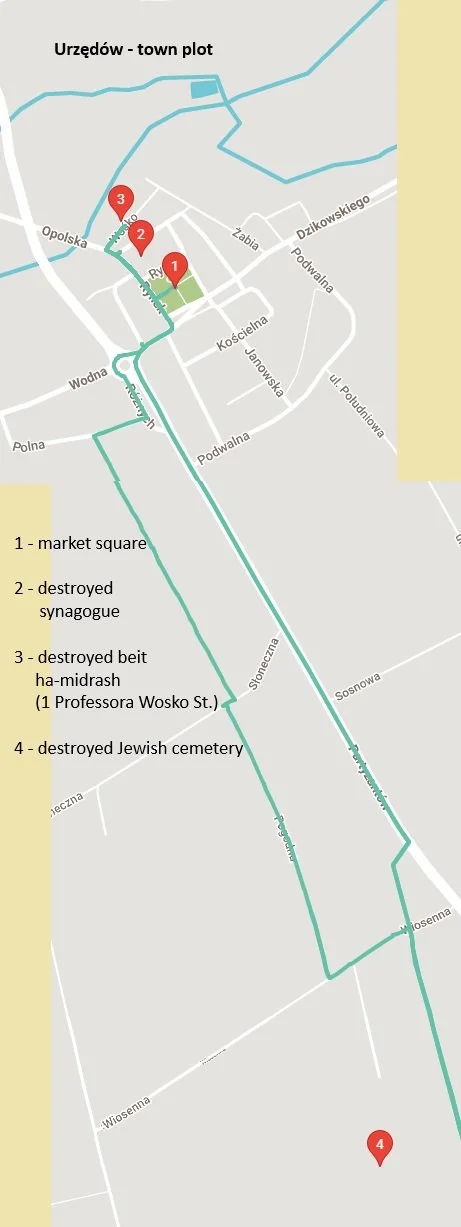
During the war, the Nazis devastated and destroyed the synagogue. The synagogue was located north of the market square, however the exact location is not known. The building of the municipal beit ha-midrash (House of Learning), located on today's Profesora Wośko Street, survived the occupation and was used as a kindergarten. It currently houses the headquarters of the Polish Angling Association.
The Jewish cemetery was destroyed during the Holocaust and no grave markers remain. It is located on the north side of a dirt road that is an extension of Ogrodowa Street to the west. In 1993, a monument in the form of a stele with a semicircular top was unveiled at the cemetery, with an inscription that reads: “To the Jews of Official Affairs murdered by the Nazis in the years 1939-1944. This place was a cemetery in the years 1908-1944”.
Of the 509 Jews who lived in town before the war, seven survived the Holocaust.
Zachor - We Remember. Please review the site content below.
------------------------------------------------------------------------
[History of the Jews of Urzedow - in Polish] [Project MUSE: Urzedow]
[Alphabetical List of Jewish Population of Modliborzyce in 1942]
------------------------------------------------------------------------

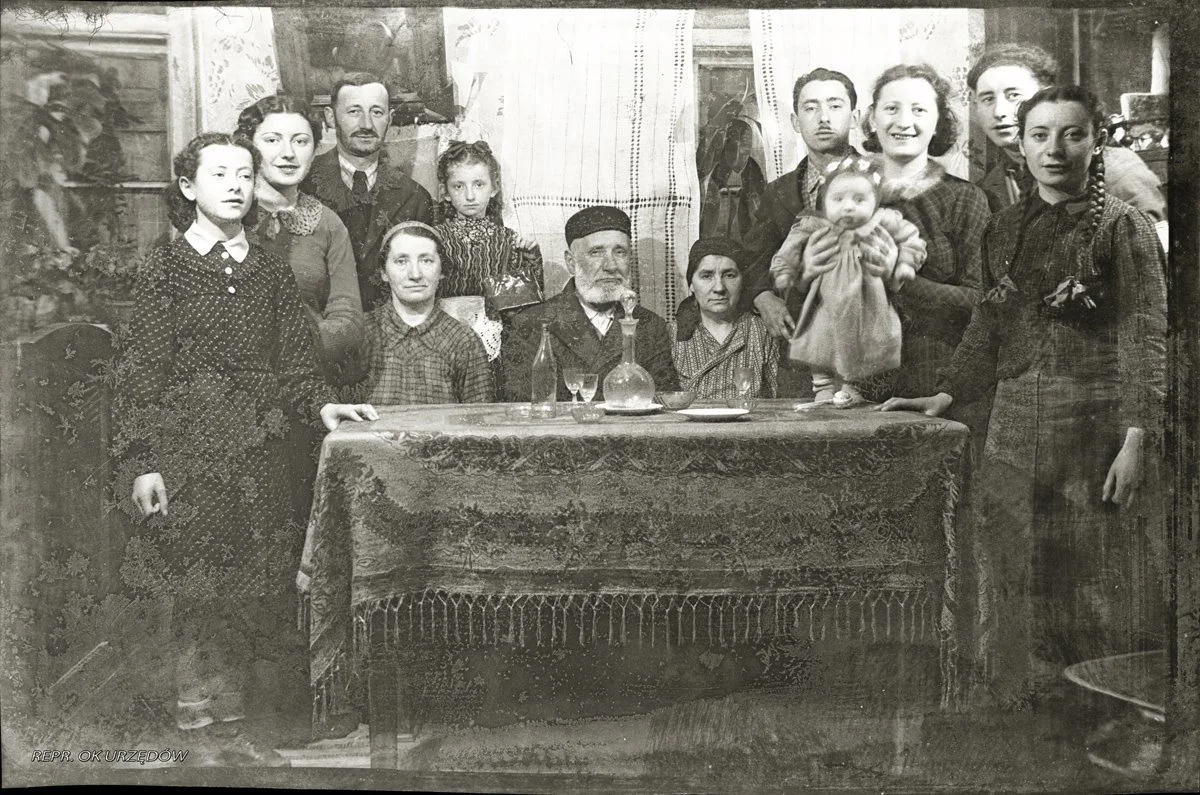
Family Szajnbrum, from Urzedow. The family was massacred in the Holocaust.

LINKS
Join the Urzedow group on Facebook!
Town of Urzedow:
- Alphabetical list of the Jewish population of Modliborzyce
(not available online)
Holocaust Survivors of Urzedow:
Helen Edelsztajn Erlich
Usher Farber
Gary Flumenbaum
Al Lewin
Rozia Perelman
Moses Rosenberg
Niusia Weingarten
Genealogy:
Jewish Vital Records in the Polish State Archives
Remember Your Family:
Central Judaica Database - Museum of History of Polish Jews
Grandchildren of Holocaust Survivors on Facebook
Guide to the YIVO Archives
Holocaust News/Events from Generations of the Shoah Int'l
Holocaust Survivors and Victims Database
JewishGen Family Finder
JewishGen Holocaust Database
JRI-Poland: Search for Your Family
Museum of History of Polish Jews Introduction
Yad Vashem: Search for Your Family
Yad Vashem: Submit Names of Your Family Members
Yad Vashem Requests Photos of Shoah Survivors and Families
CONTACTS
U.S.: LublinJewish@gmail.com