Sobibor Sub-Camps: The Lublin Waterworks Labor Camps
In accordance with the German plans at the very beginning of the Nazi occupation, the Lublin district was intended to become 'the pillar of the General Gouvernement's agricultural policy. In order to modernise the agriculture in this region, the German authorities wanted to regulate the small rivers and to improve the meadows. Therefore the Wasserwirtschaftsinspektion (Inspection for the Water Economy) in the Lublin district installed a network of small work camps during 1940. Jewish and Polish prisoners worked there. Chelm County became one of several centres for these camps. The Sobibor death camp was built in this district in early 1942.
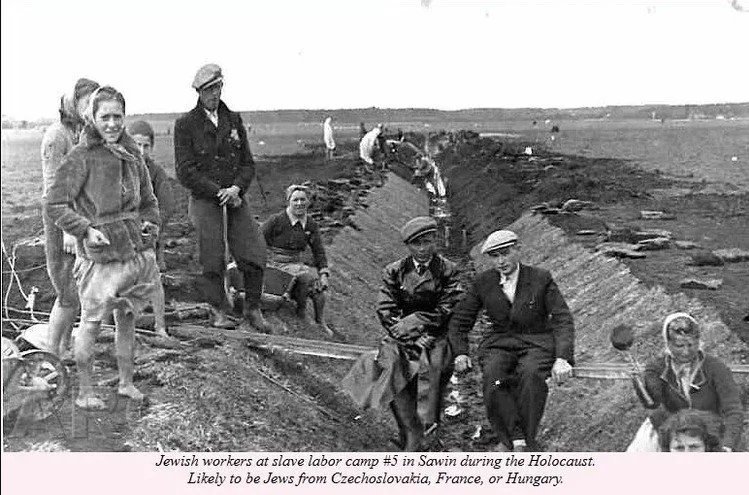
These forced labour camps were set up in the swampy surroundings of Sobibor. They were located at Adampol, Czerniejow, Dorohusk, Dorohucza, Hansk, Ilowa, Kamien, Krychow, Luta, Nowosiolki (Staw), Osowa, Ruda Opalin, Sajczyce, Sawin, Siedliszcze, Sobibor village, Tomaszowka, Trawniki, Ujazdow, Wlodawa, and Zmudz. Below is some information about these slave labor centers:
ADAMPOL: About 8 km. from Wlodawa was Adampol. Jewish slave labor at Adampol was used at an estate farm to manage livestock and harvest grains. According to Holocaust survivor Efraim Tilip in the Wlodawa Yizkor Book, the conditions of Adampol were as such: "It was very crowded and extremely dirty. Swarms of lice crept over everyone. We dug pits and chopped down trees. In this camp many were starving and looked like skeletons. But, as German strangers did not come here, the place seemed to us like paradise.”
The camp was liquidated on August 13, 1943, during which 475 Jewish prisoners were executed on the spot. In the spring of 1944, a special unit supervised by Sicherheitsdienst officers arrived to Adampol to conceal German crimes. Survivors of the camp such as Jack Pomeranc, Pesach Soroka, and Hannah Lewis have provided some insights into the crimes that took place there. In 2016, archaeologist Dr. Caroline Sturdy Colls uncovered evidence of mass graves in Adampol.
Several S.S. men there included Richard Nitschke, Willy Seliger and Bernhard Falkenberg. The latter is recognized as a Righteous of Nations at Yad Vashem for his support of the Jewish prisoners. Some prisoners also have positive memories regarding Willy Seliger, but evidence points to his involvement in many crimes against the local Jewish population as well. Nitschke is remembered as a brutal sadist. See also: Testimony regarding Adampol murders. See additionally: “Rescuing Jews from the Adampol Labor Camp” by Harold Werner, 1992. There is a memorial plaque at the site of the Adampol camp.
CZERNIEJOW: Czerniejów was located south and east of Chelm, in an extremely rural area. According to the Wlodawa Yizkor book, “In May 1940, the Judenrat sent out its first 150 demands [for 150 recruits]. It was exactly on the eve of the holiday of Shavuot. These 150 young men had to go to work in the Czerniejow camp, near Chelm, to do irrigation work.” Not much information is available about the forced labor at this location and few, if any, of the victims survived the duration of the war. No trace of the camp has remained.
DOROHUSK: See Dorohucza link, below. Dorohusk was a separate camp from Dorohucza but we provide details about it at the Dorohucza link.
DOROHUCZA: See Dorohucza Concentration Camp.
HANSK: Some Jewish slave laborers from Hansk were transported to Krychow, per Jules Schelvis’ testimony. The Hansk town administrators were collaborating with the German authorities, and oversaw slave labor at Krychow, including for Gypsies (Roma and Sinti), not only Jews. See: Krychow Concentration Camp.
IŁOWA: Not much information is available about the forced labor at this location and none of the victims survived the duration of the war. No trace of the camp has remained.
KAMIEN: The Kamien labor camp was the smallest of the Sobibor sub-camps, with around 150 prisoners. Kamien was located south and east of the city of Chelm, near several rivers. Prisoners were involved in irrigation works, cultivation works, and agricultural initiatives. Not much information is available about the forced labor at this location and few, if any, of the victims survived the duration of the war. No trace of the camp has remained.
KRYCHOW: See Krychow Concentration Camp.
LUTA: Luta had a pre-war Jewish population of 20 Jews. The water-drainage camp in Luta existed between July 1940 and late 1943 and encompassed an area ranging from 3,600 square meters up to 1.5 hectares. The camp was also equipped with a barbed-wire fence. A local Waterworks authority forced slave laborers to work on drying the marshes along the Krzywianki River. Prisoners at Luta came from Germany, Austria, Netherlands and Poland. In October 1941, 150 Jews were executed at Luta; the remainder were re-located to Krychow at that time. A memorial was erected for these 150 victims in 2013; see Lasting Memory Foundation.
Subsequently, in March of 1942, Luta again functioned as a transit camp to Sobibor. Four wooden guard towers were added, and the camp grew in size after Jewish slave laborers were used to expand it. Local witnesses recalled an average of 1,000 deportees at a time. In October 1943, the S.S. camp commandant ordered the transport of 200 slave laborers to Sobibor and another 150 inmates to the Osowa camp. At this time, 600 Luta different camp inmates were executed in the nearby Kutuszej forest. Luta was likely the last of the Sobibor sub-camps to be liquidated. The commander of Luta was also in charge of the water-drainage camp in the village of Osowa, a 6 km. walk from Luta. One source indicates that some of the remaining Luta prisoners were sent to Sobibor for execution in late 1943. No trace of the camp has remained.
OSOWA: The Nazis established a labor camp at Osowa, near Hansk and Wlodawa, in 1941 which had an average of about 1,000 prisoners at the camp at a time. The camp was located 7 kilometers west of Sobibór. In total, about 4,000 people passed through the camp. Over the course of 19 deportations from the Warsaw ghetto to the Lublin District in the spring of 1941, 2,200 new laborers were dispatched to the slave labor camps at Krychow, Sajczyce, Osowa, and Sawin.
The prisoners at Osowa worked mostly in melioration of the surrounding meadows. The camp was disbanded in 1943 and its prisoners taken to the nearby Sobibor extermination camp, where they were murdered. Osowa mostly held Jews from Poland, Jews from the Netherlands, and Czechoslovakian Jews brought from the Theresienstadt Ghetto. At one point, S.S. operative Hilmar Moser was stationed at Osawa. Other S.S. men at Osowa included: unknown Hilvert, unknown Bayko (~28 years old).
There is a memorial Jewish cemetery at this locale called “Cmentarz ludności Żydowskiej - okres II WS” (Osowa, Poland). It is near the Tarasinka River and southeast of the village of Osowa. According to a local guide, “the Jewish cemetery is very easy to find. Near property no. 70, there's a sign pointing you in the direction of the cemetery, and you can park there. Then, continue straight ahead, over the bridge, across the causeway, and along the sidewalk.” It has a broken gate and a monument. There are between six and eight mass graves including Jewish victims.
NOTE: There was also an Ossowa Labor Camp located near Ostrowki, Radzyn Podlaski district. This was a different camp than the one discussed above.
RUDA OPALIN: Ruda Opalin and nearby Ruda Huta, near Chelm, Poland, had pre-war Jewish populations of nearly 300 Jews. A labor camp was established at Ruda Opalin in 1940, and more than 800 Jews at a time were employed in water and drainage works at this locale. Four names of prisoners of the camp, who were ultimately murdered, are known: Itzek Ehrlichson, David Friedman, Judka Friedman and Abram Szarbasson. Additionally, 1,700 Jews from Krakow were dispersed between Sawin and Ruda Opalin. In May of 1942, all remaining Jews in slave labor at Ruda Opalin were deported to the Sobibor death camp. Samuel Lerer, the Sobibor survivor, also survived Ruda Opalin. In total, the camp had around 1,500 individuals who cycled through it during its existence. Nearly all of them, with Lerer as the exception, were murdered. S.S. at Ruda Opalin Labor Camp included Fritz Rolixmann and Josef Napieralla. Other Nazi operatives there included Wilhelm Hase, unknown Jakubowski, Paul Raebel (head of the Selbstschutz) and Edmund or Eduard Schroeder. No trace of the camp has remained.
SAJCZYCE: Located near the village of Sawin in Chelm County, the labor camp at Sajczyce was 140 by 60 meters in size. Jews from Poland were sent to this location initially; later, Jews from Czechoslovakia and Bohemia were also sent to this locale. In total, about 1,500 Jews passed through the camp. The work of the prisoners was to meliorate the Uherka River. There were also tailor and shoemaker workshops within the camp. Although there was no hospital in the camp, a doctor from Chelm, Mohlberger, stayed there. At the camp, some Jews were shot and buried in the Jewish cemetery in Sawin. The camp was liquidated in the winter of 1942-1943. The Jews who survived the camp were gathered for a transport to the extermination camp in Sobibór. No trace of the camp has remained.
SAWIN: See Sawin Labor Camp for additional details.
SIEDLISZCZE: Siedliszcze was located south of Cycow and northeast of the city of Piaski in a rural area. Before the Shoah, Siedliszcze (pronounced: Seed-litz; different than Siedlce) had at 1,591 Jews residing there. On Łęczyńska Street, a synagogue was erected in town in the 1600s. The wooden synagogue destroyed by a fire in 1886. A wooden beit midrash stood approximately 6 m. away from the wooden synagogue, which had been built on an elongated rectangular plan (11x19 m.). A new masonry synagogue with a metal roof was erected on the same site in 1898. After another fire, a new synagogue was constructed in 1927. It was located at 10 Szpitalna Street. The synagogue was completely destroyed during the occupation by the Germans, so that no material trace of it has remained to this day. A description of how it looked is available here. The Jewish cemetery is located near Szpitalna Street and was founded in the 1800s. It is on a hill, near the veterinary clinic, west of Szpitalna Street. The area of the cemetery is overgrown with forest. No matzevot are visible. A mikveh in town was located at today’s Adama Mickiewicza Street and was erected in the mid-1800s. It was destroyed in the Holocaust.
In December 1939, a Jewish Council (Judenrat) was established in Siedliszcze. The labor camp in Siedliszcze was established at the end of 1940.
Transports to Siedliszcze ghetto/labor camp included: 1,822 Jews from city of Lublin to Siedliszcze on March 18, 1941; an unknown numbers of Jews from Krakow in April of 1941; 3,000 Jews from Czechoslovakia to Siedliscze in April, 1942; and 780 Jews from Terezin (Czechoslovakia) on May 9, 1942. This last transport included 516 women, 160 elderly men and 104 children from the Protectorate of Bohemia and Moravia. For the displaced Jews from Bohemia and Moravia, the living conditions were particularly oppressive at Siedliszcze because they did not know either Polish or Ukrainian, which made it difficult to make contacts and, consequently, to get food.
The Jewish Council in Lublin reported that the Jewish population of Siedliszcze numbered 1,276 in November 1941. The town's Jewish population swelled to approximately 2,056 people by the end of May, 1942. Additionally, there are some indicators that Roma and Gypsies were in the Siedliszcze labor camp. Those in the labor camp were in forced labor in reclamation and to regulate the Mogielanka river for the Wasserwirtschaft Inspektion (German Water Management Board).
According to Hella Felenbaum Weiss, a Siedliszcze Holocaust survivor, her parents were transported from Siedliszcze labor camp to Krychow labor camp in late 1941. On May 18, 1942, 630 Jews in the Siedliszcze labor camp were transported to Sobibor Death Camp. On October 22, 1942, 500 Jews from the Siedliszcze labor camp were transported to the death camp in Sobibor, while another 800 were sent to the forced labor camp in Staw-Nowosiółki. The labor camp as well as the Jewish community ceased to exist after October of 1942. Those not deported to Sobibor were murdered by a local S.S. unit stationed in the village of Cycow, and disposed of at the Jewish cemetery. Sarah Hermann, Zelda Metz, Regina Zielkinski
SOBIBOR VILLAGE: Sobibor village had a pre-war Jewish population of 40 Jews. According to Franz Stangl, "We got to the village of Sobibor around suppertime. In the middle of the village there was another work camp. The man in charge carried a gun and wore a blue uniform I wasn’t familiar with. He took me to a barrack where we had supper. Jewish girls served us. During the meal, he described the work that was being done there; it was mostly drainage.” Around 70 Jews at a time were interned at the Sobibor village labor camp. This labor camp was separate from the Sobibor Death Camp.
STAW-NOWOSIOLKI: The pre-war Jewish community in Staw was 25 individuals. Staw is a rural area north and west of Chelm. The Staw-Nowosiolki labor camp was located near the steam mill of Lejzor, halfway between the pond and Stołpie. The area of the camp was adjacent to the Garka River. The labor camp was fenced with barbed wire. The Jews of Siedliszcze, who were incarcerated there, worked on the regulation of the Garka River on the section Kolonia Ochoża-Parypse-Czułczyce-Jagodno. At least 250 Jews were interred in the camp.
According to Hela Weiss Fellenbaum, a survivor of the camp who subsequently survived Sobibor by escaping, wrote about Staw: “It was just like hell: slow dying, unsanitary conditions, hunger and illnesses. Here, I was together with my two brothers, one of whom was 9-years old. We had to work in the open air, walking long distances, return by foot and singing songs. No matter whether it was raining or snowing, we had to work without clothes and shoes, and they put us in an old mill. And we didn’t have even one piece of soap to wash ourselves.”
At this labor camp, prisoners were held in extremely difficult conditions. Quite often, they were forced to sleep on the ground and in the open air — hunger and slave conditions overtook them. Attempts to escape or petty theft of vegetables or fruits were punishable by death, and the bodies of the dead were buried at the bottom of a dry mill pond. When the works on the drainage of the river were completed, Jews from the camp were sent on the road to Chełm on the left side of the road (now opposite the street leading to the parish cemetery), where they were shot and buried in a mass grave, which they were forced to dig themselves. See also: Testimony regarding Staw murders. There was also a transport from Staw Labor Camp to Sobibor gas chambers on December 20, 1942. No trace of the camp has remained.
TOMASZOWKA: There was a Forced Labor Camp north of Tomaszówka, where slave laborers worked on the regulation of the Krzemianki River. It was established in 1941 and was located in the local school. The location near the river is south and east of Hansk village as well as south and west of Osowa. It is unclear how many Jewish prisoners were held at Tomaszowka. Not much information is available about the forced labor at this location and none of the victims survived the duration of the war. No trace of the camp has remained. NOTE: There is a different Tomaszowka where Jews lived, discussed in the Wlodawa yizkor book. This location is east of the city of Wlodawa, in what is now Belarus.
TRAWNIKI: See Trawniki Concentration Camp.
UJAZDOW: South of Krychow was Ujazdow. Jews from Poland, Germany, Slovakia, the Netherlands and Prague — numbering at least 200 — were working in slave labor at Ujazdow. Their tasks included land works including drainage, irrigation, and infrastructure development. However, after the outbreak of typhoid fever, most were sent to the Sobibor gas chambers. Some Jewish slave laborers from Ujazdow were transported to Krychow, per Jules Schelvis’ testimony. No trace of the camp has remained.
WLODAWA: The slave labor at Wlodawa included bridge construction, digging ditches, chopping/carrying trees, and irrigation/dam/water works. Among the known transports to Wlodawa were: ~800 Jews from Mielec, Krakow district on March 15, 1942; 1,000 Jews from Vienna on April 27, 1942; 375 Jews from Kalisz; and an unknown number of Jews from Czechoslovakia and Germany. Transports to the nearby Sobibor Death Camp from Wlodawa took place as follows: 1,300 in May 1942, 5,400 in October 1942, 2,800 in November 1942, 2,000 in April 1943, and 150 in May 1943. In June 1942, all Jewish children under the age of 10 were rounded up, deported, and gassed.
The Wlodawa Ghetto was liquidated on May 1, 1943, and the nearby Adampol Labor Camp was liquidated on August 13, 1943. These were the last ghettos in the Lublin district that still had Jews living in them. The Jews at the Adampol Slave Labor camp were shot, and their bodies were put into a mass grave site, while the Jews from Wlodawa were sent to their deaths in the Sobibor Death Camp.
While in existence, the Wlodawa Labor Camp had at least 500 Jews working in slave labor at a time. Among the Nazis complicit in the crimes at Wlodawa Labor camp were Hans Ansel, Hans Augustin, Willi Delius, Luitpold Fuhrmann, unknown Grim, unknown Groh, Vanya Georgi, unknown Gutsche, Gerhard Hager, Claus Harms, Jozef Jowik, Werner Kalmus, Julian Kelm, unknown Knauf, Alojzy Alois Lanz, Anton Mueller, Richard Nitschke, Gerd Rossberger, Adolf Schaub, Josef Schmidt, Hubert Schoenborn, unknown Stroyholtz. The pre-war Jewish population in Wlodawa was 5,650 Jews. Of these, around 180 survived the Shoah.
ZMUDZ: Zmudz is located north of Uchanie and directly west of Siedliszcze, in an extremely rural area. The pre-war Jewish population was probably around 50 individuals. In March 1941, the S.S. established in a workshop for the use of the Air Force and requested 300 Jewish slave workers from the Judenrat in Izbica. A list of known Jewish refugees in the village of Zmudz is listed here. Slave laborers were probably sent to Zmudz from locations other than Izbica as well. Conditions in the Żmudź camp were extremely harsh; witnesses described it as a large, barbed-wire-enclosed camp, guarded by Germans, with dugouts instead of barracks for prisoner housing. Weaker prisoners were regularly transported by trolley from Żmudź to the Sobibor death camp. No trace of the camp has remained.
Additional S.S. involved in the Waterworks camps included: SS-Obersturmführer Karl Hofbauer, Ernst Gschliesser, engineer Franz Holzheimer/Holtzheimer (from the Hanover area), unknown Strumpf, Georg Haller and Szmul Siwka (Jewish police, Warsaw). A more comprehensive list of S.S. operatives is available HERE.
SOURCES: "War of the Doomed" by Shmuel Krakowski.
“The Waterworks' Camps in the Lublin District, 1940-1942” by Frank Grelka.
“Yizkor Book in Memory of Vlodava and Region” by Shimon Kanc.
“Fighting Back: A Memoir of Jewish Resistance in WWII” by Harold Werner.