Order Police and the Extermination of the Jews in the Zamosc Region
by Stefan Klemp
[original German text translated to English]
Nearly 800 Jews were deported from Dortmund on the night of April 30 to May 1, 1942. On May 3, 1942, the train transport arrived in Zamość, and the Jews were taken to a large barracks camp. There, a selection took place; young and able-bodied women were separated from children, the sick, and the elderly. Gradually, they were transported away from Zamość and murdered. It is certain that not a single Jew from this transport survived. When, where, and by whom they were killed remained unknown—despite years of investigations in the Federal Republic of Germany.
The Ordnungspolizei—specifically its mobile murder squads, the police battalions—played a pivotal role in the extermination of the Jews during the war. In the early 1970s, a trial concerning the extermination of the Jews in the Lublin District commenced before the Wiesbaden Regional Court; it concluded on March 1, 1973, with the conviction of four high-ranking officials of the Security Police and the SD. While some murder operations in Zamość were at least partially clarified, the record states the following regarding the "resettlement" of May 27, 1942—to which a large portion of Dortmund’s Jewish population fell victim: “Around the end of May 1942, another resettlement operation took place, targeting almost exclusively foreign—that is, German and Czech—Jews who did not reside in Nowa Osada [new city, Zamosc] (the local ghetto). The specific circumstances surrounding this operation could not be ascertained.”
Furthermore, the regional court did not even clarify which units of the Order Police were deployed there at the time of the crime in May 1942, although police battalions, police regiments, gendarmerie, and their local offices also made a significant contribution to the mass murder in Zamość. It also left open which police battalion participated in the preceding extermination operation on April 11, 1942. The perpetrators thus remained unknown or were not even identified. If they were known, law enforcement authorities discontinued the proceedings against them. Or the court acquitted them, as was the case with the only Order Police officer accused in the Wiesbaden trial. Ultimately, in 65 years, the justice system in the Federal Republic has failed to solve this crime, a course of action that is quite typical. The example of Zamość illustrates this.
The implementation of the National Socialist extermination policy by the—otherwise mobile—units of the Schutzpolizei (Protection Police) over an extended period can be clearly reconstructed. Comparable locations include Warsaw and Łódź, where Ordnungspolizei officers contributed to the murder of Jews by guarding the ghettos. In these places, they left behind a relatively large number of traces, making the failure of subsequent investigations quite astonishing.
Uniformed Schutzpolizei officers did not commit murders solely in the East; they also guarded the deportation trains traveling from the Reich to Poland. This procedure was established by the Chief of the Ordnungspolizei, Kurt Daluege—for instance, on October 24, 1941—in connection with the deportations of Jews "from the Old Reich and the Protectorate." In a priority circular, he stipulated the organizational details for the deportation of 50,000 Jews: “The resettlements shall be carried out using Reichsbahn transport trains, each carrying 1,000 persons. […] Pursuant to agreements reached with the Chief of the Security Police and the SD, the Ordnungspolizei shall assume responsibility for guarding the transport trains. […] The mission of the escort detachments shall be deemed concluded following the proper handover of the transports to the competent Security Police authorities at the respective destinations.” This division of duties remained in effect in 1942. A detachment from Dortmund escorted victims on their journey to Zamość. After the war, Hahn—a Schutzpolizei officer from Dortmund—testified that the Jews had been quartered in a barracks camp located outside Zamość. SS personnel were present within the camp. The barracks were reportedly in very poor condition and stood on stilts, as the site was located in a marshy area.
A large portion of the Jews from the Dortmund transport was likely murdered at the Sobibor concentration camp on May 27, 1942. However, they may also have fallen victim to one of the numerous mass shooting operations. Those deemed "fit for work" survived longer, as is evident from letters preserved in the Marsberg City Archives in the Sauerland region. Tracing the fate of the Jews deported via Dortmund proved difficult for several reasons. Since the summer of 1941, the Zamość area had hosted several large camps for Soviet prisoners of war as well as forced labor camps for Jews, meaning there were various possible places of detention. Soviet prisoners of war were shot by German police personnel during several large-scale operations in late 1941. However, the police battalions involved—Battalions 32 and 314—were no longer stationed in Zamość by 1942.
Involvement in Crimes in the Zamość Area
The Zamość Ghetto was liquidated between April 1942 and March 1943. During this period, the following units of the Ordnungspolizei (Order Police) were deployed in the city and the district: Police Battalions 41, 67, and 101; the I./SS-Gendarmerie Battalion (motorized); the Zamość Mounted Police Platoon; Mounted Police Detachment III; and the Zamość Gendarmerie Headquarters. The deployment of the Frankfurt/Oder Police Company in the General Government had not previously been linked to the events in Zamość. Until now, the stationing of Police Battalion 84 in the area in early 1942 had also remained unknown.
Police Battalion 41, based in Leipzig, was transferred to Zamość in May 1942. The entire battalion remained there until June 1942. The State Security Service (Staatssicherheit) compiled intelligence regarding execution operations. For the period in question, the following deployments and killing operations carried out by Police Battalion 41 are listed: Anti-partisan operations:
• May 14-30, 1942: major operation in the Chełm and Włodawa area (similar to the operations of the Frankfurt/Oder Police Company).
• May 2-July 1942: in the Chubelow area.
• May/June and August 1942: ‘'punitive expedition’ in and around Hrubieszów and Zamość.
… Note: During this operation alone, 1,000 partisans were reportedly wounded or taken prisoner.
• May 14, 1942, to March 9, 1943: in the Janów Lubelski forest area.
• June 11, 1942: operation north of Barchaczów, near Zamość.
Even while the battalion was billeted in the Lublin area from June to August 1942, it continued to conduct operations in the Zamość area, participating in the persecution of Jews during these missions. As indicated in the final report from Ludwigsburg, the unit was involved in further executions of Jews in the region in July 1942. Around Whitsun, the battalion was billeted in a school within the town; it remained there for at least two weeks. In August 1942, two members of the battalion killed a woman of Jewish descent in the vicinity of Kraśnik. In the GDR, four members of the battalion were sentenced to multi-year prison terms. Investigations were also conducted in the Federal Republic against members of this battalion—including for their involvement in the destruction of the Warsaw Ghetto in April and May 1943—yet no one was convicted. Immediately after the outbreak of the war, Soviet military tribunals had sentenced three members of Police Battalion 41 to death.
Police Battalion 67 from Essen was placed under the command of the Commander of the Order Police in the Lublin District on May 28, 1942, and proceeded to Poland. Initially, the unit undertook a brief deployment in Leslau in the Warthegau region before commencing operations in the Lublin District. From June or July 1942 onwards, the 1st Company of the Police Battalion was deployed in Zamość. It is possible that they relieved Police Battalion 41 there. The battalion headquarters was located at this site. The 1st Platoon of the 1st Company remained stationed in Zamość for an extended period, while the other platoons were distributed among the surrounding localities. In a decree of September 18, 1969, dismissing criminal proceedings, the Dortmund Public Prosecutor's Office detailed a series of actions in which members of Police Battalion 67 were involved. In this context, an "expulsion of Jews" carried out in October 1942 may also be linked to the murder of the Jews from Dortmund. Under cover of darkness, members of the 1st Company established a cordon, while another detachment searched buildings and herded Jews together in a public square. The SD—which presumably directed the operation—was also reportedly involved in these searches. Members of the company marched approximately 400 Jews on foot to Izbica, where a transit camp was located. From there, between that time and early November 1942, the Jews were transported in several convoys to the extermination camps of Bełżec and Sobibor, and in some cases, to the Majdanek concentration camp.
Presumably in the summer or autumn of 1942, members of the 1st Platoon of the 1st Company of Police Battalion 67 were deployed to cordon off an unidentified locality in the Zamość district. The victims were driven on foot to Zwierzyniec, from where they were transported by rail to an extermination camp. Shootings are reported to have occurred as early as during the forced march itself. The 2nd Platoon of the 1st Company was stationed in Krasnobród. Under the command of Platoon Leader Kurt Columbus, the policemen—in one instance—marched Jewish residents on foot to Zamość. Upon reaching their destination, the Jews were reportedly handed over to the SD and interned in a fenced camp located outside the city. In another instance, on August 12, 1942, at least 18 Jews—men, women, and children—who had evaded deportation were burned to death in a barn. The order for this action had, once again, been issued by Lieutenant Columbus.
According to the findings of the Dortmund Public Prosecutor's Office, Police Battalion 67 participated in the liquidation of the residual ghetto in January 1943. The surviving Jews were reportedly transported—via the Izbica transit camp—to an extermination camp. Members of the 1st Company took part in this deportation. Shootings occurred during the operation. All participating policemen stated at that time and were therefore unaware that the Jews were to be transported to extermination camps. The Dortmund public prosecutor's office could not refute this claim. The proceedings were discontinued as usual.
The majority of the battalion members came from Essen and lived there even after the war. The camaraderie endured. The men stuck together and said little. It is known, however, that two Jewish women had to work in the battalion kitchen. At some point, they were “no longer there,” according to the cook.
The 1st Company of the SS Gendarmerie Battalion arrived in Warsaw at the beginning of July 1942. At the end of July 1942, the companies were distributed to locations in the Lublin District. The 3rd Company was stationed in Zamość for a long time. The 1st Company was temporarily stationed in Izbica. The Gendarmerie Battalion included numerous gendarmes from Münster-Hiltrup and Kamen. A member of the 3rd Company reported that in 1942 he came across a settlement between Lublin and Zamość inhabited only by Jews. A German Jew told him that he had worked at the “Lose” textile shop in Essen. Investigators suspected it might have been the settlement of Konska Wola. On August 2, 1942, members of the 3rd Company, under the command of Captain Walter Bärtling, shot 92 inhabitants of the village of Kulno, including 70 Jews. Five days later, 48 inhabitants of the village of Alexandrow, in the commune of Jozefow, Zamość district, fell victim to the murderers. (Note: After Bartling vacated his post later in the war, he was succeeded by Captain Arno Fichtner.)
The company also participated in an action against the ghetto of Zamość. A witness recounts how he drove through the ghetto with Captain Bärtling and some company members, presumably after the evacuation in October 1942 or January 1943: “Here I saw the most gruesome thing I have ever experienced or seen, for we drove through an evacuated ghetto. There was no sign of life anywhere. Everywhere lay the bodies of Jewish people who had been shot or killed in other ways, men, women, and children, all mixed together indiscriminately. The bodies lay scattered individually and also in heaps or piles. In some places, it even looked as if these people had been killed, at least partially, by hand grenades. I was so shocked and depressed that today I am no longer able to even give an approximate number of those killed. However, it must have been a very considerable number. Captain Bärtling hardly spoke at all and walked about in a lofty pose. I had the impression that he was still proud to be able to show us something like that.” […] “As we were walking through the ghetto in this manner, a small boy, about three or four years old, suddenly came running toward us from somewhere. He looked around him in sheer terror, and we stopped and exchanged glances. Captain Bärtling continued walking calmly; he looked at one of the men from the 3rd Company who was present—it is possible that this was a driver—and, by raising his hand and pointing his thumb downward, gave him the order to shoot the boy. I then heard a shot. I did not turn around again.” The interrogating officer from the Baden-Württemberg State Criminal Police Office noted at this point: “The witness weeps during this account.”
It is also possible that the gendarmes, like Police Battalion 67, were involved in multiple operations. There are further parallels:
Initially, five Jewish women worked as cooks in the company kitchen; later, there were two. The gendarmes also employed a Jewish tailor—and, according to one witness, a shoemaker as well—as well as an errand boy. All of them were shot. Officers like Walter Bärtling took pleasure in murdering Jews and enriched themselves with their victims' property. Valuables, textiles, and similar items passed into the personal possession of the officers and non-commissioned officers. Subordinates were required to transport this stolen loot back home whenever they went on leave. The gendarmes, too, were characterized by a strong esprit de corps. As a rule, the blame was shifted onto those who—from the perspective of the perpetrators—were conveniently already dead, such as the Company Commander, Bärtling. A squad leader, Wilhelm H., even claimed that he had been unfit for duty throughout his entire time in Zamość due to athlete's foot. All investigations conducted as part of the proceedings initiated in 1964 against members of the Gendarmerie Battalion were discontinued in 1980, 1982, and 1999 (following a reopening of the case). While authorities in Dortmund continued their investigations until some of the principal defendants had died of natural causes, a member of the Gendarmerie Battalion was sentenced to death and executed in the GDR.
The Zamość Mounted Platoon was, of all police units, the one deployed in the Polish city for the longest duration. It consisted of approximately 40 police officers born between 1918 and 1920. They received their training in 1940 at the Rathenow Riding and Driving School. In October or November 1940, the mounted platoon arrived in Zamość. In 1941, a horse-drawn transport section was attached to the platoon. The mounted platoon belonged to Police Regiment 25, stationed in Lublin; the regimental commander was the officer serving at the time as the Commander of the Order Police.
The men of this unit also participated in murder operations. In the course of these actions, members of this mounted detachment committed acts of exceptional cruelty. The individual primarily responsible for this was the commander of the mounted platoon—First Lieutenant and SS-Obersturmführer Bruno Meiert. During the campaign of extermination in the East, he went to such extremes that the SS itself launched an investigation against him in 1942. It is possible that he had been denounced by members of his own mounted and transport squadron, as well as by a Wehrmacht officer. Meiert was charged before the SS and Police Court in Kraków for having independently issued the order—in a specific locality—to shoot 22 Jews and to hang one other. He was alleged to have personally shot Poles on multiple occasions, acting without orders. In 1942, he was acquitted on the grounds that he had carried out these killings in accordance with orders. Bruno Meiert was also acquitted by the Regional Court of Wiesbaden. In its indictment, the public prosecutor's office had accused him of having orchestrated the shooting of 780 Russian prisoners of war in a wooded area between Zamość and Krasnobród—around November 1, 1941—and of having personally participated in the shooting.
Around April 11, 1942, he participated in a similar manner in Zamość during the "resettlement" of approximately 3,000 Jewish people, despite being fully aware that numerous individuals—particularly those deemed unfit for transport—would be shot during the deportation, and that the remainder would be sent to the gas chambers of the Bełżec concentration camp to be killed there. Furthermore, it is alleged that from the autumn of 1941 to May 1942, while in the Zamość Ghetto, he shot and killed an unspecified number of Jews—though in at least five instances—each time killing multiple individuals, including women. According to the testimony of a member of the Mounted and Driving Squad, during one operation Meiert shot and killed two small children who were being held by the hand by their mother. In 1957, Meiert was hired as a commissioner by the Schleswig-Holstein police force. By 1961, holding the rank of Chief Police Commissioner, he served as the commander of the so-called Staff Company of the Riot Police in Schleswig-Holstein. Following his suspension from duty due to ongoing investigations, he found employment in the private sector.
Members of Police Cavalry Detachment III—specifically the 2nd Squadron—are alleged to have been involved in the "resettlement" of the Jewish population of Zamość. Furthermore, the investigative files of the Braunschweig Public Prosecutor's Office note: “Two additional operations were carried out on May 27 and August 11, 1942, during which another 3,000 Jews were rounded up. In these instances, too, a significant number of people were shot and killed during the actual transport.” Regarding further resettlement operations in the autumn of 1942, the files state: “The remaining Jewish population of Zamość was transported to the Jewish residential settlement in Izbica in November 1942."17 A member of the 1st Platoon stated: "Our squadron—or at times merely elements thereof—was frequently deployed to set up cordons whenever the SS conducted sweeps for Jews in Zamość or Lublin. I do not know where these Jews were taken afterward.” A member of the 3rd Platoon of the 2nd Squadron had learned that his squadron had participated in an operation against Jews in 1942. “At that time, Jews were reportedly shot by the 2nd Squadron in Zamość. However, I can no longer recall any specific details.” It remains unknown exactly when this shooting operation was carried out or who the victims were. However, given that Police Cavalry Detachment III was deployed in Zamość in May 1942, its 2nd Squadron falls within the group of units that may have been involved in the deportation and murder of the Jews from Dortmund.
The analysis of the Vienna "Schupo Card Index" yielded new insights regarding the perpetrators involved. Subsequently, Police Battalion 84 (home base: Gleiwitz) was stationed in Zamość from January until the end of April 1942. In January 1942, it had been placed under the command of the Commander of the Order Police in Kraków. In March 1942, the battalion participated in the liquidation of the Lublin Ghetto, during which 30,000 Jews were transported to Bełżec and 1,000 Jews were shot on the spot. The battalion also guarded the transports bound for Bełżec. Chronologically, it could therefore also have been involved in the first operation in the Zamość Ghetto. The Wiesbaden judgment regarding this "resettlement" of April 11, 1942, states that the defendant, Meiert, received the operational order from the commander of the police battalion stationed in Zamość at the time—a battalion whose number and commander he allegedly could no longer recall. The Jewish residential district was subsequently cordoned off by German police forces. At the very least, based on the current state of research, it appears highly probable that this unit was Police Battalion 84.
However, regarding the May operation, Police Battalion 84—as a whole—can be ruled out as a potential perpetrator, as it had already been withdrawn by the end of April 1942. As investigations by the Central Office in Ludwigsburg revealed, the unit was subordinated to the 291st Infantry Division on May 3, 1942, and was located over 1,000 kilometers away from Zamość stationed at a distant location. Later, the men of Police Battalion 84 were assigned to the SS Police Division. Based on current knowledge, no investigations have been conducted against members of Police Battalion 84. Nor have they been questioned as witnesses.
The fact that the Frankfurt/Oder Police Company was stationed in Zamość in mid-1942 is substantiated by source material; however, law enforcement authorities either failed to link this unit to the deportations of Jews or were unable to identify any names.22 Police service passes belonging to members of the company from Brandenburg indicate that the unit was deployed in the General Government from March 1, 1942, to August 4, 1942.
In the section regarding "Operations"—such as combat engagements and special missions—it is noted that the company participated in a combat operation in the Chełm and Włodawa area from May 5 to May 30, 1942. Thus, in this instance as well, participation in the "resettlement" of May 27, 1942, remains uncertain, though possible.
Perspectives on Perpetrator Research
While the analysis of the existing investigative files at the North Rhine-Westphalia State Archive (Department of Westphalia, Münster) did not yield the hoped-for concrete leads regarding the murderers of the Westphalian Jews, we now know the police units whose members are potential suspects—either as direct participants in the crimes or as witnesses.
In May and June 1942, the Zamość Mounted Police Platoon and Mounted Police Detachment III were stationed in Zamość. According to documents, Police Battalion 41 and the Frankfurt an der Oder Police Company were deployed outside the city; however, this does not necessarily mean that they could not have returned for a special operation. In the case of Police Battalion 41, concrete evidence suggesting this possibility does exist. A thorough analysis of the investigations into Mounted Police Detachment III—as well as the Hamburg investigative proceedings against members of Police Battalion 41—is particularly warranted.24 Two trials against members of this battalion were also conducted in the German Democratic Republic (GDR). Regarding the Zamość Mounted Police Platoon, the investigative files held by the Wiesbaden Public Prosecutor's Office would need to be analyzed. Even though the 1973 Wiesbaden verdict yielded no far-reaching insights specifically concerning the deportations of late May 1942, individual witness statements contained therein may nonetheless hold valuable information. Furthermore, new investigations initiated following the Demjanjuk verdict may potentially yield ...findings from the Central Office in Ludwigsburg [may yield] new leads regarding crimes in the Zamość area, as all units and agencies involved in Operation Reinhard are being included in the review.
It should further be noted that an SS Riding and Driving School was located in Zamość, and that numerous large prisoner-of-war camps existed there. The commander of the SS unit—specifically the SS Riding and Driving School, which also housed a camp—was SS-Sturmbannführer Josef Fritz. Furthermore, it will be necessary to investigate whether—and if so, which—units composed of "foreign nationals" participated in the murder operations in the Zamość area. The SS training camp at Trawniki was located not far away. Based on current knowledge, no foreign police or SS forces were involved in the operation of April 11, 1942; however, this does not apply to the mass murder of May 27, 1942, which remains unsolved. Investigations are ongoing.
The original article in German, as well as the sources, are available at the bottom of the page here.
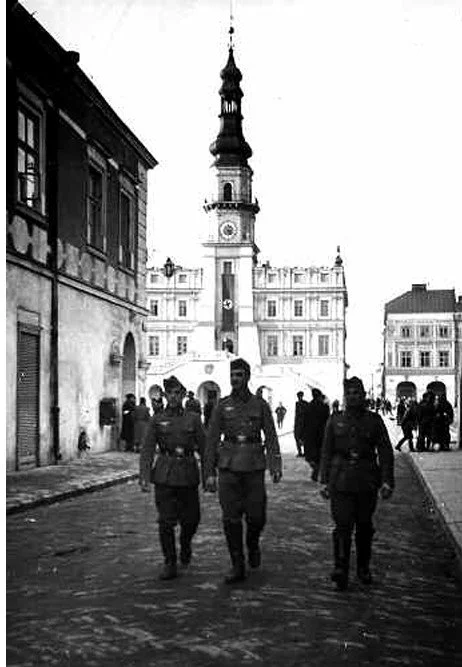
Arrival of the S.S. unit in Zamość on October 28, 1939.
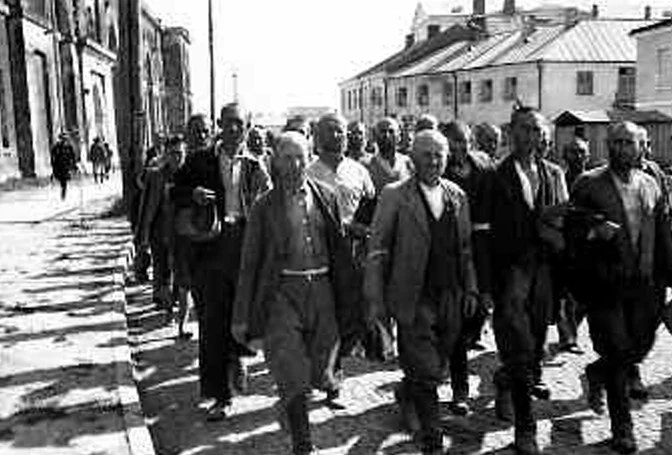
Zamosc: Deportation of the male Jewish population for forced labor in the spring of 1940.
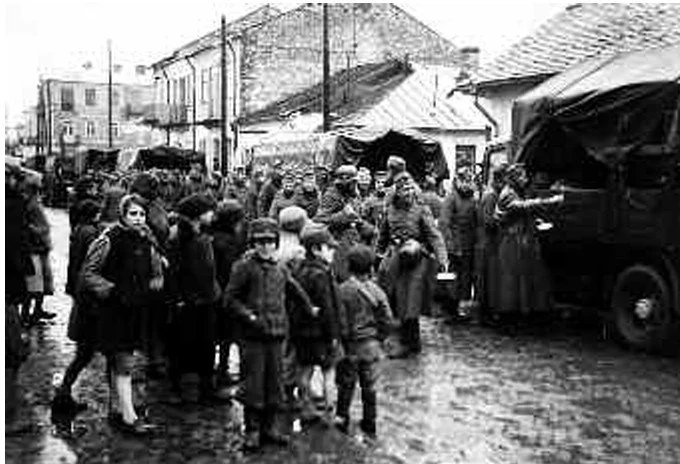
Zamosc, spring, 1940: First encounter with the local population, around 12noon on the day of arrival.
Related Articles:
Please see The German Military in Zamosc, 1939–1944 as well as Nazis in Zamosc and the Holocaust in Zamosc.