Remember Jewish Bilgoraj
Pronunciation: Bill-gore-aye
HISTORY OF THE JEWISH COMMUNITY
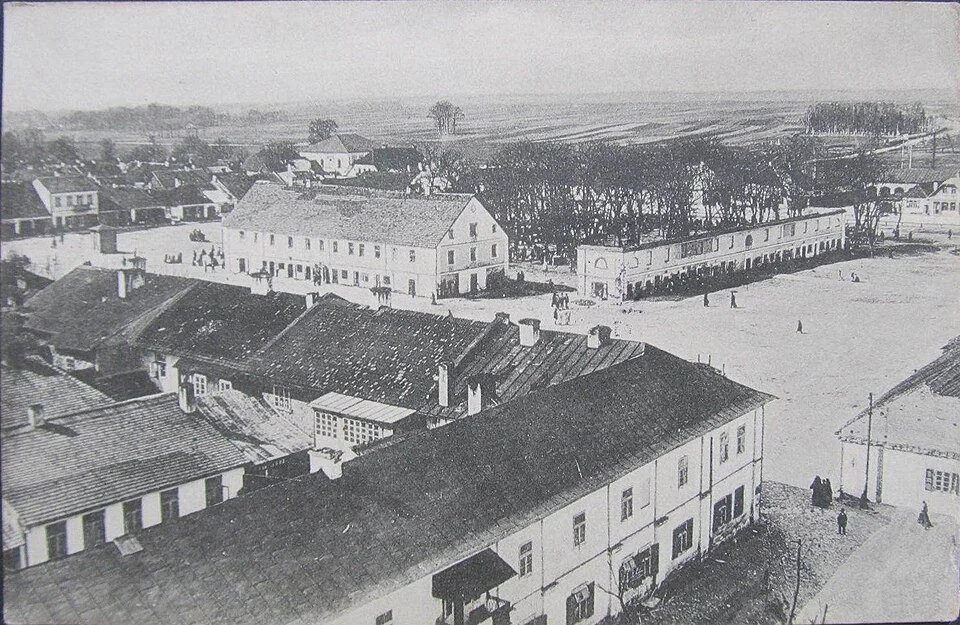
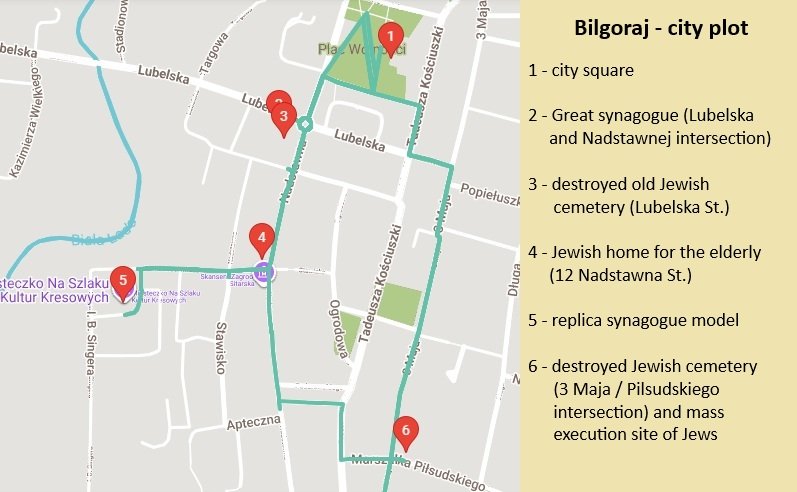
Jews appeared in Bilgoraj as early as the 1300s, with a written account mentioning them as early as 1597. In 1616, they were officially permitted settlement there and already had lived there prior to that time. In 1611, Zbigniew Gorajski, owner of the community, moved the market day from Saturday to Thursday, taking into account religious customs. In 1674, out of 237 citizens of the city, 40 were Jews. At this time, the Jewish community in Bilgoraj was under the jurisdiction of the Szczebrzeszynkahal. In 1765, the Jewish population included 661 people, of which 17 were outside Biłgoraj (mostly in Frampol). The Jewish quarter was built on the south-west corner of the market square, at the exit toward Krzeszow (later Nadstawna Street). A synagogue was constructed at this locale as early as the 1700s.
The first known rabbi in Biłgoraj was Szmul (1740–1807). He held his office until 1795 and was 24 years old at the time of taking office. He was succeeded by Eliahu Margules. Then Moshe Tzvi Hirsh Majzels took office. After his death, his son – Avigdor Majzels – became town rabbi. Later, his son-in-law Yitzhak Natan Berliner held the position. From 1864, the office of rabbi was held by the Nachum Palast. His assistant was Rabbi Szmul Engel from Galicia. Palast was succeeded by Jakub Mordechaj Zylberman, the grandfather of Isaac Baszevis Singer, until 1913. After that, his son, Rabbi Józef Zylberman, took office.
In 1778, out of 68 tenement houses at the market square, 56 belonged to Jews. They also had several houses on Tarnogrodzka, Cerkiewna and Nadstawna streets (next to which there was a mikvah, synagogue and Jewish school). Before 1760, there was a Jewish tailoring and furrier’s guild in the town, which may also have included shoemakers. In the 1700s, there was also a weaving guild. According to an inventory from 1802, there was one glazier, one tailor, two hatmakers, three goldsmiths and several bakers, butchers and shoemakers in the city. In 1778, the town had 2,176 people, including 418 Jews. During the Austrian partition, at the end of the 1700s, Jews were given German-sounding surnames in the area because Bilgoraj found itself within the borders of the Austrian Empire. The 1800s also brought an increase in the popularity of Hasidism to Bilgoraj. In 1819, out of 2,307 inhabitants, 616 were Jewish.
Throughout the 1800s, among the Jewish financial tycoons in Biłgoraj were Szmul Ela Szwerdszarf (a timber merchant, setting wood to Gdańsk); Dawid Lubliner (a construction entrepreneur, the owner of the largest brick tenement house in Biłgoraj); Josef Goldman (buyer and financier); Abuś Pelec (merchant); and Herszel Szajnwald (grain merchant, owner of a mill in Rożnówka). The Jewish community in Biłgoraj owned a brick synagogue, two houses of learning, a mikvah, two cemeteries, four houses of prayer, a Talmud-Torah school and a shelter for the poor. In 1860. Biłgoraj had 5,434 people, including 2,070 Jews.
By 1899, the population of Biłgoraj was 8,953 people, including 3,810 Jews. In the early 1900s, Urysz Zylberberg, Mojżesz Wajsman, Ieck Majer Warszawiak, M. Berger, J. Korensztajn, L. Sznicer, W. Sznicer and Tuchman operated wood [sitar] manufacturing workshops in town. Around World War I, the owners of large Jewish shops and wholesalers in the city included: Szmul Lajchert (colonial goods); Lipa Wakszul (food/colonial store and wholesaler); Chaskiel Kandel, Szloma Sztul, Berek Klajnminc and Szlafrok (shops); R. Majman (cloth shop) and Eljasz Enstein (pharmacy warehouse). Most of the beer halls and eateries at that time belonged to Jews. Their owners were Gerszon Kielmanowicz, Fiszel Kielmanowicz, Jankiel Senders and J. Szarfman.
In 1921, Biłgoraj was inhabited by 5,603 people, including 3,715 Jews. In the 1927 elections in town, the following parties won representation: Polish Socialist Party – 2, People's National Union – 3, Union for the Repair of the Republic of Poland – 1, Non-Partisan Poles – 6, Aguda – 5, Zionist Organization – 1, Mizrachi – 2, Non-Partisan Jews – 4.
in 1919, Gershon Gutwein became the head of the Jewish Religious Community, Motel Roku was the rabbi and Moshe Zylberman was the assistant rabbi. By 1928, the Jewish Community in Biłgoraj employed 9 people: Rabbi M. Rokach, assistant rabbi Ch. Holcman, A. Berman (secretary), L. Merensztajn (butcher), W. Weinberg (position unclear), I. Zylberman (kashrut supervisor), Ch. Szuldiner (ritual slaughterer), A. Szuldiner (janitor), Z. Altbaum (position unclear).
Wholesale trade and large stores of various industries were largely in the hands of Jews. The Jewish population was also engaged in small trade, owning about 300 shops. he vast majority of the Jewish population was poor, including the craftsmen, rope makers, porters, carriers, shoemakers, tailors and small shopkeepers. Wealthy Jewish families included: Erbesfelds, Grynapls, Harmans, Izorfs, Izajnwalds, Kandls, Tajers and Wakszuls. Other wealthy individuals included dentist Aron Kaminer, printing house operator Berek Kaminer and pianist Dawid Kaminer.
NEARBY JEWISH COMMUNITIES
Jews also lived in Aleksandrow (unknown Jewish population), Biszcza (unknown Jewish population), Dugi Kat (unknown Jewish population), Dzwola (unknown Jewish population), Dyle (unknown Jewish population), Frampol (2,500 Jews), Goraj (700 Jews), Gorajec (unknown Jewish population), Jozefow Bilgorajski (2,800 Jews), Lukowa (50-100 Jews), Majdan Sopocki (unknown Jewish population), Nadrzecze (unknown Jewish population), Rozaniec (unknown Jewish population), Susiec (unknown Jewish population), Tarnogrod (2,515 Jews), Teodorowka (unknown Jewish population), and Zwierzyniec (1,500 Jews). Additional information is available about some of these communities:
- Katy: The village of Katy near Frampol had 37 Jews in 1921. By 1939, there were seven Jewish families in the village. Nathan Bryk, Holocaust survivor from the village, later testified: “In September 1939 the Germans occupied our town. As Jews we had no rights whatsoever. They confiscated our flour factory, and we, a family of 8 people, lost everything.” In September 1942, The Jews of Kąty were forced to move to Frampol, about 5 km. northwest of the village. On November 2, 1942, all the Jewish men, women and children remaining in Frampol were either deported to the death camp in Bełżec or murdered on site.
- Potok Górny: According to the 1921 census, 256 Jews lived in the district Potok Gorny, mainly in three villages: Potok Górny (58), Kulno (90) and Lipiny Górne (55). In September of 1942, Holocaust survivor Shlomo-Yitzhak Sprung recalled that all the Jews of Potok Górny were loaded into horse-drawn wagons and transported to the Krzeszów Ghetto. In the nearby community of Kulno, 109 Jews were present in 1939. A letter written by the municipality head (wójt gminy), dated September 16, 1942, instructs the head of Kulno village (sołtys) "to provide a sufficient number of horse-drawn wagons for the ten Jewish families, at least two per family.” Jews from the villages of Kulno, Lipiny, Potok Górny, Szyszków and other rural communities were relocated to the Krzeszów ghetto. The Kulno deportees to Krzeszów remained in the town only for about 6 to 8 weeks. Eventually, they shared the tragic fate of the Jews in Krzeszów who were sent to the Bełżec death camp during the November 2-4 mass deportation and murdered. Meanwhile, in Lipiny Dolne, 33 Jews lived in the village in 1939. In mid-September 1942, all Jews from the Potok Górny municipality, including Lipiny Dolne, were deported — the majority to Krzeszów, and a few eastwards to the town of Tarnogród. The families Kacenberg, Urman and Wajcenberg from Lipiny Dolne were among those deported.
BILGORAJ DURING THE HOLOCAUST
Biłgoraj was initially occupied by the Soviet Union, but they retreated on October 3, 1939, at which point the Germans occupied the community. Under the German occupation, the Jewish population could only live in part of 3 Maja Street and Nadstawna and Ogrodowa Streets. On their left shoulder, Jews had to wear white armbands with the Star of David and were not allowed to go out on the Main Street, inhabited by Germans. In December 1939, the Jewish Council (Judenrat) was established in Biłgoraj, led by Szymon Bin. The ghetto was established in June of 1940. In October 1939. The Germans liquidated Jewish banks and the Loan and Savings Cooperative.
In August 1940. The Germans shot all the members of the Judenrat in Biłgoraj. The reason was the refusal of President Bin and Vice-President Hillel Janower to select a group of Jews who were to be transported to the German Nazi death camp in Bełżec and to create the Jewish Police.
Jews from Austria were forced into the Bilgoraj ghetto in 1941. Groups of Jews from the Bilgoraj ghetto were also forced to leave: First, on April 6, 1941 when 800 Jews were forced to walk to nearby Goraj; second, on April 22, 1942, when 220 Jewish individuals were displaced to Tarnogrod.
Between 1941 and 1944, the city was affected by infectious diseases such as typhus, typhoid fever and dysentery.
In the Biłgoraj district, three actions were carried out to deport Jews to the death camp in Bełżec. The first such action took place on August 16, 1940. Round-ups were organized in individual towns of the county, as a result of which 202 Jews were captured, including 80 from Biłgoraj. The second similar action was carried out on August 8–9, 1942: in a transport of 1,500 people, about 800 Jews came from Biłgoraj. They were mainly women, children and the elderly.
The action of complete extermination of the Jewish population in the General Government was christened by the Germans as “Operation Reinhard”. It began in Biłgoraj on November 2, 1942. Odilo Globocnik, the commander of the police and S.S. of the Lublin district, was responsible for carrying it out. The city was surrounded by special Schupo units, which consisted of Germans and Latvian, Croatian, Lithuanian and Ukrainian collaborators. The Jews were gathered near the Market Square, and from there they were led to the “Deutsches Haus”. There, the Gestapo searched those gathered in search of gold and valuables. Subsequently, Jews walking in columns were murdered by policemen. The bodies of the dead laid along the entirety of Maja Street.
In the evening, the Jewish community from Tarnogród and Krzeszów was brought to Biłgoraj. The next day, all the Jews were led out of the barracks and lined up in a column of eight people in a row. They were pierced with bayonets and shot, while babies were killed with rifle whips. Another group of Jewish residents was marched to Zwierzyniec. During the march, there were more murders. From Zwierzyniec, they were transported by rail to the Bełżec gas chambers.
SLAVE LABOR DURING THE HOLOCAUST
Forced labor for the Jewish community was introduced in October of 1939. It included men from 14 to 60 years of age. The Jews of Biłgoraj were engaged in cutting wood in the forests, building roads in the county, at the railway station in Rapy, in the Gliniska quarries, and to construct a canal on the Biała Łada River. Their work began at 6 a.m. and ended at 5 p.m. Each day began with runs, jumps and other forced gymnastics, which was combined with beating. The Jews lined up in compact columns, usually singing a song that began with the words: "Our Propeller Rydz taught us nothing, and Hitler the Golden taught us how to work.” Other Jewish workers were transported to labor camps in Bukowa and Dyly, where they carried out drainage works.
Regarding the activity of Nazi Werner Ansel, Bogdan Musial wrote that he “commanded a 40-man detachment of the armed Special Service, recruited from ethnic Germans, which was deployed for requisitions as well as for operations targeting Poles and Jews. In May 1940, he ordered the establishment of a forced labor camp in Bukowa; by September, 168 men were interned there, 93 of whom were Jews. And, in July 1940, he requested the execution of seven individuals in retaliation for an ambush and the death of a Gendarmerie sergeant” (source: Deutsche Zivilverwaltung und Judenverfolgung im Generalgouvernement).
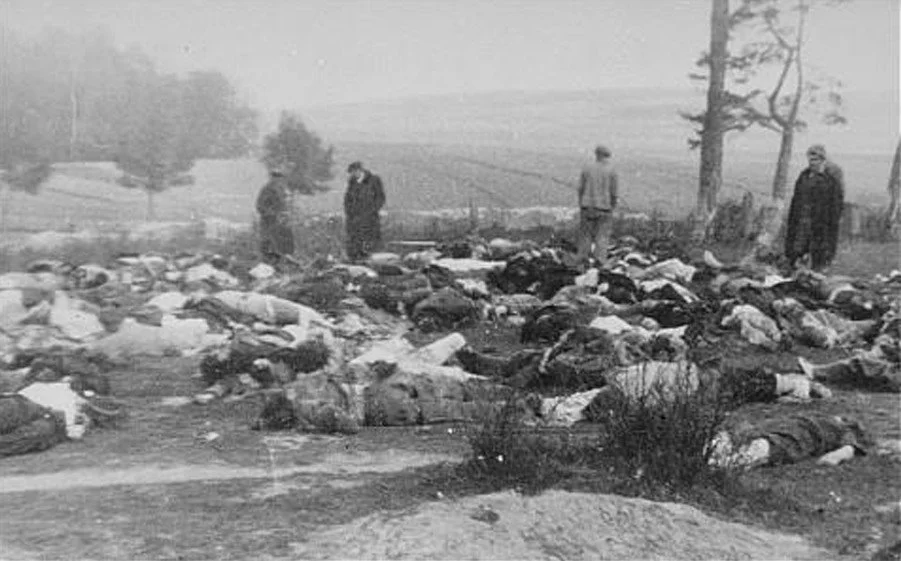
At the Jewish cemetery on Konopnicka Street, around 300 Jews that had been caught in hiding were shot during the winter of 1942-1943. The ghetto was liquidated on January 15, 1943.
NAZI PERPETRATORS
Nazi operatives in Bilgoraj included: Karl Adam, unknown Amann, Werner Ansel, Hans Augustyn, Ryszard Barda, Willi Bornemann, Wilhelm Brunner, Wilhelm Eckhardt, Alois Faltermayer, unknown Furche, Hauptwachtmeister Georg Frank, Max George, Michael Gerhardt, unknown Irl, Otto John, Friedrich Keller, Robert Kolb from the Zamosc S.S., Johann Leibeck, unknown Lovner, Georg Majewski, Konrad Meier, Richard Müller, Erich Orlaski, Otto Pukall, Heinrich Rathje, Karl Reichert, unknown Schlesinger, Jakob Schwarzwalder, unknown Stolz, Walter Trautwein, Johannes van Dollen, Reinhold Witt and the Police Reserve Battalion 67.
Other local collaborators included: Aleksander Bitschkow, Fedir Dmytryjiw, Wladyslaw Duma, Wasili Kokoth, unknown Mrozik, Michal Pawliszyn, Nikolai Poltawschinko, Robert Schymura and Michal Zur.
WHAT REMAINS
On March 1, 1943, according to German data, Biłgoraj had 4,547 inhabitants, including 4,258 Poles, 212 Ukrainians, 66 Germans and 11 others. The Nazi authorities did not mention a single Jew.
The Nazis murdered a total of about 4,000 Jewish inhabitants of Biłgoraj. After the war, the community was not revived. Rywka Weinberg, Lila Stern, Benzion Rosenbaum, Chaim Rosenbaum, and Perla Twersky were saved by Jan Mikulski. A listing of Jews from Bilgoraj who lived in Szczecin and Lower Silesia in 1946-1947 is available here.
Zachor - We Remember. Please review the site content below.
ADDITIONAL SOURCES
Some additional sources on the destroyed Jewish community of Bilgoraj include: (1) The Holocaust of Biłgoraj. The Book of Memory, edited by A. Kronenberg, Gdańsk 2009. (2) The Singer Family and the World That Is No Longer There, eds. M. Adamczyk-Garbowska, B. Wróblewski, Lublin 2005. (3) Jews in Biłgoraj in the Nineteenth Century in the Light of Archival Materials (1810–1875). P. Sygowski. (4) Jews in Biłgoraj at the turn of the nineteenth and twentieth centuries. A. Kopciowski. (5) Jews of Biłgoraj in the pre-partition period, [in:] Biłgoraj, poznaj. H. Gmiterek. (6) The History of Biłgoraj, eds. J. Markiewicz, R. Szczygieł, W. Śladkowski, Lublin 1985. (7) National minorities in the Lublin region in the years 1918–1939, ed. M. Adamczyk, Kielce 2007. R. Dąbrowski.
-----------------------------------------------------------------------------------
[Bilgoraj Yizkor Book — English Translation] [see also: Yizkor book]
[3D Model of Bilgoraj — 1910] [Bilgoraj Old Jewish Cemetery]
[Project MUSE: Bilgoraj] [Bilgoraj New Jewish Cemetery]
[Bilgoraj Jews in Tarnogrod as refugees, 1940-1941]
[Bilgoraj Holocaust Survivors — 1946/1947]
-----------------------------------------------------------------------------------
CONTACTS
U.S.: LublinJewish@gmail.com
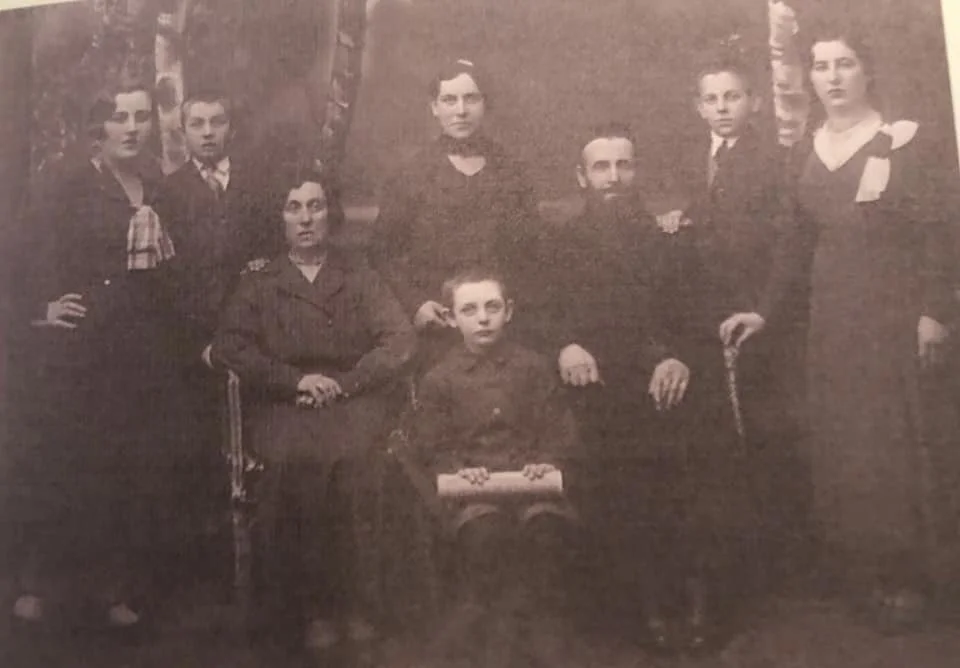
The Szwarc family, from Bilgoraj.
City square, 1910. In the back is the synagogue (visible, in white).
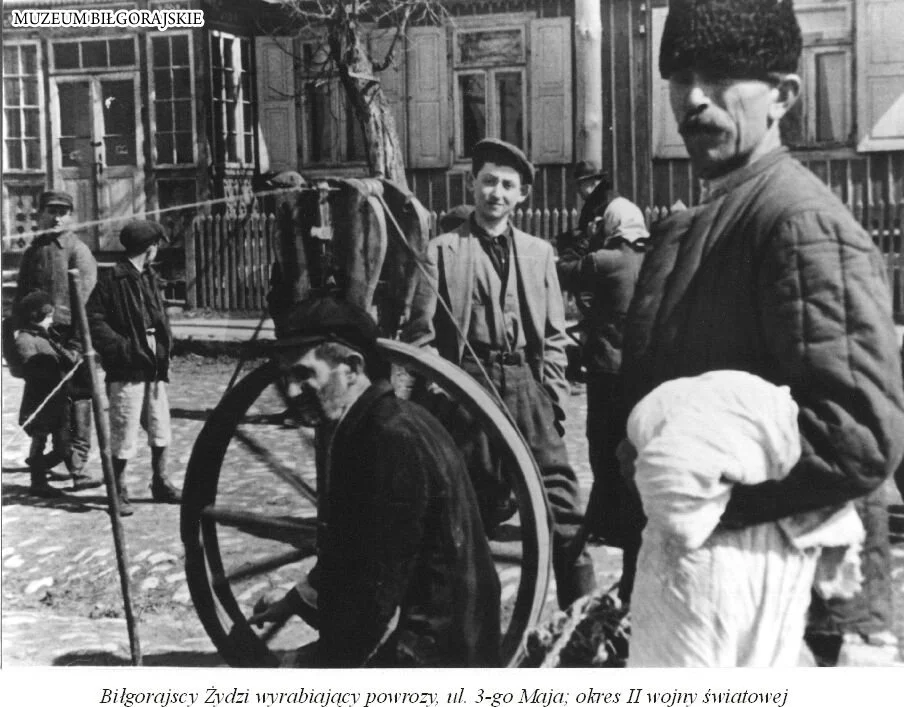
Jewish rope makers in Bilgoraj, pre-war.
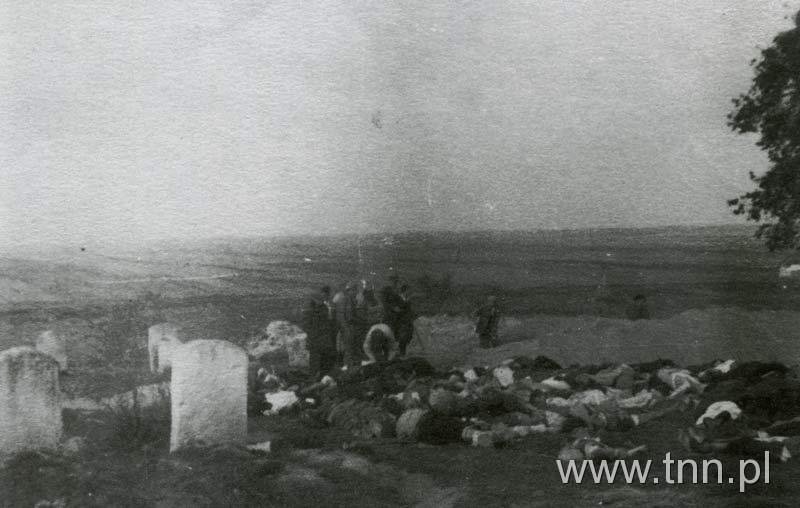
Mass-grave execution site at the Jewish cemetery, circa 1942.
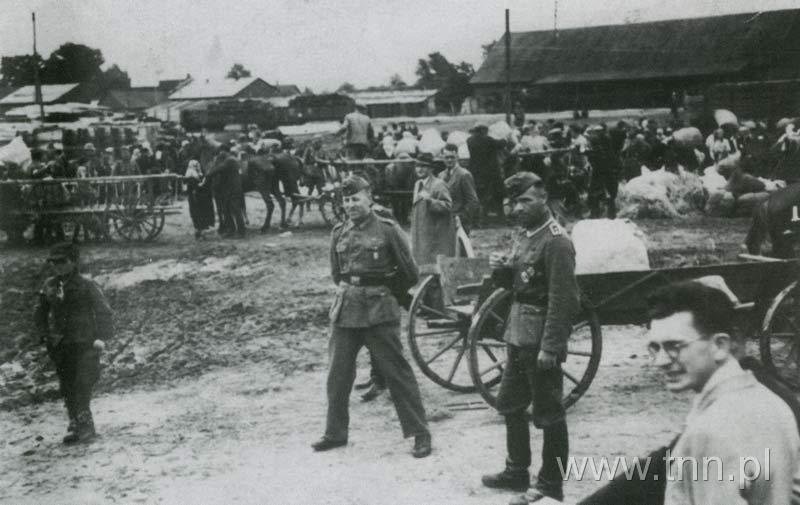
A deportation from Bilgoraj, 1942.
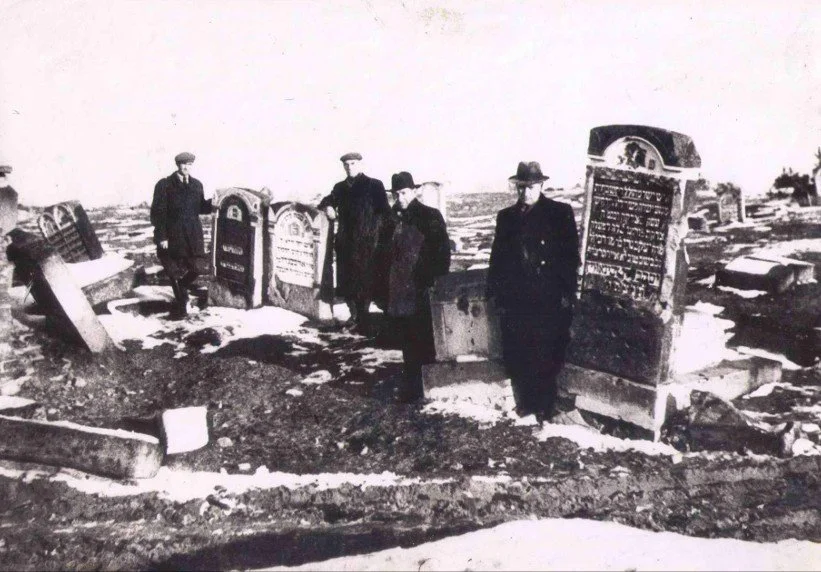
At the Bilgoraj cemetery.
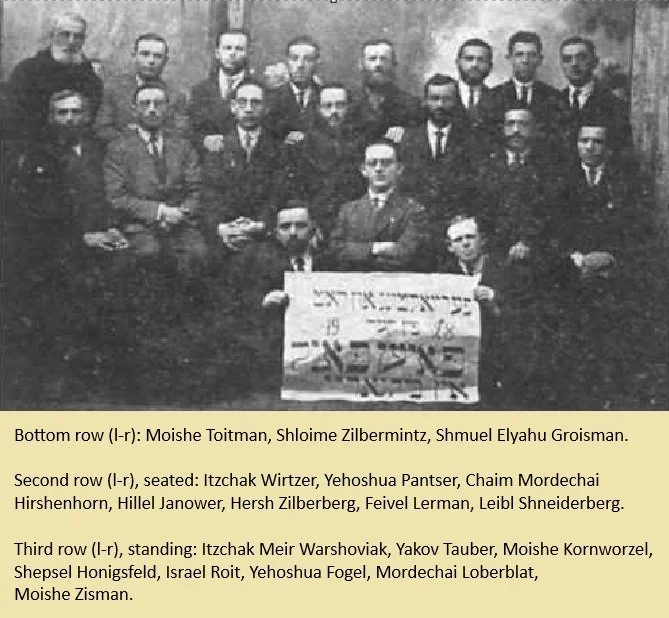
Left to right: Haim Stern, Ben-Zion Rozenboim, Joel Langbord, Jehuda [idel] Sharp.
Photo from 1948.
Photo of a murder action of Jews in the cemetery of Bilgoraj. People standing looking at the bodies.
There is no information regarding the source of the photo.
Holocaust Survivors of Bilgoraj:
Beinish Adler
Hersh Altman
Ela Aszenberg
Fiszel Barbanel
Benjamin Berger
Rakhil Berger
Herszko Brezel
Briks family
Lejba Bryk
Chaim Fajner
Shlomo Fajner
Lejb Feder
Szloma Feder
Ester Fefer
Sabrina Anger Fenster
Boruch Flamenbaum
Perla Frajberg
Lejzor Fruchthendler
Mina Gelernter
Gorman/Garman family
Arlene Graber Rymer
Liuba Greiber
Rakhil Greiber
Szloma Gutesman
Benia Hochman
Moszko Hochman
Nusen Hochan
Szmuel Honigman
Blima Honigsfeld
Abram Janower
Gedala Kahan
Israel Kiperman
Hinda Lavruzhnik
Pola Mendelsohn
Dwojra (Dvora) Mercer
Chaja Met
Rozia Milchman
Josef Pech
Szymon Pech
Meir Reichenberg
Wolf Rochenberg
Gitla Rot
Moszko Rot
Rozenberg family
Binem Schulman
Simcha Sam Shatz
Bela Szerer
Markus Szlajcher
Szprinca Tajer
Beniek Teitelbaum
Szandla Unterbuch
Szame Wajchman
Rywka Wajnberg
Icek Waldman
Rachel Wircer Moses
Boruch Wermut
Herszko Zylberfajn
Moszko Zylberfajn
Sara Zylberfajn Kocher