Remember Jewish Lubartow
Pronunciation: Loob-bart-ov
HISTORY OF THE JEWISH COMMUNITY
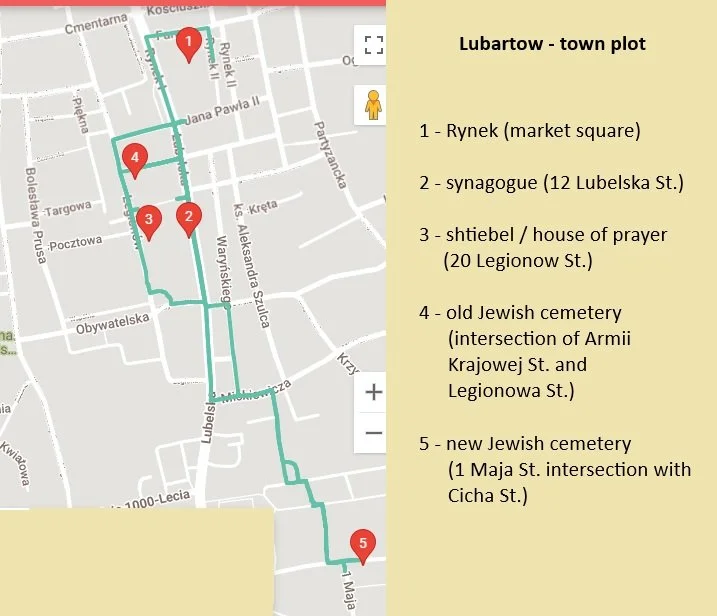
The first mention of the existence of a Jewish community in Lubartów dates back to 1592. Apart from tailors and hatmakers, Jewish bookbinders, soap makers, goldsmiths and jewelers also lived in the city. There was a Jewish-Christian craftsmen's guild. Jews also made a living by renting gardens and farms. Jews lived mainly on Lubelska Street, where there was also a large synagogue (12 Lubelska Street) and a cemetery. The Wieprz River, along which Lubartów is situated, was utilized for transporting grain from the town. Two Jewish residents of Lubartów, Jonasz Perec and Samson Koplowicz, maintained their own galleys anchored in the ports along the Vistula River.
In 1676, 80 Jews (37%) lived in Lubartów. They had their own court, which decided on religious, property and minor disputes, and was presided over by a rabbi. In the 1700s, Jews in Lubartów owned 163 houses. In 1789, the Jewish population owned 248 houses in the town, while there were 201 Christian houses. There was also a Jewish hospital in Lubartów, funded by donations, which was destroyed during the November Uprising in 1831. The Perec family imported furs, tea and tobacco from Russia. Among the merchants working for the needs of the Perec manor were: Herszek Perec, Moszek Perec, Jonas Szmulowicz, Wolf Michlewicz, Ajzyk Majerowicz and Szmul Majerowicz.
In 1820, 3150 people lived in Lubartów, including 1985 Jews (63%). Seven years later, in 1827, the number of Jews increased to 2074 people (57.5%). Jews also conducted transactions with the Christian population. In 1826, there were 6 Jewish hatmakers, 7 tailors, 5 butchers and 2 bakers in Lubartów. Jews also operated a sawmill and metal products factory. In the 1830s, the members of the synagogue committee included Jonas Zilber, Motyl Welnder and Icek Majer Kopel. In 1819, Jonasz Szaja Perec bequeathed a donation to the Jewish cemetery. He donated religious and legal books for the use of the Lubartów synagogue and the income from his stalls helped pay for lighting in the synagogue. In 1826, another wealthy merchant, Dawid Mendlowicz, allocated a percentage of the sum of 300 zlotys for Jewish schools in Lubartów.
In the first half of the nineteenth century, south of the Market Square, in the area of Cicha Street, a new cemetery was established. Berek Kohn was the rabbi in the 1860s. Between 1890-1907, the rabbi was Szloma Pud. The next rabbi was Jakub Szulim Kohn, son of Berek, until 1912. He was succeeded by Wigdor Lejbuś Gelblum, who lived at 33 Lubelska St. Chaim Jonas Szryft (he lived at 19 Piękna Street) was another rabbi in town. The cantors were: Dawid Goldman, Szmul Kuperman and Lejbuś Ber Grynger. There were also two secretaries for the Jewish community: Aron Lerner and Abram Krajcer.
In 1900, 6,870 people lived in Lubartów, including 3,855 Jews (56%). The wealthiest Jewish family at that time was the Kirszenberg family, the owners of the Zagrody farm. Izrael Kirszenberg and his wife Chaja Ruchla Kirszenberg were ardent supporters of Hasidism. The Kirszenberg family was known for its wealth throughout the Kingdom of Poland. Other wealthy families of that time include the Finkelsztajn and Goldglas families. Wealthier Jews organized charitable contributions for the poor. The collection was handled by Rywa Lazer.
In 1930, the following individuals were employed by the Jewish community: Rabbi Geldblum, Bergenson (Secretary), Szajnsznajder (head of the Talmud Torah school), Sztulman (butcher), Zylbertasz (butcher), Szylewicz (synagogue employee), Dejka (guard at the Jewish cemetery), Ligenza (caretaker), Sztaglica (kontroler), and Morgensztern (synagogue employee). Houses of prayer operated in town, run by: (1) The Kirszenberg family, who owned a house of prayer in Zagrody. Chaja Ruchla Kirszenberg founded a private house of prayer in 1897; Tauba Kirszenberg operated one at Market Square II. (2) A house of prayer on Rynek II Street was founded by Michel Fagenblat and Chaim Szryft. (3) A house of prayer on Lubelska Street belonged to Mendel Cwajgrajch and Moszek Rajtman. (4) A house of prayer was located at Kamionkowska Street (currently: 20 Legionów Street) and belonged to the Lubartów Hasidim. (5) A private house of prayer at Nowopoprzeczna and Furmańska Streets was founded by Boruch Lejb Honigsblum.
In the years 1920-1939, about 30% of Jewish children studied in both elementary schools in Lubartów. Mosaic religion lessons were conducted there by Rabbi Josef Federbusz (who lived at 10 Cmentarna Street). Additionally, there was a cheder in Lubartów run by Jechiel Najdin (Najden), who taught together with his daughter Chana. Polish, French and German language lessons were conducted there and some Catholic children also attended them. In 1930, there was a Jewish religious school Talmud Torah in Lubartów. Its director was Szajnsznajder.
Teachers (malamedim) within the Jewish community included: Pinkwas Honiksblum, Leyb-Boruch Honigsblum, Moszek Grosman, Jojna Erlich, Pinkwas Reitman, Sucher Rozbruch, Chaim Szylewicz, and Szulim Aron. Among the entrepeneuers in the community were: carbonated water factory: Majer-Luzer Rozenbaum (Rynek II–16), Jankiel-Dawid Ejzencwajg (Rynek I–9), Moszek-Joel Feldman (7 Lubelska St.); vinegar factory (13 Lubelska St.): Abram Frydlender. bakers: Szmul Rajs (16 Nowopoprzeczna Street), Dwoira Norman (8 Lubelska Street), Pinkwas Duman and Chana Winder (32 Legionów Street), Lejzor Wajc (31 Bandurskiego Street), Icek Szajnfled (38 Bandurskiego Street), Ela Montal (8 Nowopoprzeczna Street); beer bottling plant (25 Kościuszki Street): Szlomo Grynblat; food wholesaler (Nowopoprzeczna St.): Sara Kaffe; butchers: Fajwel Zalcman (5 Poprzeczna St.), Josef Zalcman (3 Poprzeczna St.), Pinkwas Zonenszajn (4 Poprzeczna St.), Berek Zalcman, Szloma Wajngarten and Abram Zonenszajn (Rynek II); beef trade: Zalcman family, Zonenszajn family.
Other owners in the community: owners of the motor transport company: 6 non-Jews as well as Motel-Icek Pelcman, Jakub Wajnberg and Chuna Erlich; operator of United Industrial Works "Telzytyn i Trocal" (6 Kolejowa St.): J. Singer from Warsaw; electrotechnical workshop: D. Olberg; mill operators: Szmul Giwercer, "Korona" Motorized Mill (75 Lubelska St.); Symcha-Chaim Persyko, “Wygoda” Motorized Mill (73 Lubelska St.), Aaron Halbergsberg, "Rekord" Motorized Mill; gas stations/petroleum products: Jakub and Szajdla Lerche, Boruch Goldfinger (Legionów St. 57), Salomon Zygerszloft, “Karpaty” gas station, Jakub Goldfinger (Legionów St. 57); owners of the largest oil mills (Legionów St. 37 and Legionów St. 57): Berek Tunkielszwarc, Wulf Wajnberg; concrete products: Jojna Szuchendler (Lubelska St. 53), Jankiel Osiński (Nowodworska St. 5); blacksmith (Żabia St. 28): Icek Rubel; glassworks: Aaron Halbergsberg; horse-drawn stagecoaches (Żabia St. and Rynek I): Gdala Perec and his sons-in-law (Berek Apelbaum, Menachim Lewin, Moszek Suchowolski), Zelik Kiszenberg, Srul Birenbaum; inns/hotels (Lubelska St. 2): Gdala Perec and S. Tochterman. The Lublin Urban Bus Company was established in 1934. The company was located in Lubartów, at 14 Rynek Street. Among the operators were: I. Pelcman, Sz. Gewercer and two non-Jews. It was owned by a Lithuanian Jew named Kierszyc (who resided at 23 Piękna Street). Printing houses were operated by: Srul Rajchnudel, who opened a bookstore and a printing house with a bookbinding shop in the city (8 Lubelska Street), as well as booksellers Szyja Suchowolski (7 Lubelska Street) and Chana Dyksztajn (the cheder building, 10 Cmentarna Street). Printing houses were owned by Jankiel Ber Nissenbaum (7 Rynek I–7 Street) and Szmul Rajchnudel (21 Legionów Street). Lubartów Glassworks, operated by Aaron Halbergsberg, employed 200 workers. It was managed by foreman Srul Besser, while its director was Halbergsberg’s son-in-law, Tobiasz Garfinkiel. In 1922, the Union of Jewish Craftsmen was established, headed by Lejb Akiersztajn. The Association gathered about 80 members. The Board consisted of: Berek Grzebieniarz, Jankiel Honigsblum, Mordko Akiersztajn, Chil Finkielsztajn and Chil Wajnberg. In 1922, the Association of Small Merchants was established in Lubartow and had around 100 members. Board members included: Hersz Kirszenberg (Chair), Szyja Cytrynblum, Jankiel Montal, Izaak Pud, Shmuel Rubinstein, Szyja Suchowolski.
From 1927, charitable organizations associated with the Jewish community operated in the city, including: (1) Gemilut Chesed – granted low-interest loans and had 400 members; (2) The "Acher-Ezer" Charitable Society, which included 300 people; and (3) Hachnasat Orchim — provide assistance and meals to poor travelers and the homeless. The founders of the Hospitality Charity Association (Hachnusas Orchim) in Lubartów in 1936 included: Szloma Bekierman, Aron Citrin, Josef Goldszer, Josef Hochlender, Szloma Hopensztang, Moszek Rozencwajg, Moszek Rozenfeld, Itzek Rubel, Szyja Szmirman, Josef Tenenbaum, Mordko Wajcman, Moszek Wajnsztejn, Szmul Wulfman, Chuna Zajdenwerk and Zanvel Oksenga. In the late 1930s, Dr. Maurycy Silberman maintained a medical practice. He lived at 10 Rynek I. Ezechiel Rajch also ran a medical practice. Jewish medical assistants included: Belik Bergant and Dawid Lustman (who provided care for the players of the Bar-Kochba sports club).
In the interwar period, political life among the Jewish population flourished in Lubartów. The first Jewish political parties appeared in the city at the beginning of the 1920s. The Lubartów branch of the Zionist-religious party Mizrachi was founded in 1920. It had 100 members in 1924 and was headed by Icek Majer Holcman, and the board consisted of: Gdala Kijewski, Chaim Lerche, Szymcha Nordman, Lejba Rozenberg and Lejba Osiński. In 1924, the Zionists founded the Organization of General Zionists. Initially, it had 20 members. It was chaired by Judka Garfinkiel. The board consisted of: Majer-Judka Gorfinkiel, Moszek Nordman, Szmul-Majer Goldman, Jankiel Szajndler, Moszek Zelkowicz and Majer Finkielsztajn. In the same year, a branch of the orthodox Aguda was established, headed by the trader Jankel Metal. The party had about 80 members. There were also branches of Poale Zion-Left and the Bund, which advocated national and cultural autonomy for Jews. Members of both parties met in the I.L. Prec Library in Lubartów, which had existed since 1923. From 1929, youth organizations were active in the city, including the Zionist He-Chalutz (Pioneer), Hashomer Hatzair and the Jewish Scouts' Association “B’rith Trumpeldor,” which were under the influence of Zionist organizations. He-Chalutz was headed by Aron Perelsztajn. The leader of “B’rith Trumpeldor” was Jakub Rajchnudel.
In 1924, the first elections to the community board after World War I were held. The Board consisted of: Moszek Joel Feldman, Gdala Kijewski, Moszek Aron Hekier and Szmul Rubinsztajn. In 1929, as a result of the elections to the City Council in Lubartów, it included two Jews from Mizrachi, three general Zionists, two from the Bund and one from Poale Zion of the Right. The District Sejm consisted of one person of the Jewish faith.
In 1924, the Jewish Gymnastic Society “Bar Kochba” was established in Lubartów, which was headed by Szmul Goldman. Under the auspices of the Society, two teams operated: Gwiazda and Maccabi. Both played football (soccer) matches against Polish teams. In 1913, 8,220 people lived in Lubartów, including 4,466 Jews (54%). In 1920s, the Merchant Cooperative Bank operated in the city. Its president was Szmul Giwercer. There was also a Cooperative Credit Union. Its board consisted of Moszek Feldman, Jankiel Montail and Szloma Olberg.
In the interwar period, the community managed a synagogue, two cemeteries, and a mikveh (located at the intersection of Orlicz-Dreszera and Pierackiego streets) and ritual slaughterhouse, as well as the communal Talmud-Torah. Meanwhile, in 1938, the Lubartów City Council consisted of several Jews: Szloma Ber Cieśla, Szloma Icek Finkielsztajn, Szmul Majer Goldman, Dawid Perec, Szloma Olberg and Chaim-Symcha Persyko. The Fundusz Obrony Narodowej (National Defense Fund) was an attempt by both the government of the Second Polish Republic and the Polish nation to collect funds necessary for improving fighting ability of the Polish Army before the increasingly likely World War II. In 1938, Jewish members of the FON committee in Lubartow included: Szloma Ber Cieśla, Moszko Feldman, Boruch Goldfinger, Dawid Perec, Dr. Maurycy Silberman and Majer Weberman.
NEARBY JEWISH COMMUNITIES
The Lubartów commune consisted of the following settlements: Berejów (32 Jews in 1939), Brzeźnica (32 Jews), Firlej (296 Jews), Górka Lubartowska (11 Jews), Kijany (47 Jews), Kaznów (10 Jews), Krokanie (5 Jews), Nowy Dwór (19 Jews), Rozkopaczew (40 Jews), Serniki (27 Jews), Serock (9 Jews), Sobolew (11 Jews), Tarło (42 Jews), Wólka Rokicka (34 Jews), Zagrody (14 Jews), Zezulin (28 Jews) and Ziółków (35 Jews).
LUBARTOW DURING THE HOLOCAUST
The Lubartow Jewish population in 1939 was 3,411. The Nazi occupation of Lubartow began in September of 1939. At the beginning of October 1939, the Nazis began to organize roundups on the streets of Lubartów and religious Jews were humiliated by the public cutting of their beards. An example of the cruelty of the Nazis was the beating of a local butcher named Moshe Lazer. On October 12, 1939, the Nazis plundered Jewish apartments and shops. On October 20, 1939, 850 Jews from Lubartów were sent to Ostrów Lubelski Ghetto, and another 634 Jews were sent to Parczew Ghetto.
On January 4, 1940, the Nazis established the Judenrat headed by Jakub Mordko Lichtenfeld and then Dawid Perec. The Judenrat consisted of: Jakub Mordko Lichtenfeld, Szloma-Ber Cieśla (Cieśler), Moszek-Joel Feldman, Srul-Icek Rajzylberg, Dawid Perec, Menasz Kosman, Chil Wajnberg, Szloma Rubinstein, Pinkwas Duman, Srul-Moszko Denenmark and Szyja Suchowolski. The leadership changed several times.
In the winter of 1940, in Pałecznica-Kolonia near Lubartów, the bodies of Jewish prisoners of war (POWs), soldiers of the September Campaign of 1939, were buried. This group of POWs had been murdered by the Germans during the “Death March” from Lublin to Biała Podlaska. According to sources: “In the winter, amidst severe frosts, a column of prisoners of war marched from the direction of Lubartów … They passed through Pałecznica around noon. The Nazis had already begun murdering the soldier-prisoners back in Lubartów. However, the greatest number were slaughtered near Niedźwiada, along the Pałecznica - Niedźwiada route. The bodies were hauled away by residents of Pałecznica, Górka Lubartowska, and Szczekarków.” Additionally, “the Nazis also transported them using trucks. The road was guarded by gendarmes from Lubartów. The bodies were gathered up and buried near the Pałecznica manor house, in the area known as the ‘Wolf Mountains’ (Wilcze Góry), close to the Lubartów road.” At least 150 soldiers were buried there.
In November 1939, transports of Jews from Lublin, Ciechanów and Slovakia — including about 2,000 Jews — arrived in Lubartów. In May 1942, another transport of 2,421 Jews from Slovakia arrived in Lubartów. In June 1942, there were 3,134 people in the ghetto, including about 2,000 refugees. A group of 450 Jewish refugees from Mława and Lublin were settled in the Lubartow Ghetto. The ghetto was subsequently inhabited by 4,500 Jews. At the beginning of October, 1942, more groups of Jews from Kamionka (near Pulawy), Ostrów Lubelski and Czemierniki were resettled to the crowded ghetto.
In the years 1940–1941, groups of Jews from Lubartów were sent to labor camps in other communities. Some of the Jews from the Lubartow Ghetto worked on construction of the concentration camp at Majdanek in Lublin.
In April 1942, the Judenrat consisted of: Moshe Joel Edelman (chairman), Shlomo Ber Cieśler, Izrael Ratensilber, Menashe Kosman and Jechiel Weinberg. An 11-person Order Service was also established. It consisted of: Izaak Pud (chairman), Izocher Kosman, Icek Apfeld, Moszek Gothelf, Icek Nirenberg, Zelik Honiksblum, Lejzor Tunkieltraub, Dawid Cieśla, Moszek Kosman, Moszek Wajcaman and Moszek Duman.
The first deportation from the Lubartów Ghetto took place on April 9, 1942 when a group of about 800 Jews was dispatched to the Belzec Death Camp. Another large deportation aktion took place on October 11, 1942. About 3,000 Jews were transported from the Lubartów ghetto to the death camps in Bełżec and Sobibór and to Majdanek, and about 500 individudal Jews were shot at the local Jewish cemetery on Cicha Street. In the mikvah building (current location 17 Gen. Orlicz-Dreszera Street), the Nazis murdered between 60 and 140 Jews.
The final liquidation of the ghetto in Lubartów took place on October 24, 1942, when about 300 Jews remaining in the city were resettled to the Piaski Luterskie Ghetto. On January 29, 1943, the last remaining Jews in the city were shot in the cemetery at Cicha Street, and in February 1943 the last remaining Jews were shot in the cemetery at Cicha Street. The Germans declared Lubartów a city “free of Jews” (Judenfrei).
ADDITIONAL SOURCES
Some additional sources about the destroyed Jewish community of Lubartow include: (1) Charliński W., On the inhabitants of Lubartów in the years 1932–1945 [in:] Lubartów and the Lubartów Land, Lubartów 2000. (2) Ćwik W., Z dziejów Lubartowa w latach 1796–1866, [in:] Lubartów – z dziejów miasta i regionu, Lublin 1977, pp. 51, 64. (3) Dumałe R. J., War, Occupation, Liberation – Lubartów 1939–1949, Lublin 2001. (4) Jędryszka M., Jews in Lubartów over the centuries, paper prepared for the scientific session "My Little Homeland". (5) Khurban Lubartow: a matzewa Lubartow un Lubartow Kedoshim, ed. B. Tshubinski, Paris 1947. (6) Kubiszyn M., Lubartów, [in:] Traces of Jews. Lubelszczyzna, Lublin 2011, pp. 224–232. (7) Kuwałek R., Sygowski P., Z dziejów zajednice żydowskiej w Lubartowie [in:] Lubartów i ziemia lubartowska, Lubartów 2000. (8) Lubartow, [in:] The Encyclopedia of Jewish Life Before and During the Holocaust, eds. S. Spector, G. Wigoder, vol. 2, New York 2001, p. 751. (9) Lubartów – from the history of the city and the region, edited by S. Tworek, Lublin 1977. (10) Lubartów. Our Little Homeland, edited by E. Sędzimiesz, Lubartów 1997. (11) Lubartów. Historical and Urban Study for the Spatial Development Plan of the City, Warsaw 1967 (typescript). (12) Opas T., The Fall and Rebirth of the City (1660–1795), [in:] Lubartów – z dziejów miasta i regionu, ed. S. Tworek, Lublin 1977, pp. 33, 35. (13) Przesmycka E., Transformations of the buildings and landscape of the towns of the Lublin region, Lublin 2001, p. 171. (14) Rościszewska Z., Lewartów /Lubartów/ in the years 1543–1634, Lublin 1932 from: Lubartów. A Historical and Urban Study for the Spatial Development Plan of the City, Warsaw 1967 (typescript). (15) There used to be my home... Books of Remembrance of Jewish Communities, eds. M. Adamczyk-Garbowska, A. Kopciowski, A. Trzciński, Lublin 2009.
WHAT REMAINS
The Nazis destroyed the synagogue and the Jewish cemetery. Among the Holocaust survivors of Lubartow were: Doba Apfeld, Szloma Cyngiel, Dawid Cyngiel, Josef Honigsblum, Gerszon Kopfe, Sura Kopfe, Izaak Pud, Berek Tunkielszwarc, Dora Wajnpert, Josef Weinberg, and Chana Goldsztein. In total, only about 40 Jews survived the Holocaust from Lubartow.
The old Jewish cemetery is located at the Armii Krajowej and Legionów Street intersection. It was founded in the 1500s and closed in the 1800s. It had a wooden fence constructed by Abram Walersztein. The cemetery was completely destroyed by the Nazis during the Holocaust. A commemorative plaque was hung in the area of the former cemetery in 2022.
The New Jewish Cemetery in Lubartów is located at the intersection of 1 Maja and Cicha Streets. The cemetery was established in 1796. It was enclosed with a masonry wall. In the 1990s, plaques authored by Marek Danielkiewicz, the Director of the Municipal Public Library in Lubartów, were installed. Around 40 tombstones remain at the site, including one from 1848.
The first mention of the synagogue in Lubartów dates back to 1611. It was a wooden structure, later replaced by a masonry building. The synagogue was a tall, two-story edifice. It was destroyed by the Germans in the summer of 1941 and then dismantled after the war. During the Holocaust period, Jews from Kamionka were shot and buried at the old Jewish cemetery. The cemetery location was 12 Lubelska St. and a kindergarten was built at the location after the war.
In 1947, a group of Jews from Lubartów founded the Lubartów Landlordship in Paris. In Tel Aviv, the Jews of Lubartów founded a monument in honor of the murdered compatriots. The image of the Lubartów synagogue is visible on the monument.
Zachor - We Remember.
--------------------------------------------------------------------------------------
[Lubartow Yizkor Book] [Matzevot — Lubartow Jewish Cemetery]
--------------------------------------------------------------------------------------
CONTACTS
U.S.: LublinJewish@gmail.com
Return to Lublin Index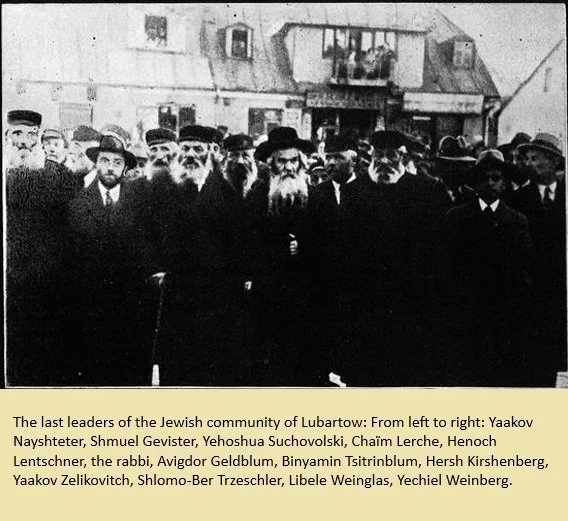
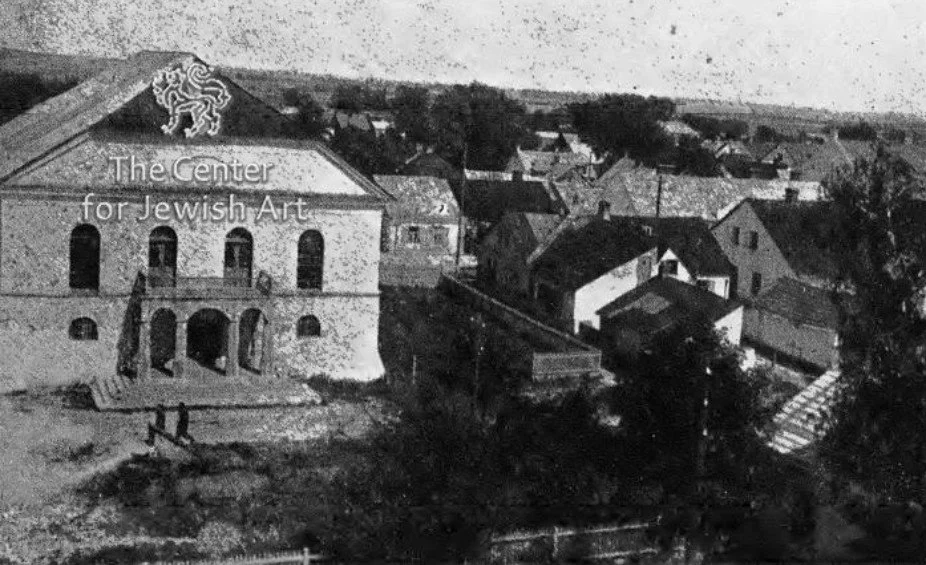
How the synagogue looked before it was destroyed in 1941.