Remember Jewish Kazimierzy Dolny
Pronounciation: Kajjz-e-meerz Dole-nee
HISTORY OF JEWISH COMMUNITY
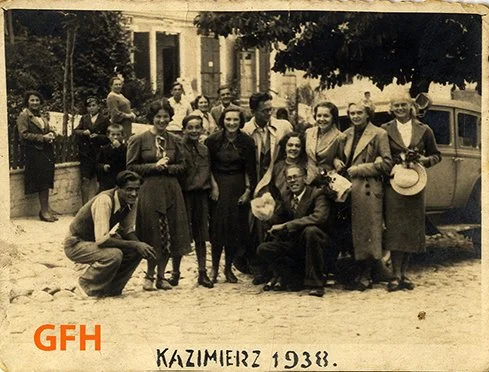
Kazimierz Dolny lies 45 kilometers (28 miles) west-northwest of Lublin. Its pre-war 1939 population of 4,641 included about 1,800 Jews.
In 1531, about 310 inhabitants were taxed in Kazimierz, including nearly 50 Jews. In the mid-1500s, a synagogue was established, and burned down in 1567. Before 1622, the wooden synagogue in Kazimierz was replaced by a brick synagogue, probably at Lubelska Street. In 1676, there were 51 Jews recorded. In 1765, 239 Jews lived in town. By 1810, 731 Jews represented around 33% of the town population.
Jews participated actively in the economic life of Kazimierz Dolny during its period of greatest prosperity. The primary source of income was the Vistula River, which during the Middle Ages served as the principal artery of communication between the north and south of the country. Goods were transported down the Vistula from Lesser Poland to Gdańsk. Additionally, Kazimierz Dolny lay along a trade route leading from the Grand Duchy of Lithuania to the Crown of the Kingdom of Poland, Greater Poland, and subsequently to Germany. Royal patronage — as well as the privileges granted to the Jewish community by successive monarchs — also played a significant role in the town's development. The Jewish community of Kazimierz was one of the oldest in Poland.
Ezekiel ben Tzvi-Hirsz Taub settled in Kazimierz Dolny around 1827. As a disciple of the Seer of Lublin, a joyful, Hasidic environment was created in town. By 1865, the 1,842 Jews represented nearly 60% of the population.
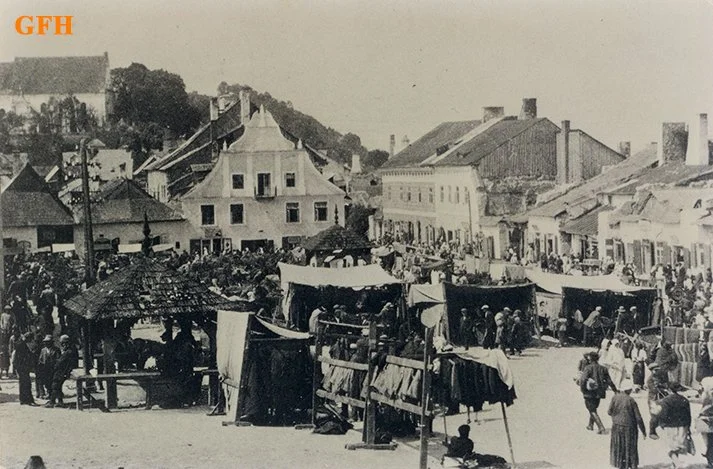
Most of the local Jews were artisans, primarily tailors and shoemakers, merchants and providers of services to the visitors who flocked to this popular tourist destination. Additionally, Jewish trades included transporting goods down the Vistula River, as well as trading in timber, grain, wine, and livestock. Kazimierz Dolny had chapters of Zionist parties and the Bund as well as Jewish youth movements. This small-town boasted a Jewish public library and chapters of the Maccabi and Shtern sports associations.
In 1930, employees of the Jewish community in Kazimierz Dolny included: Rabbi Israel Zylbermintz, Rozenberg (rzezak), Dynszajn (rzezak), and Frydman (secretary). The Jewish Cultural and Educational Association “Tarbut” was established in Kazimierz Dolny in the mid-1920s. Its mission was to develop a secular educational program, which included operating kindergartens, elementary and vocational schools, universities, and similar institutions. The courses organized by the association were conducted in Hebrew, Polish, and Yiddish. Children attended traditional and other education institutions, a general school that provided secular education and Hebrew-language instruction, a Beit Yaakov school and the Szabasowka public primary school.
NEARBY JEWISH COMMUNITIES
Jews also lived in nearby communities Janowiec nad Wisłą (360 Jews in 1939), Jastków (unknown number of Jews in 1939), Kock (2,213 Jews), Markuszów (2,000 Jews), and Wąwolnica (900 Jews in 1939).
LABOR CAMPS NEAR KAZIMIERZ DOLNY
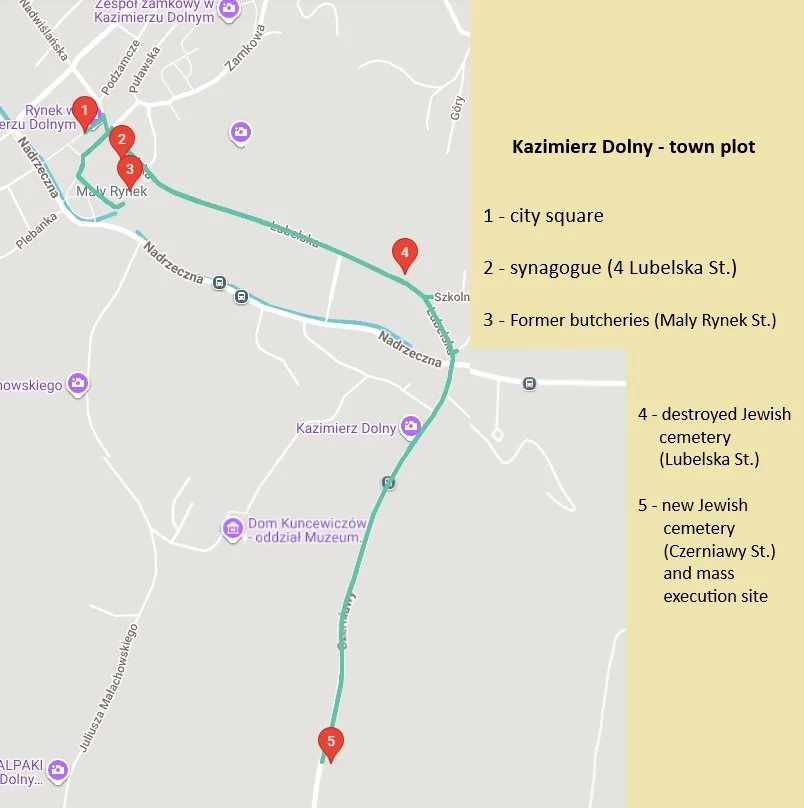
From the spring of 1940 until the autumn of 1942, a Nazi labor camp operated in Kazimierz Dolny, situated within the brewery buildings at 50 Puławska Street. It is estimated that approximately 1,500 people — Jews of Poland and Czechoslovakia — passed through the camp. The prisoners were forced to perform cleanup work within the town as well as labor in the local quarries. After March of 1942, the workers engaged in the demolition of wooden buildings. After the completion of the work, the camp was liquidated, and the prisoners were either transported to an unknown location or shot in Fall, 1943 at the new Jewish cemetery at Czerniawy Street.
KAZIMIERZ DOLNY IN THE HOLOCAUST
During the Nazi occupation, Kazimierz, along with other towns located on the right bank of the Vistula, found itself in the Lublin district belonging to the General Government. As early as October 1939, all Jews aged 14 — 60 were forced to work, and in November they were ordered to wear armbands with the Star of David, as well as to mark all businesses owned by Jews with this symbol. Jewish deposits and bank accounts were blocked, and their right to benefits were abolished.
The ghetto in Kazimierz Dolny was established in 1940 and included around 2,000 Jews initially. It was situated in the vicinity of Lubelska Street and the Small Market Square (Mały Rynek). A group of Jews from Pulawy as well as Jews from towns surrounding Kazimierz Dolny were relocated to the Kazimierz Dolny ghetto. In late 1939, the Germans ordered a Jewish Council (Judenrat) and a Jewish police force established. Chaim Fajersztajn and Yaakov Halberstadt were among the Judenrat members.
By mid-1941, the situation of the Jewish population within the Kazimierz ghetto had become dire. Extreme overcrowding and famine prevailed. Epidemics spread rapidly, and there was a severe shortage of clothing and footwear. In June or July of 1941, a deportation was ordered, during which 300 to 500 Jews were dispatched out of the Kazimierz ghetto to an unclear location. Approximately 1,000 able-bodied Jews remained in the town. By this time, a labor camp established by the Germans was already operational; housed in the buildings of a former brewery at 50 Puławska Street, it held Jewish prisoners (both men and women) from Poland and the Czech lands, who were forced to work in nearby quarries and perform cleanup duties throughout the town.
In late March, 1942, a group of 2,000 Jewish prisoners from the Kazimierz Dolny and Wawolnica ghettos were forced to walk on foot to the Opole Lubelskie Ghetto, and then to Naleczow. On Passover (April 1, 1942) at 4am, this group was dispatched from Naleczow to the Belzec Gas Chambers.
ADDITIONAL SOURCES
The Vistula Museum houses a variety of materials concerning the history of the Jewish community in Kazimierz, including old photographs, a film about Kazimierz shot prior to 1939, as well as contemporary accounts by Poles regarding life in pre-war Kazimierz. Some of their materials include: A 19th-century Hanukkah lamp, A spice box dating from 1869, a mezuzah created in the second half of the 20th century, and a small goblet from the second half of the 20th century. Additional source material on the destroyed Jewish community of Kazimierz Dolny:
(1) Adamczyk-Garbowska M., Kazimierz vel Kuzmir: A Town of Various Dreams, Lublin 2006 (includes further bibliography). (2) Dzierzbicki J., Kazimierz on the Vistula, Radom 1933. (3) Husarski W., Kazimierz Dolny, Warsaw 1957. (4) Jaworski A., Strynkowski B., The Jews of Kazimierz: History, Culture, Cuisine, Kazimierz Dolny 1989. (5) Kamiński I., Kazimierz on the Vistula: The Town and Its People, Warsaw 1983. (6) Kazimierz Dolny, [in:] The Encyclopedia of Jewish Life Before and During the Holocaust, ed. Sh. Spector, Vol. II, Jerusalem – New York 2001, p. 610. (7) Sas-Jaworski A., The History of the Jews of Kazimierz, Warsaw 1997. (8) Sas-Jaworski A., Strynkowski B., The Jews of Kazimierz: History, Culture, and Cuisine, Kazimierz Dolny 1989. (9) Shneiderman S. L., The River Remembers, New York 1953. (10) Sygowski P., Some Information on the Jews, Synagogues, and Jewish Cemeteries of Kazimierz Dolny, "Brulion Kazimierski" 2001, no. 2, pp. 54–55. (11) Sygowski P., Some Information on the Jews, Synagogues, and Jewish Cemeteries of Kazimierz Dolny [II], "Brulion Kazimierski" 2002, no. 3, pp. 48–50. (12) Trzciński A., A Guide to Jewish Lublin and Surroundings, Warsaw – Lublin 1991. (13) Wójcikowski W., Kazimierz Dolny and Its Surroundings, Lublin 1985. A listing of these same sources in Polish is available here.
WHAT REMAINS
Only a few Jews from Kazimierz Dolny survived the war: Naftali Fajersztajn, Stanisław Lichtson and Berek Cytryn (aka Bronisław Zieliński), and a handful of others. Located at 4 Lubelska Street, the Jewish synagogue serves as a cultural and educational museum that includes information regarding pre-war Jewish life in the town. Additionally, the Celejowska House (Nadwiślańskie Museum) at 13 Senatorka Street collects documentation related to the pre-war Jewish community.
A plaque on the wall of the former synagogue has an inscription: "In honor of three thousand Polish citizens of Jewish nationality, former inhabitants of Kazimierz Dolny, murdered by the Nazi occupiers during World War II.”
On Czerniawy Street, the new Jewish cemetery has several restored matzevot. The Old Jewish Cemetery in Kazimierz Dolny is located at 55 Lubelska Street, on the site currently occupied by the sports field of the Municipal School Complex. The primary trace of the cemetery’s existence is a monument in the form of a matzevah situated within the wall enclosing the sports field on the side facing Lubelska Street. No other traces of the cemetery remain.
Zachor - We Remember. Please review the site content below.
-----------------------------------------------------------------------------------
Article: Kazimierz Dolny used to be the most Jewish town in Poland
Yizkor book translation - English
-----------------------------------------------------------------------------------
CONTACTS
U.S.: LublinJewish@gmail.com
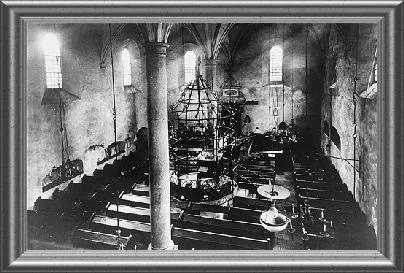
How the interior of the synagogue looked.
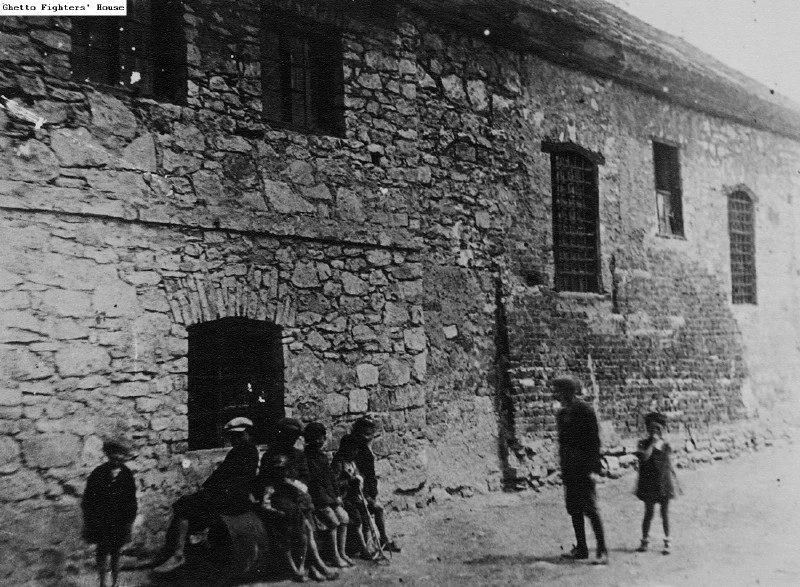
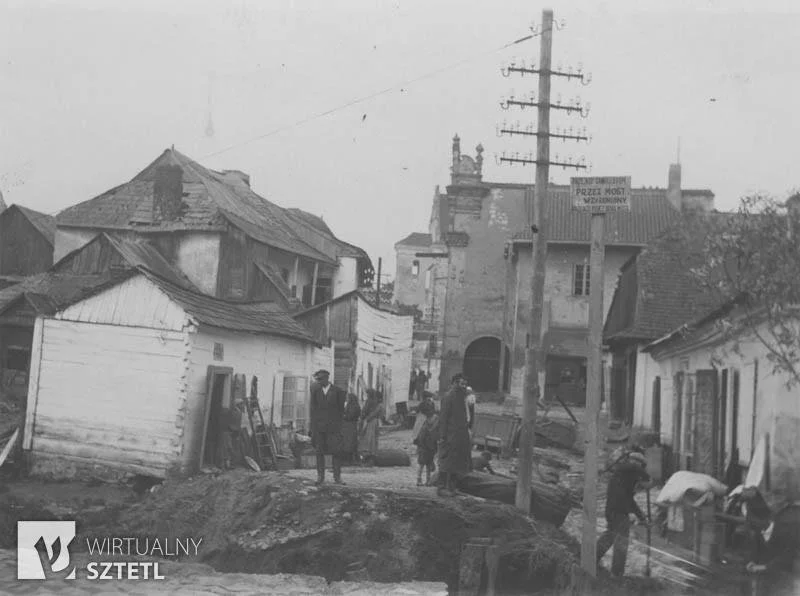
An undated photo that includes the synagogue before it was destroyed.