Remember Jewish Uchanie
Pronunciation: You-khan-ee
HISTORY OF JEWISH UCHANIE
The first mention of the Jewish community in Uchanie was in 1611. The Jewish community lived in and around the market square. The synagogue was constituted in the early 1600s.
In 1769, 175 Jews lived in the town. There were 1,382 Jews living in Uchanie in 1886, constituting 64% of the total inhabitants.
Jankiel Kantor was the rabbi during World War I. The president of the Jewish community was Kiwa Klajner. After Kantor, the next community rabbi was Zyndel Lipszyc. He served until 1928, when his son Mejłach Lipszyc assumed the role of rabbi. Several Jewish houses of prayer existed in Uchanie, in addition to the synagogue. The houses of prayer were operated privately by Uszej Goldztein and unknown Iwerski. Both were established in 1909.
The Linat ha-Tzedek (Hebrew: Honest Accommodation) charity association was established in town in 1928. Its task was to materially and morally support sick Jews. The president and founder of the organization was Moszko Kleiner. It had 15 members. The Zionist youth group He-Chalutz – Pioneers in Uchanie was founded on September 28, 1930. It had about 20 members and the local chapter president was Dawid Dychter. Additionally, the branch of the Jewish Social Democratic Workers' Party "Poale Zion" in Uchanie was established in April 1928. The local organization existed until September 1939. The branch of Betar – the Trumpeldor Jewish Youth Association in Uchanie was established in 1930. The organization existed until the outbreak of World War II. Pinkwas Frejman was President and the association had 40 members. The Society of Friends of Working Palestine in Uchanie was founded on July 15, 1933. It had 33 members, and the function of the president was held by Szmul Lempel. The headquarters was located at Cerkiewna Street. The Society existed until January 1936. The branch of the Jewish Cultural and Educational Association “Tarbut” in Uchanie was established in 1924. Srul Dajcz was President, with a board consisting of Gecel Becher, Rywen Plover and Jufer Pychos. Later, Nusyn Kleiner was elected President. The Tarbut in Uchanie operated until 1937. The Jewish Association of Evening Courses was established in Uchanie in 1928. The purpose of the association was to educate Jewish workers. Nachman Topf was the President.
In 1921, Uchanie had 1686 inhabitants, 999 (59%) of whom were Jews. In 1931, there were 2,142 individuals living in the town, including 1,028 Jews (47%).
Uchanie had 2,044 inhabitants in 1938 and 1,161 (70%) of them were Jewish.
NEARBY JEWISH COMMUNITIES
Information is available about one community near Uchanie:
- Staszic Kolonia: The village of Staszic Kolonia had 4 Jewish residents in 1921. By 1939, the local Jewish population included 5 families totaling around 45 individuals. Staszic is approximately 3.5 km. south of the village of Uchanie. In 1941, the Germans brought in Jews from other neighboring townlets and villages, as well as from Łowicz, Łódź, and Krakow, and they set up a ghetto in Uchanie. There was also a slave labor camp for Jews during the Holocaust in Staszic Kolonia, although the numbers of prisoners there as well as what took place there remains undocumented. On June 8, 1942, some 2,000 Jews in the Uchanie Ghetto were deported to Sobibor death camp.
THE HOLOCAUST IN UCHANIE
The German troops occupied Uchanie at the end of September, 1939. The Nazis used Jews from Uchanie as forced laborers. Jewish properties were confiscated, and the Germans established a ghetto in Uchanie in 1940 — over 2,000 Jews were held in the ghetto. Ninety Jews from Krakow were sent to Uchanie in November, 1940. In April, 1942, a group of 680 Jews from Horodlo (near to Uchanie and Hrubieszow) were also deported to the Uchanie ghetto.
On June 10, 1942, approximately 2,025 Jews from Uchanie were transported by the Germans to the train station in Miaczyn near Zamosc. At Miaczyn, the weaker (and elderly) Jews were sent to Sobibor gas chambers while younger Jews were sent to either the Staszic Labor Camp or the Staw Labor Camp. The Staszic labor camp was located near the village of Staszic Kolonia and prisoners worked on water melioration (techniques to improve land productivity, manage water resources, landscape regulation). The Nazis murdered the Jews who worked in Staszic in the fall of 1942. There was a transport from Staw Labor Camp to Sobibor gas chambers on December 20, 1942. Additional information about Staw labor camp is available here.
Holocaust survivor Jacob Finkelstein recalls a mass execution in Uchanie: "In 1942, the holiday of Shavuot fell in May, on a Sunday. On that day, the Gestapo brought 43 Jews to the cemetery. Some were from Uchanie, others from Horodło. The Nazis executed them by gunfire—ten at a time, lined up in a row. My four younger sisters witnessed it all. That day, I lost my uncle Motl and my grandfather’s brother, Shloime. A man named Zdzisław Mastalerczuk lived near the cemetery. In 1944, after the liberation, I met Zdzisław, and he showed me the spot in the cemetery where the Gestapo had killed my father. He had been buried right next to the entrance.”
In October 1942, a small group of Jews from Uchanie were sent to Hrubieszow, and then to Sobibor gas chambers.
This marked the end of the Jewish community in Uchanie. Zachor — we remember.
Among the Nazis operating in Uchanie were Otto Rother and Jakob Wisniewski. In nearby Teratyn, the following Nazis were operating: Friedrich Fuchs, Walter Mochel and Oberwachmeister Siemen.
WHAT REMAINS
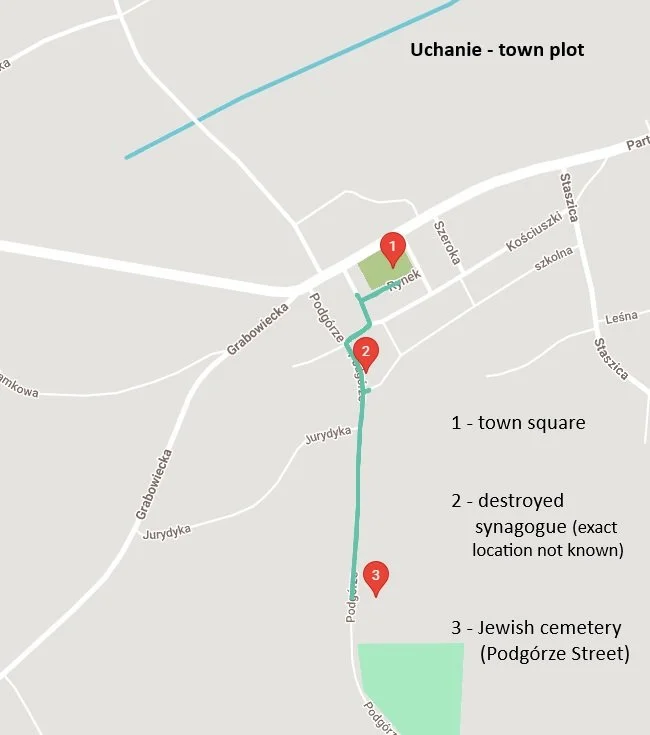
It is unclear where in the village the synagogue was located. All material traces of it were destroyed in the Holocaust.
The Jewish cemetery was located on a small hill near the Roman Catholic church (near Podgórze Street). As of 2011, one of the remaining 10 matzevot dates back to 1829. The cemetery is enclosed by a metal mesh fence, constructed by Holocaust survivor Chaim Leder. Within its grounds stand five tombstones. No symbols or commemorative plaques exist to remember the destroyed Jewish community.
Zachor - We Remember.
------------------------------------------------------------------------
[Helene Shafran: Memories from Uchanie]
[Rubin Shafran Testimony: Deportation from Uchanie to Belzec]
------------------------------------------------------------------------
List of Refugees in Zmudz County, as of Sept. 7, 1941
Members of the Municipal council: 1) Wolf Sztajnworcel,
2) Azryel Nyrenberg and 3) Abram Zylbersztajn (of Syczow);
as well as:
Hersz Zylberman of Lesczanach
Masia Szafer of Zmudzi
Ruchla Horowicz of Syczow
Ezryl Hendel of Syczow
Chaja Pech of Bielin
Hersz Bongart of Ksawerow
Mendel Blecher of Lipinki
Lejba Rozenbaum of Sychow
Josko Mendzelwicz of Roztoka
Jankiel Weberszpil of Rudno
Doba Cukier of Wolkowiany
Ita Krysztal of Leszczany
Mordko Frajman of Syczow
Ita Apelcwajg of Leszczanska
Szymon Alt of Wolka Leszczanska
Moszko Cymerman of Wolka Leszczanska
Motel Mont of Zmudz
Chawa Szydlowicz of Zmudz
Lejzor Gierszenbaum of Koczow
Icek Sygal of Koczow
Icek Kierszenbaum of Koczow
Fajga Sztajnworcel of Zmudz
Ezryl Nerenberg of Zmudz
Srul Goldberg of Zmudz
Munysz Szach of Syczow
Brucha Hohler of Zmudz
(source: JDC Archives)
See also: List of the Needy in Zmudz, 1941
NOTE: Learn more about Jews in Żmudź at Remember Jewish Dubienka.


LINKS
Join the Uchanie group on Facebook!
Survivors from Uchanie:
Yosef Abend
Maier Brand
Enrique Hersh Dychter
Yankel Jacob Finklestein
Gustav Gutterman
Jack Kucher (Jacob Kuczer)
Chaim Ella Leder
Anna Mangot
Baruch Mehl
Benjamin Mehl
Leib Merenstein
Perla Najman
Mosze Opatowski
Lev Nisen
Baruch Shafran
Rubin Shafran
Sarah Shafran Gutterman
Survivors of Horodlo:
Yisrael Barg
Abish Berger
Bentzion Bergman
Susana Bergman
Moshe Biderman
Yitzchok Binstok
Elia Borensztejn
Ira Borensztejn
Klara Borensztejn
Aharon Fluk
Shmuel Frind
Nathan Hecht
Szaul Kupfersztok
Abram Kalisz
Freda Perelmutter Schipper
Tzvi Platt
Abram Rojter
Melach Szechter
Fania Sztejn
Michel Zajdel
Josef Zavidowicz
Nechama Zinger
Moshe Zuberman
Genealogy:
Jewish Records Indexing Poland - Uchanie
Jewish Vital Records in the Polish State Archives
Remember Your Family:
Central Judaica Database - Museum of History of Polish Jews
Grandchildren of Holocaust Survivors on Facebook
Guide to the YIVO Archives
Holocaust News/Events from Generations of the Shoah Int'l
Holocaust Survivors and Victims Database
JewishGen Family Finder
JewishGen Holocaust Database
JRI-Poland: Search for Your Family
Museum of History of Polish Jews Introduction
Yad Vashem: Search for Your Family
Yad Vashem: Submit Names of Your Family Members
Yad Vashem Requests Photos of Shoah Survivors and Families
CONTACTS
U.S.: LublinJewish@gmail.com